Ductile Iron Pipe for Sewage: Choosing Linings for Corrosive Service
Ductile Iron Pipe for Sewage: Choosing Linings for Corrosive Service
Selecting ductile iron pipe for sewage requires more than checking pressure ratings. The internal lining must withstand the wastewater, the atmosphere above it, and the conditions created by operation. Hydrogen sulfide, biogenic sulfuric acid, abrasive solids, and industrial discharges can demand different protection strategies—even within one network.
The useful question is not simply “Which lining resists corrosion best?” It is “Which lining can survive this exposure, be installed reliably, and remain maintainable?” Cement mortar, calcium aluminate mortar, and resin-based systems each have a place. The choice depends on where deterioration is likely to begin and how much uncertainty the project can tolerate.
Start with the exposure above the waterline
A wastewater sample does not describe the entire pipe environment. In partially filled sewers, hydrogen sulfide can enter the headspace and support biological processes that generate sulfuric acid on moist surfaces. The crown may therefore experience much more aggressive conditions than the bulk sewage pH suggests.
This distinction matters around force-main discharges, turbulent transitions, and sections with long retention times. A pressure main operating full has a different exposure profile from a gravity sewer, but intermittent pumping, trapped air, and downstream discharge conditions still deserve attention. Do not extend one lining decision across these locations without reviewing them separately.
Before requesting lining proposals, establish:
- Normal and upset wastewater chemistry, including pH excursions and industrial inputs.
- Operating temperature, including hot discharges and cleaning conditions.
- Flow regime, retention time, headspace conditions, and known sulfide concerns.
- Grit loading, expected cleaning methods, and locations exposed to concentrated wear.
Where records are incomplete, identify the uncertainty explicitly. An average pH value cannot establish resistance to occasional chemical shocks or crown corrosion.
Where the three lining approaches fit
Cement mortar: useful, but not a default for every sewer
Conventional cement mortar provides an alkaline environment at the iron surface and is an established lining approach. It can be a practical candidate where wastewater chemistry is compatible and significant acid exposure is not expected. Availability, application consistency, and local repair capability may also favor it.
Its limitation is sustained acid attack. Acid can consume alkaline constituents and progressively degrade the mortar. Increasing thickness alone does not resolve an unsuitable chemical match. For a sulfide-prone gravity sewer, a proposal based only on the sewage being “near neutral” leaves the main exposure question unanswered.
Calcium aluminate mortar: assess the specific formulation
Calcium aluminate mortar is often considered when biogenic sulfuric acid exposure makes conventional cement mortar less attractive. Its binder chemistry can provide greater resistance in such environments, but products are not interchangeable. Binder composition, aggregate selection, application quality, curing, and thickness all affect performance.
Ask for evidence relevant to the proposed formulation and exposure—not simply a statement that it contains calcium aluminate cement. Laboratory acid testing can inform selection, but it does not by itself establish a guaranteed field life. Industrial chemical mixtures also need separate review; resistance to sewer-generated acid does not imply universal chemical resistance.
Resin-based linings: barrier quality becomes decisive
Epoxy and other resin-based systems protect the iron by forming a barrier. Suitably selected formulations can address aggressive wastewater exposure, but “epoxy lined” is not a complete specification. Chemical resistance depends on the resin system, concentration, temperature, exposure duration, and cure condition.
Barrier integrity deserves equal attention. Inadequate surface preparation, pinholes, handling damage, or poorly treated terminations can expose the substrate. For abrasive service, review wear resistance as well as chemical compatibility. A lining that tolerates the liquid chemically may still be unsuitable where grit repeatedly strikes the same area.
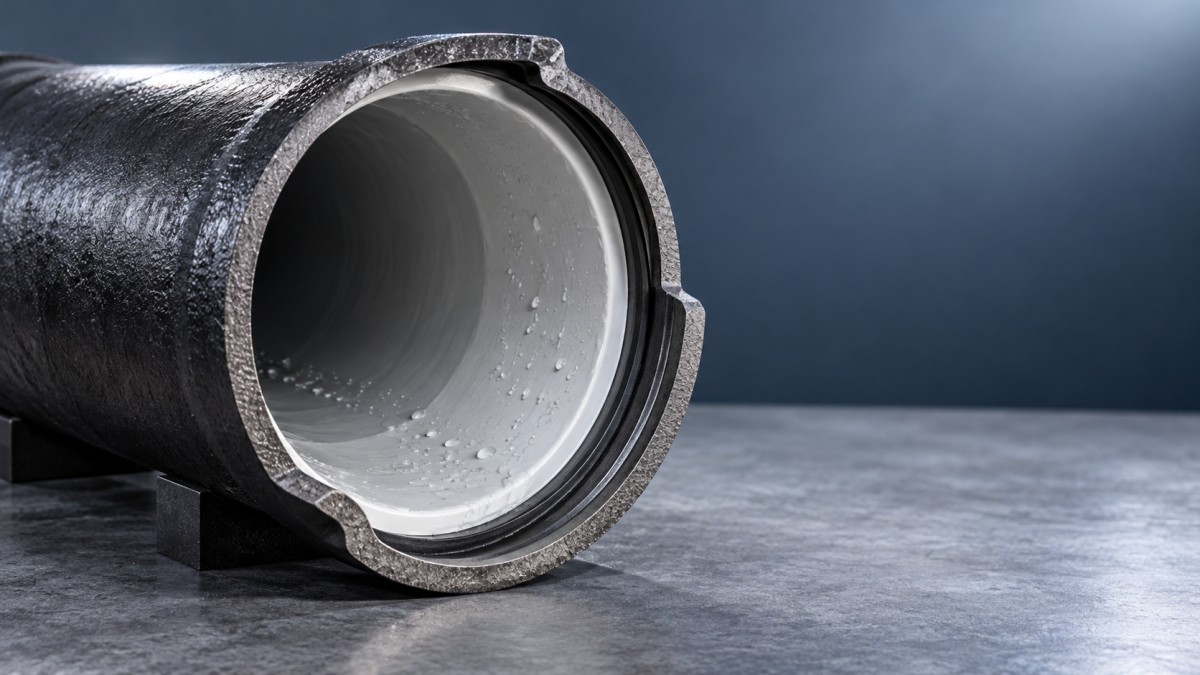
The weak point may be a detail, not the pipe barrel
A straight pipe sample is convenient to inspect. It does not demonstrate continuity through sockets, fittings, field cuts, and transitions. These details deserve drawings and procedures, particularly where exposed iron could face aggressive sewage or condensate.
For resin systems, define the required surface preparation, dry-film thickness, curing conditions, and inspection method. Where holiday testing is appropriate, the procedure and test voltage must suit the lining and thickness; an arbitrary voltage can damage the coating or give misleading results. Specify how defects will be repaired and retested.
Mortar systems need equally clear requirements for curing, handling, permissible defects, and repairs. Assess cracks under the applicable lining specification and exposure conditions rather than assuming every crack is either harmless or grounds for rejection.
Maintenance accessories require their own compatibility review. An external item such as the Straight Split Repair Clamp (Blue) should not be treated as a substitute for restoring internal corrosion protection. Before approving any clamp, verify its dimensions, pressure suitability, materials, seal compatibility, and permitted application. Its blue finish does not establish wastewater resistance.
Turn the lining choice into an auditable specification
A useful supplier submission connects the service conditions to a named lining system and an inspection plan. A generic brochure or nominal lining thickness is not enough. Request written limits for chemical exposure and temperature, supporting test information, and clear exclusions.
Also confirm who applies the lining and who accepts responsibility for it. Shanxi Datong Foundry Co., Ltd., located in Chuandi Industrial Park, Zezhou County, combines smelting and casting operations and manufactures ductile iron pipes, fittings, and rubber sealing rings. When evaluating an integrated manufacturer of this kind, establish whether the proposed specialty lining is applied in-house or by a separate applicator, and how inspection records remain traceable to delivered pipe.
Joint seals need a separate check. Selecting a corrosion-resistant lining does not establish that the rubber compound will tolerate industrial contaminants or elevated temperatures. Confirm compatibility for the complete wetted system, including fittings and repair materials.
Compare installed risk, not just lining price
For ductile iron pipe for sewage, lifecycle cost includes inspection, site repairs, installation constraints, and the consequences of taking the line out of service. A cheaper lining is not economical if its exposure limits are routinely exceeded. Conversely, a more chemically resistant system may add little value where service is demonstrably mild and application or repair becomes unnecessarily difficult.
Before approval, require three things to agree: the exposure assessment, the lining supplier’s documented limitations, and the construction inspection plan. If crown conditions, industrial discharge chemistry, or repair procedures remain unresolved, close those gaps before accepting a service-life claim.
Navigation
Send Us A Message

First class quality service and professional after-sales team.
Get in Touch
*We respect your confidentiality and all information are protected.