Grade C Ductile Iron Pipe: Is C a Material Grade or a Pressure Class?
“Grade C Ductile Iron Pipe” is an incomplete specification. In the pressure-class systems used by ISO 2531 and EN 545, a designation such as C25, C30, or C40 identifies a pipe pressure class. It does not identify a metallurgical grade of ductile iron. The letter C on its own, however, does not establish a pressure rating or prove that either standard applies.
The distinction affects how a quotation or technical drawing should be interpreted. Material requirements describe the iron’s mechanical properties. Pressure classification describes pressure capability within a defined standard. A usable specification needs both, together with pipe dimensions, joint details, and the applicable standard edition.
Reading the C designation correctly
Within the relevant ISO 2531 and EN 545 classification systems, C is followed by a number. That number relates to the allowable operating pressure, expressed in bar, under the standard’s defined conditions. For example, C40 is a pressure-class designation. Its meaning comes from the governing standard, including its dimensional rules, design assumptions, and applicable limitations.
A description containing only “Grade C” leaves several possibilities open: an abbreviated pressure class, an internal catalogue category, or terminology taken from another specification. None establishes a complete pipe requirement. The useful clarification is the full designation and its source, rather than an assumed expansion of the letter.
These descriptions answer different questions. A tensile test result cannot fill a missing pressure-class field, and a factory pressure-test record cannot replace the design requirements for an installed pipeline.
The iron has separate mechanical requirements
Ductile iron contains graphite predominantly in spheroidal form. This structure supports greater ductility than the flake graphite structure associated with grey cast iron. Material acceptance nevertheless depends on specified properties and tests, rather than the word “ductile” alone.
Relevant properties include tensile strength, elongation, and hardness where required by the applicable specification. Sampling location and test-piece preparation also matter: a result from a separately cast specimen does not automatically have the same significance as one taken from the pipe wall. The governing standard defines the accepted procedure.
A higher C class does not automatically mean a stronger grade of iron. Pipes with different pressure classes can meet the same material requirements while using different wall dimensions. Conversely, satisfactory tensile properties do not establish that a particular wall thickness is adequate for the stated pressure.
This separation explains why a technical document should retain distinct entries for material compliance and pressure classification. Combining them into “Grade C material” hides information needed to evaluate the pipe.
Pressure class, wall thickness, and diameter belong together
Internal pressure creates stress in the pipe wall. For the same material and comparable design conditions, increasing diameter increases the wall’s pressure-resisting demand, while increasing effective wall thickness improves its resistance. Pressure-class selection therefore has a dimensional consequence.
A C-class designation does not correspond to one universal thickness across all diameters. The relevant dimensional tables and calculation rules connect nominal diameter, class, and wall requirements. Comparisons must use the same diameter and distinguish nominal thickness from minimum permitted thickness after manufacturing tolerances.
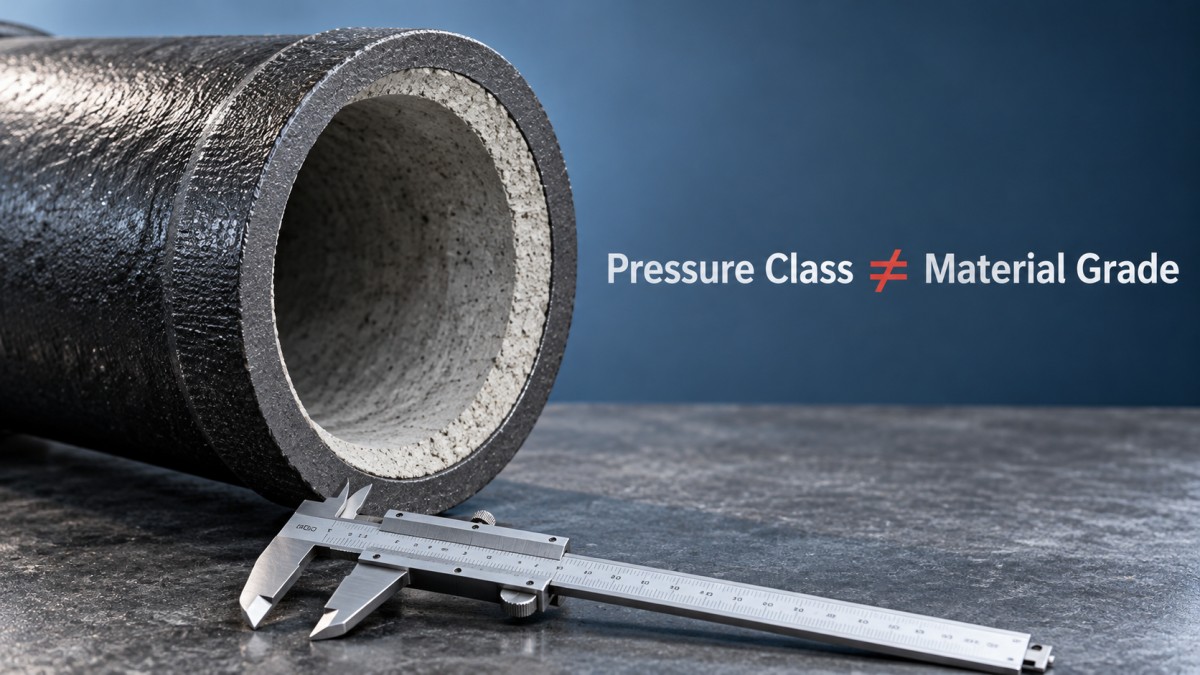
Wall-thickness descriptions from different classification systems also need care. A K-class designation and a C-class designation use different classification approaches; their numbers cannot be compared directly. Converting a legacy specification requires the relevant standard editions, diameter, thickness requirements, and pressure criteria. A simple numerical substitution is insufficient.
Internal cement mortar lining and external protective coatings serve other functions. Their thickness should not be added to the iron wall when assessing pressure resistance unless a specific engineered design explicitly permits a structural contribution.
The pressure number does not describe every loading condition
Operating pressure is only one pressure condition in a water network. Pump starts, rapid valve movement, and sudden changes in flow produce transients. Standards distinguish allowable operating pressure, maximum allowable pressure associated with occasional conditions, and allowable site test pressure. These are commonly identified as PFA, PMA, and PEA, respectively.
The applicable standard defines these terms and their relationships. A C-class number should not be treated as permission for unlimited pressure surges, nor should a higher factory test pressure be interpreted as the continuous service rating.
Consider a line whose steady pressure is below the pipe’s stated allowable operating pressure. If a transient exceeds the permitted maximum pressure of a joint or fitting, the assembly still fails the pressure assessment. Adequate pipe-barrel capacity does not resolve a lower limit elsewhere in the line.
External loads require a separate assessment. Burial depth, traffic loading, bedding support, and soil conditions affect structural performance. A pressure class alone does not demonstrate suitability for an unsupported span, a particular trench arrangement, or vacuum conditions.
Joints and accessories need their own ratings
A pipe barrel, socket joint, flange, and valve do not necessarily share one pressure limit. Joint design, diameter, gasket material, permitted angular deflection, and restraint arrangement can affect the assembled connection’s capability. Pressure information must therefore cover the supplied configuration.
For a flanged connection, a PN designation belongs to the flange-rating system. Matching the numerical part of PN and C labels does not, by itself, establish compatibility. Dimensions, bolting, gasket requirements, and pressure-temperature limits still need to agree.
The same distinction applies to a separately listed accessory such as gate: its name provides no evidence of pressure compatibility. The accessory’s technical documentation must identify its component type, connection details, and applicable rating.
Pressure capacity and axial restraint also answer different questions. A joint that seals at the required pressure does not necessarily resist the thrust generated at bends, tees, or closed ends. Restrained joints or other designed thrust-resisting measures address that load.
Turning an ambiguous description into a usable specification
The most useful replacement for “Grade C” is a traceable description linking the pipe to its standard, edition, nominal diameter, full pressure class, and joint type. Material acceptance criteria and protective systems belong alongside that description, with any project-specific requirements stated separately.
Supporting documents should agree on those identifiers. Pipe markings establish the link to the supplied product; dimensional records address wall requirements; mechanical test results support material conformity; and hydrostatic test records document the prescribed manufacturing test. Each supplies evidence for a different part of the specification.
A generic certificate stating “ductile iron, Grade C” does not resolve missing details. Where a quotation says C40 but a drawing uses a legacy thickness class, the discrepancy needs an explicit technical resolution tied to the same diameter and service requirements.
Until the governing specification is identified, “Grade C Ductile Iron Pipe” remains a description awaiting clarification. The decisive information is the complete pressure-class designation and the documents connecting it to the actual pipe and joint assembly.
Navigation
Send Us A Message

First class quality service and professional after-sales team.
Get in Touch
*We respect your confidentiality and all information are protected.