How external coating specifications affect ductile iron pipe prices
External coating specifications affect the ductile iron pipe price through material consumption, surface preparation, application time, inspection, and repair obligations. Two quotations with the same diameter and pressure class can therefore cover different corrosion protection systems. A meaningful price comparison starts with the complete coating specification, including treatment of sockets, spigots, exposed ends, and damage during delivery.
A higher coating price is justified when the specified protection addresses the installation environment and its acceptance requirements. Extra thickness or a more expensive material has limited value if the system is unsuitable for the ground conditions, poorly applied, or damaged before burial. The commercial question is whether the quoted amount includes the protection the project actually requires.
The coating description determines what the price includes
Descriptions such as “external protective coating” or “black finish” leave too much unresolved. Appearance does not establish the underlying material, deposited quantity, or performance. A metallic zinc layer with a finishing coat and a black organic coating without that metallic layer can look similar after production while representing different specifications and costs.
For a metallic coating, the specified deposited mass per unit area influences material consumption. For an organic barrier coating, dry film thickness is a relevant acceptance parameter. These measurements are not interchangeable: a thickness reading for the finishing layer does not demonstrate that the required metallic deposit is present underneath it.
Polyethylene encasement is a separate protective measure rather than a bonded factory coating. A quotation including encasement materials should identify them separately; otherwise, its price cannot be compared directly with a factory coating surcharge. Suitability still needs to follow the project’s corrosion assessment and installation specification.
Ground conditions change the value of the coating premium
The appropriate protection level follows the exposure conditions. Soil resistivity, moisture, chemical characteristics, and the possibility of stray current influence corrosion assessment. Groundwater variation and dissimilar backfill along the route can also create different exposure conditions within one pipeline. A coating selected from a brief description such as “buried water main” lacks this context.
A uniform enhanced specification simplifies ordering and acceptance across a route with varying conditions, but it also applies its premium to every pipe. A project allowing different protection by location needs reliable identification, segregated storage, and installation records. Any saving from selective coating must be weighed against those practical requirements and the consequences of placing a pipe in the wrong section.
Greater coating thickness does not automatically resolve every corrosion concern. A barrier coating relies on continuity and adhesion; local damage can expose the substrate even where the surrounding film is thick. Where stray current exposure is identified, the protection design requires specific assessment rather than an assumption that a thicker coating alone will address it.
Application requirements explain part of the surcharge
A coating price includes the work needed to make the material adhere and perform. Removing contamination, preparing the surface to the specified condition, and controlling application conditions all consume production capacity. A requirement for abrasive preparation and a defined surface profile represents a different manufacturing scope from applying a finishing coat to a surface prepared by a simpler method.
Increasing film thickness raises material use, but the price effect is not necessarily proportional. The specified build could require additional passes or longer intervals between coats. Curing requirements also affect how soon pipes can be inspected, moved, stacked, and dispatched. Small orders with a special coating can carry setup costs spread across fewer pipes.
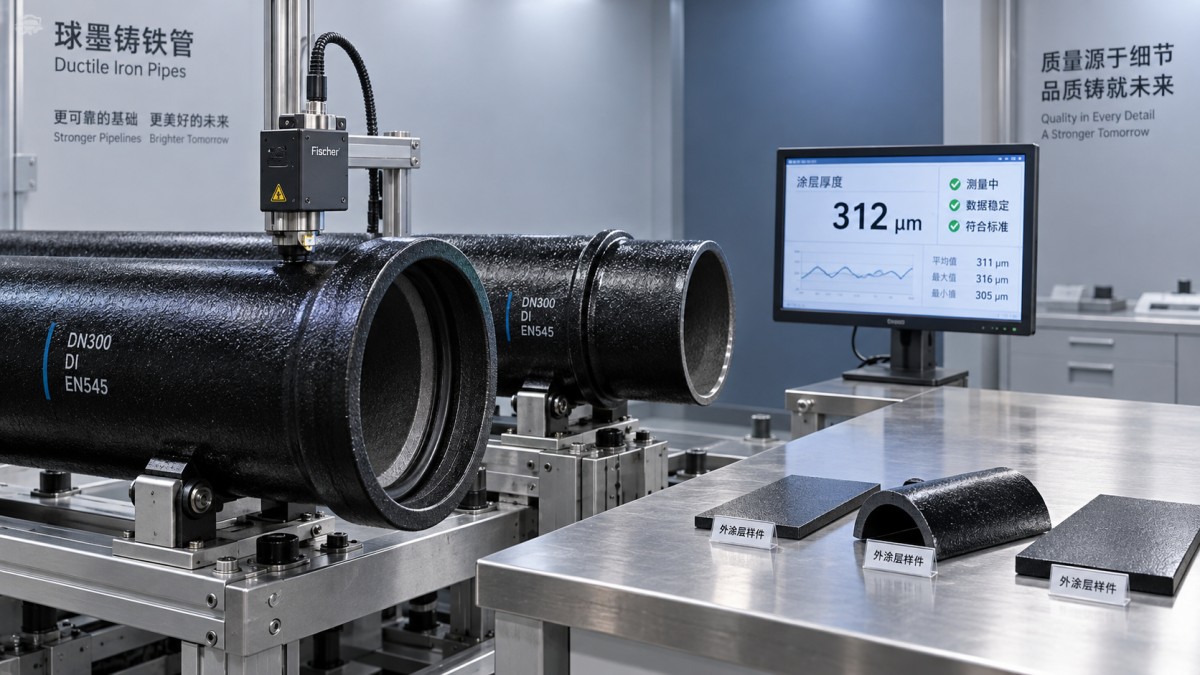
Thickness needs both an acceptance basis and a suitable measurement procedure. An average value alone can conceal thin areas, while excessive local build can cause application defects or interfere with joint dimensions. The specification should establish the relevant limits and how readings are distributed across the pipe, including difficult geometries.
Sockets and spigots deserve particular attention. Masking, transitions between coated areas, and compatibility with joint assembly affect the work involved. A fully coated barrel does not establish that the ends have received the required treatment. Joint contact surfaces must follow the approved pipe and coating design rather than an assumption that every surface should receive the same film build.
Inspection and repair obligations belong in the quoted scope
Inspection costs become significant when a specification requires detailed records, additional testing, or witnessed acceptance. Dry film thickness measurement, adhesion testing, and holiday testing answer different questions. Holiday testing detects discontinuities in a suitable insulating barrier coating; its method and settings must suit the coating system. It is not a universal requirement for every external finish.
The quotation should state which inspections are included, their frequency, the acceptance criteria, and the documents delivered with the shipment. “Tested coating” is insufficient if one offer covers visual examination and another includes documented instrument measurements and additional acceptance tests.
Repair requirements also affect the delivered cost. Handling marks discovered before dispatch need an agreed assessment method and compatible repair materials. Some defects permit local repair; others require removal and reapplication over a larger area. Where repair changes thickness or continuity, the applicable inspection must be repeated before acceptance.
For an item described as Ductile Iron Pulling Pipe, the product name alone does not establish external coating resistance to installation abrasion. If the proposed installation involves pulling through ground or a prepared bore, the coating specification needs to address expected contact conditions, protective measures, and acceptance after handling. Those requirements should be priced explicitly without assuming a particular coating capability from the name.
Compare the cost at the same delivery and acceptance point
A factory coating premium and the cost of accepted protection on site are different figures. Packaging, separating pipes during transport, lifting arrangements, and site repair materials affect the latter. A coating that needs additional protection during handling can shift expenditure outside the pipe quotation, especially when unloading and storage are excluded.
A useful commercial comparison holds diameter, pipe class, quantity, and delivery basis constant, then reconciles the coating scope. The comparison should capture the factory coating charge, supplementary protection, specified inspection, protective handling, and any allocated site repair work. Where an item is excluded, a separate allowance makes the difference visible instead of leaving it within an apparently lower pipe price.
Price per pipe also needs a common length basis. For otherwise comparable pipes, external coated area increases with diameter and length, so a coating surcharge per unit cannot be transferred unchanged between sizes. Socket geometry and local treatment requirements further limit comparisons based only on barrel area.
Before an order is placed, the agreed coating schedule should become part of the purchase specification, including permitted substitutions and repair acceptance. A lower quotation becomes commercially meaningful once those requirements match. Any remaining premium can then be assessed against a defined difference in protection, inspection, or delivery scope.
Navigation
Send Us A Message

First class quality service and professional after-sales team.
Get in Touch
*We respect your confidentiality and all information are protected.