Ductile Iron Pipe specifications
Ductile Iron Pipe Specifications: What Really Matters in Water, Drainage, and Industrial Projects
Understanding Ductile Iron Pipe specifications is essential for choosing reliable piping solutions for water, drainage, and industrial systems. Shanxi Datong Foundry Co., Ltd., as an integrated manufacturer specializing in ductile iron pipes, fittings, and rubber sealing rings, combines smelting and casting processes to deliver consistent quality and performance. This guide will help you explore key standards, dimensions, and material requirements to support efficient project planning and long-term system durability.
In practice, most problems with ductile iron pipeline selection do not come from the pipe material itself. They come from incomplete specification review: wall class misunderstood, joint type chosen too casually, pressure rating copied from an old drawing, or coating requirements left vague until procurement. When that happens, even a sound material can turn into a costly coordination issue on site.
For buyers, contractors, and project engineers, the value of reading specifications carefully is simple: it reduces mismatch between design intent and delivered product. That matters whether the line will carry drinking water, sewage, or process media in an industrial network.
Specifications are more than diameter and pressure
When people ask for “ductile iron pipe specs,” they often mean size and pressure class. Those are important, but they are only part of the picture. A workable specification usually needs to cover several layers at once: applicable standard, nominal diameter, pressure level, pipe class or wall thickness approach, joint design, lining, external coating, gasket material, and intended service environment.
This is especially true in municipal and utility work, where the same nominal pipe size may be available with different socket types, flange arrangements, corrosion protection systems, and installation expectations. For example, a pipe suitable for buried potable water service may not be the right choice for exposed plant piping or aggressive soil conditions without adjustments to coating or connection details.
The Chinese term 球磨管 is often used in commercial communication around ductile iron pipe products, but the real engineering discussion still comes back to measurable requirements. If a specification is vague, two suppliers may quote materially different products while both claiming compliance.
Which specification points should be checked first
A practical review usually starts with five questions.
- Which standard governs the pipe and fittings in the project documents?
- What operating pressure and surge conditions must the line handle?
- Is the system buried, exposed, flanged, restrained, or subject to special loads?
- What fluid is being conveyed, and does it affect lining or gasket choice?
- Are dimensions required to match existing infrastructure or mixed-brand components?
These questions sound basic, yet they often reveal the hidden risks. A project may state a nominal pressure, for instance, but not clarify whether transient pressure has been considered. Another may identify potable water service but omit any detail on internal lining compatibility or approval requirements that depend on the destination market.
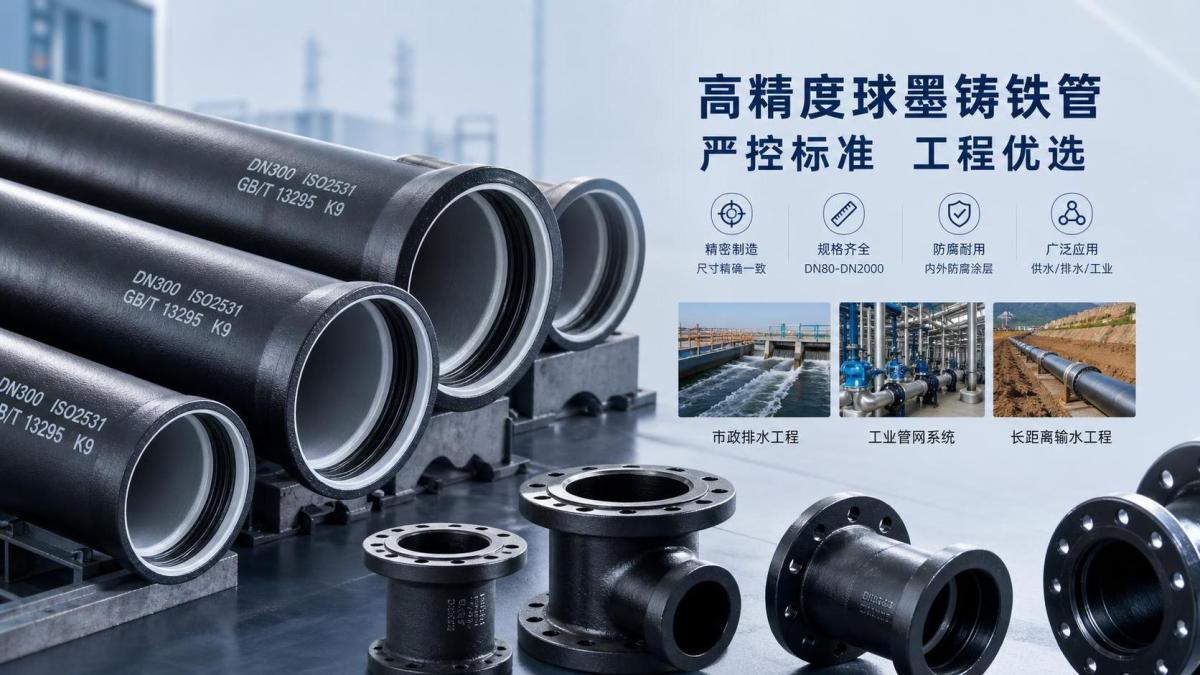
Standards, dimensions, and tolerance control
Ductile iron pipes are usually produced in accordance with recognized national, regional, or project-specific standards. The exact standard matters because it affects dimensions, allowable tolerances, mechanical requirements, test methods, and sometimes marking rules. In export or multi-party projects, the standard must be aligned early; otherwise, confusion appears later in flange drilling, socket dimensions, or acceptance inspection.
Nominal diameter also needs careful reading. DN is not the same as exact measured outside diameter in every product family, and fittings compatibility should never be assumed purely from nameplate size. That becomes even more relevant where repair works or line extensions must connect to installed systems from different periods or manufacturers.
Tolerance control is another area buyers tend to notice only after delivery. Pipe straightness, wall uniformity, flange flatness, and joint geometry influence field assembly more than many procurement teams expect. An integrated manufacturing structure can help here because smelting, casting, and downstream quality control remain more closely linked. Shanxi Datong Foundry Co., Ltd., located in Chuandi Industrial Park, Zezhou County, operates as an integrated factory producing ductile iron pipes, fittings, and rubber sealing rings, which is relevant for projects that want tighter coordination between material production and component matching.
Pressure class is only useful when tied to the application
Pressure rating should never be read in isolation. A buried transmission main, a sewage discharge line, and a flanged plant connection can all require different design attention even if their nominal pressure values look close on paper. Installation method, surge potential, support spacing, and connection type all affect the real selection logic.
In some applications, flanged ductile iron pipe sections are used where dismantling, valve connection, or above-ground equipment tie-in is expected. One example is Flanged Di Pipe, which is used in drinking water and sewage systems and is available in pressure levels such as Pn10, Pn16, Pn25, and Pn40, with size coverage from DN80 to DN2600mm. Those figures are useful, but they still need to be checked against the full project condition, especially support arrangement, flange standard, and mating equipment dimensions.
This is where many specification reviews should slow down for a moment. A higher pressure rating does not automatically mean a better commercial choice. If the system does not need it, over-specification may add cost and weight without improving service life in any meaningful way. On the other hand, underestimating surge or localized mechanical stress can create a problem that does not appear until commissioning.
Lining, coating, and gasket choices are not side notes
Internal lining and external protection are often treated as accessories in early-stage inquiries, but for actual durability they are central. Water quality, wastewater composition, soil environment, and installation exposure all influence what is appropriate. Cement mortar lining is common in many water applications, but whether it is suitable should still be confirmed against the conveyed medium and project specification. The same caution applies to external zinc-based protection, bituminous finishes, epoxy systems, or other special coatings where corrosive soils or coastal environments are involved.
Rubber sealing rings deserve the same level of attention. Gasket material compatibility can affect leak tightness and long-term joint performance. If the project involves sewage, industrial discharge, or temperature variation, the seal requirement may differ from a standard potable water line. Since gaskets are sometimes sourced separately from the pipe, coordination risk can increase unless the supplier has matching production or controlled compatibility processes.
Where buyers and engineers often make the wrong assumption
One common mistake is assuming all ductile iron pipe offers the same performance if the base material is the same. It does not. Material grade matters, but so do casting consistency, dimensional control, socket accuracy, coating application, and inspection discipline.
Another is focusing on unit price before clarifying package scope. Does the quoted offer include gaskets? Fittings? Flanged specials? Protective caps? Test requirements? Marking? Documentation? The cheaper offer may stop being cheaper once these gaps are filled.
There is also a recurring issue in mixed-system projects: the pipe is specified correctly, but fittings or joints are not reviewed with equal care. In reality, system reliability is built through compatibility across the full pipeline section, not through the straight pipe alone.
What manufacturing integration can change
For projects with larger volume, tighter delivery windows, or a need for consistent component matching, the structure of the supplier matters almost as much as the nominal specification. An integrated plant that combines smelting and casting generally has better visibility over the production chain than a purely trading model. That does not replace project-side inspection, but it can improve consistency in chemistry control, casting quality, scheduling, and coordination between pipe bodies, fittings, and sealing components.
Capacity is not the only measure, but it does matter when supply continuity is under pressure. In a market where phased deliveries and lot consistency often affect installation planning, a manufacturer offering high-volume production can be a practical advantage. For instance, the related flanged product line referenced above is associated with a production capacity of 500000 tons per year, which may be relevant for infrastructure or utility programs requiring scalable supply rather than small-batch spot procurement.
A short checklist before finalizing a pipe specification
That checklist will not replace an engineering review, but it does catch many of the problems that create rework later.
The better approach is to specify for the system, not just the pipe
Ductile iron pipe remains a practical choice for water supply, drainage, and many industrial networks because it balances strength, durability, and installation familiarity. Still, good outcomes depend on how precisely the specification reflects the service condition. Diameter, pressure, and material name alone are not enough.
If you are comparing suppliers or reviewing a tender package, it is worth checking whether the documentation clearly defines standard compliance, joint form, protective systems, gasket compatibility, and fittings coordination. For projects involving flanged sections, large diameters, or mixed service conditions, those details usually matter more than broad product descriptions.
The next step is usually not to ask for “the best pipe,” but to confirm the exact parameters the system must satisfy. Once that is clear, the right specification tends to become much easier to defend, purchase, and install.
Navigation
Send Us A Message

First class quality service and professional after-sales team.
Get in Touch
*We respect your confidentiality and all information are protected.