What is a ductile iron pipe used for?
What is a ductile iron pipe used for?
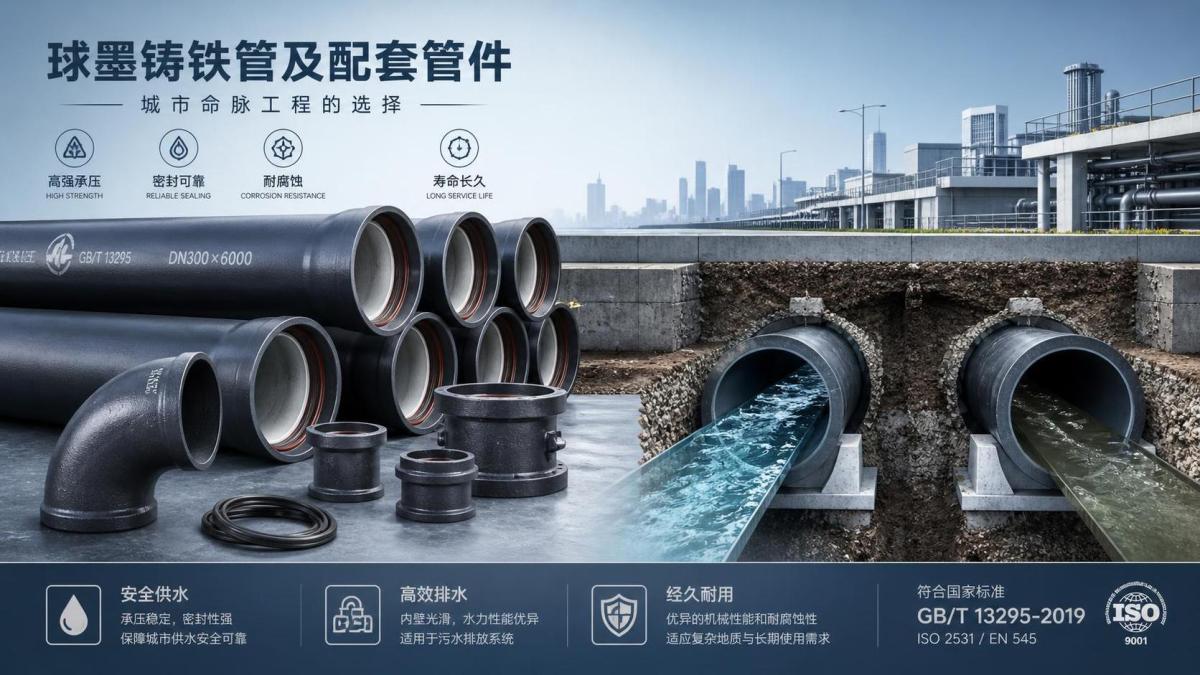
Ductile iron pipe is mainly used to move water and wastewater where long service life, structural strength, and installation reliability matter more than the lowest initial material cost. In practical terms, that means buried municipal water mains, sewage and drainage lines, irrigation networks, fire protection pipelines, and many industrial utility systems. If a project involves pressure, traffic loads above the trench, changing soil conditions, or a need for dependable joints over decades, ductile iron usually enters the conversation very quickly.
That broad answer is true, but it is not the whole story. People rarely ask this question just to define the product. They usually want to know whether ductile iron pipe is the right choice for a specific job, how it compares with alternatives, and what hidden issues show up after installation rather than on a quotation sheet. Those are the points worth unpacking.
The material itself explains much of its use. Compared with traditional grey cast iron, ductile iron has much better toughness and impact resistance because its graphite structure is nodular rather than flake-like. In field terms, that translates into a pipe that can tolerate handling stress, moderate ground movement, internal pressure, and service demands that would make more brittle materials a riskier bet. This is one reason the term 球磨管 is often associated with dependable underground infrastructure in many markets.
Where ductile iron pipe is most commonly used
Municipal water supply is still the most familiar application. Cities and utilities use ductile iron pipe for transmission mains and distribution networks because it offers a strong balance of pressure capacity, joint integrity, and durability in buried service. It is especially relevant where roads, intersections, or developed urban corridors make future excavation expensive and disruptive. A pipe material that can handle external loads and still maintain a secure joint becomes more valuable when replacement is difficult.
Sewage transport and drainage are another major use. Not every wastewater line is automatically a ductile iron project, but the material is often selected when the line faces heavy surface loading, aggressive installation conditions, or elevated performance expectations at critical crossings and urban sections. In some designs, the decision comes down to how much confidence the owner wants in the pipe wall strength and the joint system over time.
Agricultural irrigation is a less glamorous but very real application. Large irrigation networks may run through varying terrain, unstable trench conditions, and remote areas where maintenance access is inconvenient. In such cases, a stronger pressure pipe with robust joints can reduce operational headaches, even if the upfront procurement discussion is more demanding.
Industrial pipeline systems also use ductile iron for water intake, process water, cooling water, and utility service lines. Whether it fits a specific plant depends on the fluid, temperature, pressure, lining requirements, and local standards. It is not a universal answer for every industrial medium, but for water-related duties it remains a practical option.
Why engineers still specify it
One reason is straightforward: buried pipelines do not live in laboratory conditions. They deal with trench compaction quality, traffic vibration, groundwater, accidental impact during installation, and sometimes less-than-ideal alignment in the field. Ductile iron pipe tends to be chosen when project teams want a material with mechanical margin, not just nominal compliance on paper.
Another reason is corrosion management. Ductile iron is not “corrosion-proof” in the absolute sense, and experienced buyers know better than to treat it that way. Its suitability depends on internal lining, external protection, soil conditions, and sometimes additional corrosion control measures. The point is not that the base metal solves everything by itself; the point is that the pipe system can be configured for demanding service when the project requirements are understood clearly.
Joint reliability matters too. Many ductile iron systems use rubber-gasket push-in or mechanical joints that are familiar to contractors and utilities. The quality of that sealing system is not a small accessory issue. In underground pipelines, leakage risk often comes from joints, installation error, or differential settlement rather than from an intact pipe barrel. That is why integrated supply of pipe, fittings, and sealing components can make sense operationally, even before anyone talks about price.
What it is not automatically good for
A common mistake is to assume ductile iron pipe is always the premium answer and therefore always the correct one. It is not. Some low-pressure or chemically specific systems may point designers toward plastic, steel, concrete, or other materials depending on the medium, environment, connection method, and lifecycle calculation. If the transported fluid is chemically aggressive, the internal lining and compatibility need close review. If the site has severe corrosive soils, external protection cannot be treated as a box-ticking exercise.
Weight is another practical consideration. Ductile iron pipe is strong, but it is also heavier than some alternatives. That affects transport, lifting equipment, site handling, and crew planning. On a congested urban project, those factors may be accepted because long-term reliability is the priority. On a remote installation with limited machinery, they may affect the final decision more than people first expect.
How to judge whether it fits your project
The useful question is not simply “What is a ductile iron pipe used for?” but “What service conditions justify using it here?” A reasonable evaluation usually includes the following:
- Operating pressure and surge conditions
- Soil aggressiveness and groundwater exposure
- Traffic loads or other external structural loads
- Expected service life and repair accessibility
- Joint type, installation method, and contractor familiarity
- Need for compatible fittings, valves, and sealing systems
- Applicable local standards and owner specifications
If one or two of these items are uncertain, the choice should stay open until drawings, soil information, and standard requirements are checked. In pipeline procurement, many downstream problems start when a buyer tries to lock in material type before understanding the service environment.
The role of fittings and system compatibility
A pipeline is never just pipe. Bends, tees, reducers, flanges, sealing rings, access points, and surface interface components influence the system at least as much as the straight lengths do. This is where manufacturers with integrated production often have an edge in consistency. Shanxi Datong Foundry Co.,Ltd., located in Chuandi Industrial Park, Zezhou County, operates as an integrated manufacturing factory focused on ductile iron pipes, fittings, and rubber sealing rings, combining smelting and casting processes. That kind of setup matters because it can reduce mismatch risk between connected components, especially on projects where dimensional consistency and stable casting quality are under scrutiny.
In real infrastructure work, the pipe network may also connect with road drainage and underground access components. For example, municipal projects that specify ductile iron in buried water or drainage sections often also require matching durable surface hardware such as Ductile Iron Manhole Cover3. It is not the same product category, but it reflects the same preference for load-bearing cast components in demanding public works environments.
What buyers and contractors usually worry about
Most project questions are not really about the generic benefits of ductile iron. They are about risk.
Will the pipe wall thickness and pressure class align with the design basis? Are the fittings supplied from the same quality framework, or sourced separately with dimensional variation? Are the rubber sealing rings suited to the intended service and installation practice? Is the coating or lining appropriate for the actual environment, not just the tender language? Can the supplier provide stable production across the order rather than a good first batch and a variable second one?
These are sensible concerns. In buried infrastructure, many failures are expensive not because the component itself is rare, but because excavation, service interruption, and traffic disruption are costly. That is why experienced purchasers tend to look beyond unit price and ask how the pipe will behave after ten or twenty years in place.
A short comparison mindset
If you are comparing ductile iron with other pipeline materials, it helps to frame the decision in terms of trade-offs rather than winners and losers. Ductile iron usually stands out for mechanical strength, buried-service confidence, and system robustness. Other materials may offer advantages in weight, corrosion behavior under certain chemistries, or installation speed. The right decision depends on which problem the project is trying hardest to avoid.
For utility owners, the problem is often long-term reliability under mixed field conditions. For contractors, it may be installation practicality and schedule certainty. For industrial users, chemical compatibility and standard compliance may dominate. The same pipe does not solve every problem equally well.
So, what is a ductile iron pipe used for in the real world?
It is used where infrastructure needs to keep working underground without drama: water networks under roads, wastewater lines in developed areas, irrigation systems across uneven ground, and industrial utility pipelines that cannot afford fragile performance. Its value is rarely just that it can carry fluid. Many materials can do that. Its value is that it can carry fluid while tolerating the physical realities of construction, burial, loading, and long service intervals.
If you are assessing a project, the next step is usually not to ask whether ductile iron is “good” in general. It is to confirm the pressure requirement, soil environment, lining and coating needs, joint type, and the availability of matching fittings and sealing rings. Once those are clear, the choice becomes much less theoretical and much more useful.
Navigation
Send Us A Message

First class quality service and professional after-sales team.
Get in Touch
*We respect your confidentiality and all information are protected.