Selecting Ductile Iron Pipe Coatings for Corrosive Soil Conditions
Selecting among Ductile Iron Pipe Coating Types is a project risk decision, not simply a material specification exercise. The correct system protects service life, construction schedules, and long-term operating budgets.
For project managers, the overall judgment is straightforward: coating selection must follow documented soil conditions, groundwater exposure, installation practice, and asset criticality. A standard coating may be sufficient, but aggressive sites require layered protection.
Start With the Soil Investigation, Not the Coating Catalog
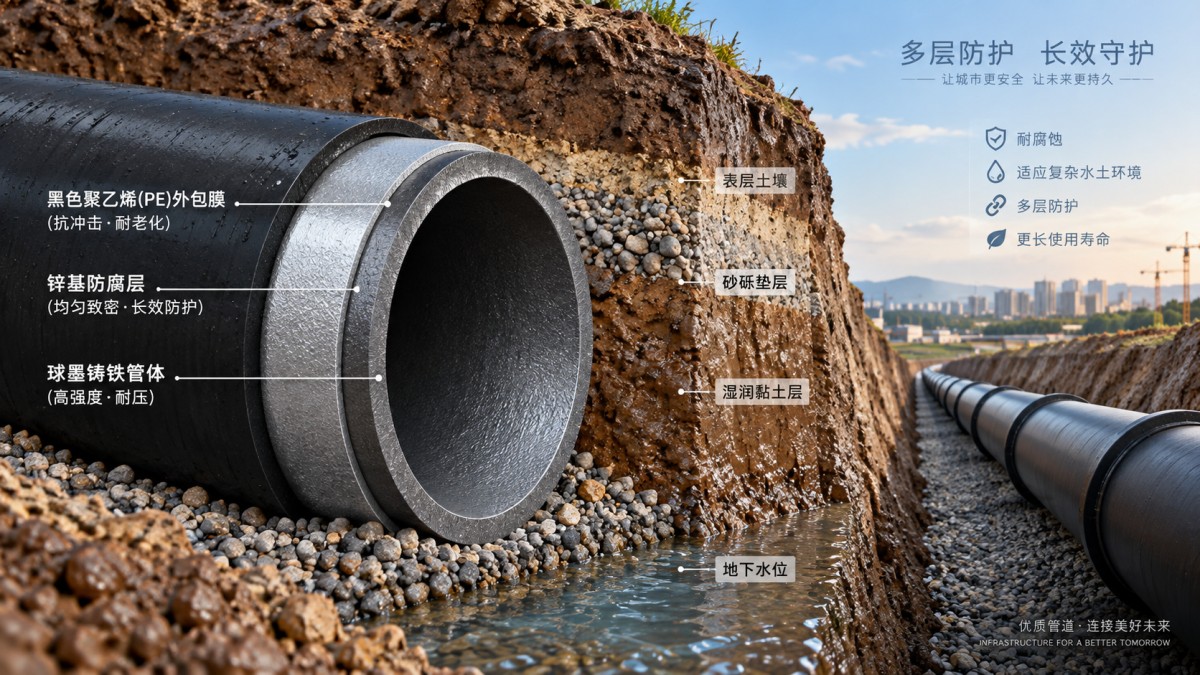
Corrosive soil conditions are rarely identified by visual inspection alone. A dry-looking trench can contain conductive clays, chlorides, sulfates, organic material, or seasonal groundwater that materially changes corrosion risk.
Before selecting a pipe coating, require the geotechnical or corrosion assessment to identify soil resistivity, pH, redox potential, moisture content, soluble salts, and evidence of stray-current exposure.
Soil resistivity is particularly useful because low-resistivity soil permits electrical corrosion processes more easily. However, it should not be considered in isolation, since chemical composition and moisture movement can create additional risks.
Project teams should also review whether the pipeline will cross several soil zones. A coating choice appropriate for one section may be inadequate where the alignment enters tidal areas, industrial fill, wetlands, or reclaimed land.
Groundwater conditions matter because continuously wet soil can keep corrosion cells active. Intermittent saturation can be equally challenging when drying and wetting cycles concentrate salts against the pipe surface.
Ask the designer to distinguish between general soil corrosion and localized attack. Localized corrosion can develop at isolated poor-soil pockets, making continuous external protection more important than an average site result suggests.
For municipal and industrial projects, previous asset records are valuable evidence. Historical failures, excavated pipe condition, and nearby utility data often reveal corrosion hazards that laboratory samples did not fully capture.
Compare Ductile Iron Pipe Coating Types by Their Protective Function
The main Ductile Iron Pipe Coating Types do not perform the same job. Some provide sacrificial electrochemical protection, while others create a barrier between the pipe and corrosive soil.
Factory-applied metallic zinc coatings are widely used for external ductile iron pipe protection. Zinc provides sacrificial action and can form protective corrosion products, particularly when paired with a suitable finishing layer.
Zinc-aluminum alloy systems may provide enhanced protection in demanding environments. Their value should be evaluated against the project’s corrosion classification, design life, local standards, and supplier qualification requirements.
Bituminous or asphaltic topcoats are often applied over metallic coatings to improve handling protection and provide an initial barrier. They are not usually a substitute for a complete corrosion-control strategy in aggressive soil.
Polyethylene encasement is a field-installed protective system that separates the pipe from direct soil contact. It is commonly specified where corrosive soil is known or where conditions vary along the route.
The effectiveness of polyethylene encasement depends heavily on installation quality. Tears, unsealed overlaps, trapped soil, and poor treatment around fittings can reduce its ability to isolate the pipe.
Fusion-bonded epoxy and other specialized barrier coatings may be considered for severe environments or specific project requirements. These systems require careful attention to coating continuity, damage repair, and compatibility with field joints.
Some projects require a combined approach, such as a zinc-based factory coating plus polyethylene encasement. Layered protection can be justified where failure consequences, replacement access, or corrosion uncertainty are high.
When Zinc-Based Coatings Are the Practical Default
Zinc-based external coatings are often a practical baseline for buried ductile iron pipelines because they provide durable factory-applied protection without adding significant field installation complexity.
They are especially attractive for projects with generally moderate soil conditions, consistent trench environments, and a need for predictable installation productivity. Factory application also reduces dependence on field workmanship.
Project managers should confirm the coating mass, finishing layer, relevant standard, and manufacturer’s quality controls. Specification language should define measurable requirements rather than simply requesting “zinc coated pipe.”
A zinc-based system can support strong lifecycle value when its protection level matches the soil classification. Over-specifying may waste capital, while under-specifying can expose the owner to premature renewal costs.
Do not assume zinc coatings eliminate the need for corrosion assessment. Highly aggressive soil, persistent groundwater, severe industrial contamination, or stray currents may require additional external protection measures.
Construction teams should protect factory coatings during unloading, storage, cutting, and backfilling. Even a robust coating system should be inspected for mechanical damage before the pipeline is covered.
Specify clear responsibility for field coating repair. The contractor should use approved repair materials and document repairs, particularly at cut ends, fittings, branch connections, and locations affected by handling equipment.
When Polyethylene Encasement Adds Real Project Value
Polyethylene encasement is often selected when the project faces corrosive soils, variable ground conditions, or uncertainty that cannot be resolved economically through additional investigation before construction starts.
It is also useful for pipelines that cross short but significant corrosive zones. Rather than changing pipe material or redesigning the route, teams can apply focused external protection where needed.
The key management issue is installation discipline. Encasement must be installed with adequate overlap, secure closures, protected seams, and minimal bridging that could expose pipe surfaces to direct soil contact.
Fittings, valves, and irregular components need special attention because their geometry creates more opportunities for incomplete coverage. The corrosion strategy must cover the entire buried assembly, not only straight pipe lengths.
Include encasement requirements in the contractor’s method statement and inspection plan. Site supervisors should verify material condition, overlap dimensions, closure method, and treatment of punctures before backfilling approval.
Polyethylene encasement is not a cure for poor trench practice. Sharp rocks, construction debris, and unsuitable bedding can damage the film and create avoidable defects during installation or later settlement.
For surface access structures in the same network, material durability should be considered consistently. A properly specified Ductile Iron Manhole Cover2 can support dependable access at locations where maintenance crews need repeated entry.
How to Choose Barrier Coatings for Severe Exposure
High-performance barrier coatings are most appropriate when the corrosion hazard is clearly severe and the project can support the added specification, inspection, handling, and repair requirements they introduce.
Examples include highly contaminated industrial sites, unusually saline soils, coastal reclamation areas, and pipelines near electrified infrastructure. In these cases, corrosion engineers should guide the final system selection.
A barrier coating only works as designed when continuity is maintained. Scratches, holidays, poor field-joint treatment, and coating damage from bedding materials can become concentrated points of corrosion attack.
Project managers should evaluate whether coating inspection can be realistically enforced. Requirements for visual checks, holiday testing, repair procedures, and acceptance records should be established before procurement begins.
Consider field joints early. A coating system with excellent factory performance may create weak points if joint areas cannot be protected reliably under the project’s actual trench access and weather conditions.
Barrier systems can increase upfront cost, but lifecycle economics may favor them where excavation is disruptive or expensive. This is common beneath highways, rail corridors, dense developments, and critical industrial facilities.
The decision should compare total risk exposure, not pipe price alone. Include failure probability, outage consequences, traffic management, environmental response, emergency excavation, customer impact, and future renewal access.
Build Coating Requirements Into Procurement and Construction Controls
A coating specification should connect design assumptions to measurable delivery requirements. It should state the soil classification basis, required coating system, applicable standards, inspection methods, and repair responsibilities.
Procurement documents should request manufacturer evidence for coating application controls, traceability, and product conformity. This helps prevent late substitutions that appear equivalent but do not meet the intended corrosion strategy.
At delivery, inspect pipe and fittings for coating damage, contamination, and storage-related deterioration. Keep coated materials off standing water and away from conditions that could compromise protective surfaces.
Coordinate coating requirements with jointing, thrust restraint, cathodic protection, and fitting selection. A pipeline performs as a system, and an isolated coating choice cannot compensate for incompatible components.
Require a pre-installation meeting that includes the pipe supplier, contractor, inspector, and design representative. This meeting should address handling, coating repairs, encasement installation, documentation, and hold points.
Inspection records should be proportionate to project risk. On critical works, photographs and location-based records provide useful evidence that protective measures were installed before the trench became inaccessible.
Do not overlook schedule implications. Specialized coatings and encasement materials may require longer procurement lead times, trained crews, or more detailed inspection, all of which should be reflected in the program.
Use Lifecycle Cost and Consequence of Failure to Make the Final Choice
The best coating choice is not always the lowest-cost option at bid stage. Project managers should compare incremental protection cost with the expected cost of repair, disruption, and lost service over the asset life.
For a low-consequence rural line in moderately corrosive soil, a standard zinc-based system may deliver appropriate value. For a trunk main beneath a city center, additional protection may be financially rational.
Consider the owner’s maintenance capability as part of the decision. Assets that can be inspected and repaired easily may tolerate more risk than deep or inaccessible pipelines with severe excavation constraints.
Document the rationale in the project record. A concise corrosion decision note should identify site data, selected protection, alternatives considered, assumptions, and any future monitoring recommendations for the asset owner.
This documentation protects project governance and supports future renewal planning. It also helps later teams understand why a particular external protection system was selected for a specific pipeline section.
Conclusion: Match Protection to Evidence, Exposure, and Asset Importance
Selecting Ductile Iron Pipe Coating Types for corrosive soil conditions should begin with reliable site information and end with a constructible, inspectable protection plan that suits the pipeline’s operating importance.
Zinc-based coatings provide an efficient foundation for many projects, while polyethylene encasement and specialized barriers address higher uncertainty or more aggressive exposure. The right answer depends on conditions, not product preference.
Project managers create the best outcome by linking corrosion assessment, lifecycle cost, supplier capability, installation controls, and acceptance documentation. That disciplined approach reduces avoidable maintenance risk and protects long-term project value.
Navigation
Send Us A Message

First class quality service and professional after-sales team.
Get in Touch
*We respect your confidentiality and all information are protected.