Ductile iron pipe K9 and K12 difference
When comparing Ductile iron pipe K9 and K12 difference, understanding strength, wall thickness, pressure capacity, and application suitability is essential for making the right project decision. As an integrated manufacturer of ductile iron pipes, fittings, and rubber sealing rings, Shanxi Datong Foundry Co.,Ltd. combines smelting and casting expertise to deliver reliable solutions for water supply and infrastructure systems.
What Is the Real Difference Between K9 and K12 Ductile Iron Pipe?
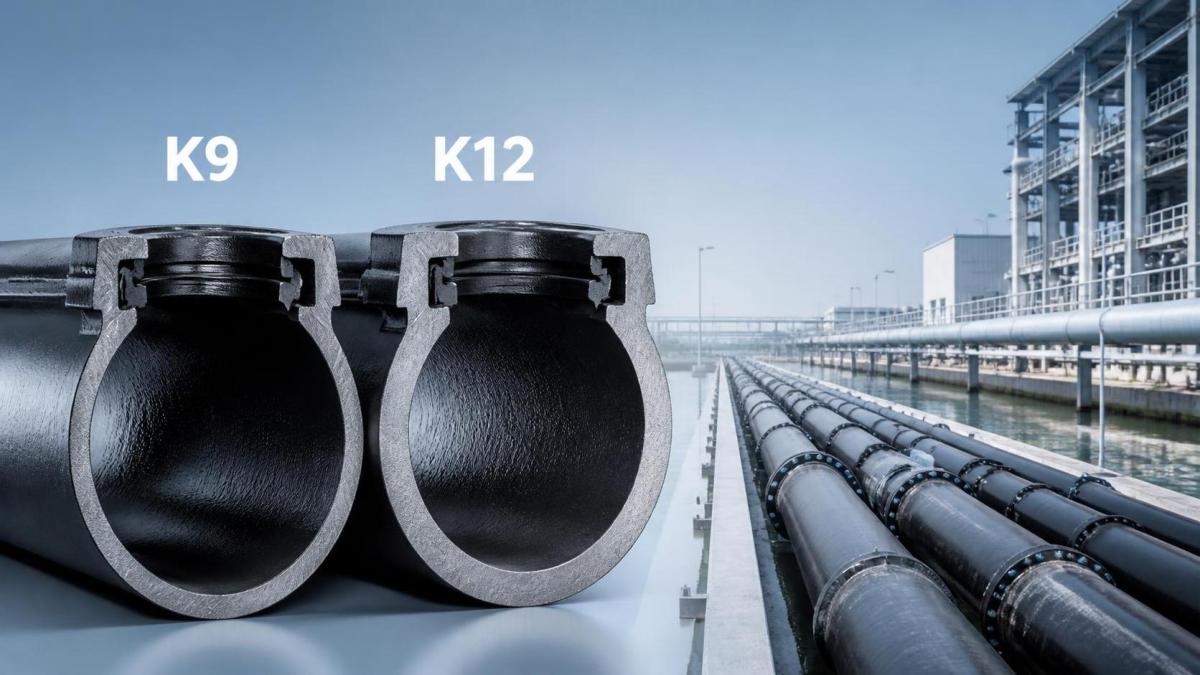
The core difference between K9 and K12 ductile iron pipe is wall thickness. K12 pipes have thicker walls than K9 pipes, which gives them greater mechanical strength.
In practical terms, K12 can better resist external loads, aggressive installation environments, and certain demanding operating conditions. K9, however, remains the more common and economical choice for many water projects.
For most buyers, the decision is not simply about selecting the stronger pipe. It is about matching pipe class to actual service conditions, project risk, and budget efficiency.
Why Pipe Class Matters in Real Projects
Many purchasers first look at nominal diameter and pressure rating, but pipe class affects more than basic specification tables. It influences transport weight, handling difficulty, installation safety, and long-term system durability.
If the class is too low for the site condition, the pipeline may face a higher risk of damage from traffic loads, deep burial, unstable soil, or construction impact. If the class is too high, the project may absorb unnecessary cost.
This is why understanding the Ductile iron pipe K9 and K12 difference is important for engineers, contractors, distributors, and infrastructure decision-makers who need both performance and cost control.
Wall Thickness: The Most Important Technical Difference
K9 and K12 are class designations commonly used for ductile iron pipe. The higher class generally means a greater wall thickness for the same nominal diameter.
That additional wall thickness improves the pipe’s ability to withstand external stress during transport, laying, backfilling, and service life. It also provides more structural reserve in difficult jobsite conditions.
For example, where heavy vehicle traffic passes above the line, or where trench conditions are less predictable, a thicker wall can provide added confidence. This is often one reason specifiers move from K9 to K12.
However, thicker is not automatically better in every case. Extra wall thickness also means more material, more weight, and usually a higher purchase and logistics cost.
Pressure Capacity and Strength: Are They Always the Same Question?
Buyers often assume that a thicker pipe class is always chosen because of higher internal pressure. In reality, internal pressure is only one part of the selection process.
Ductile iron pipe design must consider internal working pressure, surge pressure, external loading, bedding condition, burial depth, and installation environment. A pipe with a thicker wall can offer more margin, but that does not mean every pipeline requires it.
In many municipal water supply systems, K9 provides sufficient performance when the network pressure, soil condition, and installation quality are properly controlled. K12 becomes more attractive when design safety margins need to be higher.
So when evaluating Ductile iron pipe K9 and K12 difference, it is better to think in terms of overall structural reliability rather than looking only at pressure figures.
Where K9 Pipe Is Commonly the Better Choice
K9 ductile iron pipe is widely used in potable water transmission, distribution networks, municipal pipelines, and general infrastructure applications. It is a standard choice because it balances performance, availability, and cost.
For projects with normal burial depth, stable soil, manageable external loads, and standard water pressure requirements, K9 is often fully adequate. In these conditions, choosing K12 may not create meaningful operational value.
Procurement teams also favor K9 when they need a dependable specification that is commonly recognized in domestic and export markets. It usually simplifies sourcing, inventory planning, and contractor familiarity.
For many water authorities and construction firms, K9 is the practical baseline class unless site-specific factors justify a thicker alternative.
When K12 Pipe Makes More Sense
K12 ductile iron pipe is generally considered when projects involve harsher mechanical demands. That may include deeper burial, heavier external loading, more difficult ground conditions, or a stronger preference for durability margin.
It can also be relevant in areas where handling damage risk is higher during transport and installation. A thicker wall offers additional robustness when the construction environment is less controlled.
Some buyers choose K12 for industrial water lines, transport corridors, or infrastructure sections where future maintenance access would be difficult or expensive. In these cases, higher upfront pipe cost may reduce lifecycle risk.
The value of K12 is strongest when the project team can clearly identify the structural or operational reason for using it. Without that reasoning, the upgrade may become cost without proportional benefit.
Cost Difference: Why the Cheapest Option Is Not Always the Lowest-Cost Decision
The most visible difference between K9 and K12 is usually material cost. Since K12 has a thicker wall, it requires more iron and therefore generally costs more per meter.
But purchase price alone is not the full economic picture. Heavier pipe can also affect shipping cost, unloading equipment, labor effort, and installation speed on site.
At the same time, under-specifying a pipeline can create expensive failures, delays, claims, or replacement work. That is why good buyers compare total project cost, not only unit price.
A sound evaluation asks whether the additional cost of K12 solves a real engineering problem. If yes, it may be a smart investment. If not, K9 often delivers better cost efficiency.
How Engineers and Buyers Should Evaluate K9 vs K12
The best way to compare K9 and K12 is to begin with service conditions, not catalog preference. Pipe class selection should follow technical requirements rather than habit.
Start by checking internal working pressure, surge conditions, trench design, soil characteristics, burial depth, traffic loading, and expected installation quality. These factors shape whether K9 is enough or K12 is justified.
Next, review operating risk. If the pipeline is easy to access, simple to repair, and installed in predictable conditions, a standard class may be the rational answer. If failure would be highly disruptive, extra margin can be justified.
Finally, compare lifecycle economics. A stronger pipe class should create measurable value through lower risk, longer service confidence, or better suitability for the actual environment.
Why Manufacturing Quality Matters as Much as Pipe Class
Even the correct class selection will not perform well if the manufacturing quality is inconsistent. Wall thickness class is only one part of product reliability.
Buyers should also assess raw material control, casting consistency, dimensional accuracy, coating quality, socket and spigot precision, and compliance with relevant standards. Joint performance is especially important in water infrastructure systems.
Shanxi Datong Foundry Co.,Ltd. operates as an integrated manufacturing factory producing ductile iron pipes, fittings, and rubber sealing rings. By combining smelting and casting processes, the company can maintain closer control over product consistency.
That integration matters because pipeline performance depends on the whole system, not only on the pipe barrel itself. Reliable joints, compatible fittings, and stable manufacturing quality all influence long-term service performance.
Choosing the Right Pipe for Trenchless or Special Applications
Some projects involve more demanding installation methods, including trenchless works, jacking sections, or locations where external stresses are more complex than ordinary open-cut pipelines.
In these cases, standard class comparison may still be relevant, but project teams often need more specialized product evaluation. Pipe geometry, load behavior, and application-specific design become more important.
For buyers handling such requirements, it may be useful to review specialized options such as Custom Ductile Iron Jacking Pipes when project conditions go beyond conventional pipeline installation needs.
This type of application reminds buyers that the best solution is not always the thickest standard pipe class. The right answer depends on how the product matches the method of installation and service environment.
Common Misunderstandings About Ductile Iron Pipe K9 and K12 Difference
One common misunderstanding is that K12 is always the superior option simply because it is thicker. From a pure strength standpoint, it offers more reserve, but project suitability still decides value.
Another misunderstanding is that K9 is only for light-duty use. In reality, K9 is widely used in serious municipal and water infrastructure systems around the world when engineering conditions support it.
Some buyers also focus too heavily on price without considering installation risk, operating environment, or future repair cost. That can lead to decisions that look cheaper initially but cost more later.
A better approach is to compare both classes in context: performance requirement, site condition, lifecycle expectation, and supply quality.
How to Make a Better Purchase Decision
If you are responsible for sourcing ductile iron pipe, begin by asking what problem the pipe must solve. Is the main challenge pressure, external loading, difficult ground, long service life, or installation risk?
Then ask suppliers for more than a quotation. Request technical support, manufacturing details, quality documentation, coating information, and application guidance relevant to your project conditions.
Where the project includes special structural demands, comparing standard pipe classes with specialized products can save time and reduce redesign later. This is especially important in infrastructure work with strict reliability targets.
The strongest purchasing decision is one that aligns engineering need, total cost, and dependable manufacturing quality in a single evaluation process.
Conclusion: Which One Should You Choose?
When assessing Ductile iron pipe K9 and K12 difference, the shortest answer is this: K9 is usually the standard, cost-effective choice for many water supply and municipal applications, while K12 is better suited to conditions requiring greater wall thickness and higher structural margin.
The correct choice depends on actual project demands, not on the assumption that a higher class is always better. If operating conditions are normal, K9 often provides the best balance of performance and economy.
If the pipeline will face higher external stress, tougher installation conditions, or stricter reliability expectations, K12 may be the more appropriate option. The key is to match pipe class to risk, environment, and lifecycle value.
For buyers, engineers, and contractors, the most useful comparison is not simply stronger versus cheaper. It is whether the selected ductile iron pipe class is truly fit for purpose and supported by reliable manufacturing quality.
Navigation
Send Us A Message

First class quality service and professional after-sales team.
Get in Touch
*We respect your confidentiality and all information are protected.