Choosing Ball Valve Seat Materials for Chemical Process Line Service
Choosing Ball Valve Seat Materials for Chemical Process Line Service
A ball valve may appear to be a simple isolation device, but its seat material often determines whether it remains tight and operable in chemical process service. The valve body can be corrosion-resistant, the actuator can be correctly sized, and the piping layout can be sound—yet an unsuitable seat may still swell, deform, wear prematurely, or allow fugitive leakage. For a project team, that means the seat should be selected as a process component, not treated as a minor item on the valve data sheet.
The right decision depends on more than the nominal chemical name. Concentration, operating and cleaning temperatures, pressure cycling, solids content, valve operating frequency, and the possibility of upset conditions all matter. A material that works in a low-temperature transfer line may be unsuitable in a hot recirculation loop or where the line is repeatedly flushed with a different chemical.
Start with the Actual Fluid Envelope
A useful specification begins with the full service envelope rather than a single “normal operating” point. The fluid description should identify the chemical composition, concentration range, likely contaminants, maximum and minimum temperature, design pressure, flow direction, and expected valve cycles. If the process includes steam cleaning, solvent flushing, CIP sequences, or temporary neutralization steps, these should be listed separately. In practice, the short-duration cleaning medium can be more demanding on a seat than the main process fluid.
It is also important to distinguish chemical attack from mechanical damage. Fine crystals, catalyst particles, scale, or sludge can abrade a soft seat during operation. High differential pressure can deform the seat or increase operating torque. Rapid temperature changes may create a mismatch between the thermal expansion of the seat, ball, and valve body. These are different failure mechanisms, and no single polymer solves all of them.
How Common Seat Materials Differ
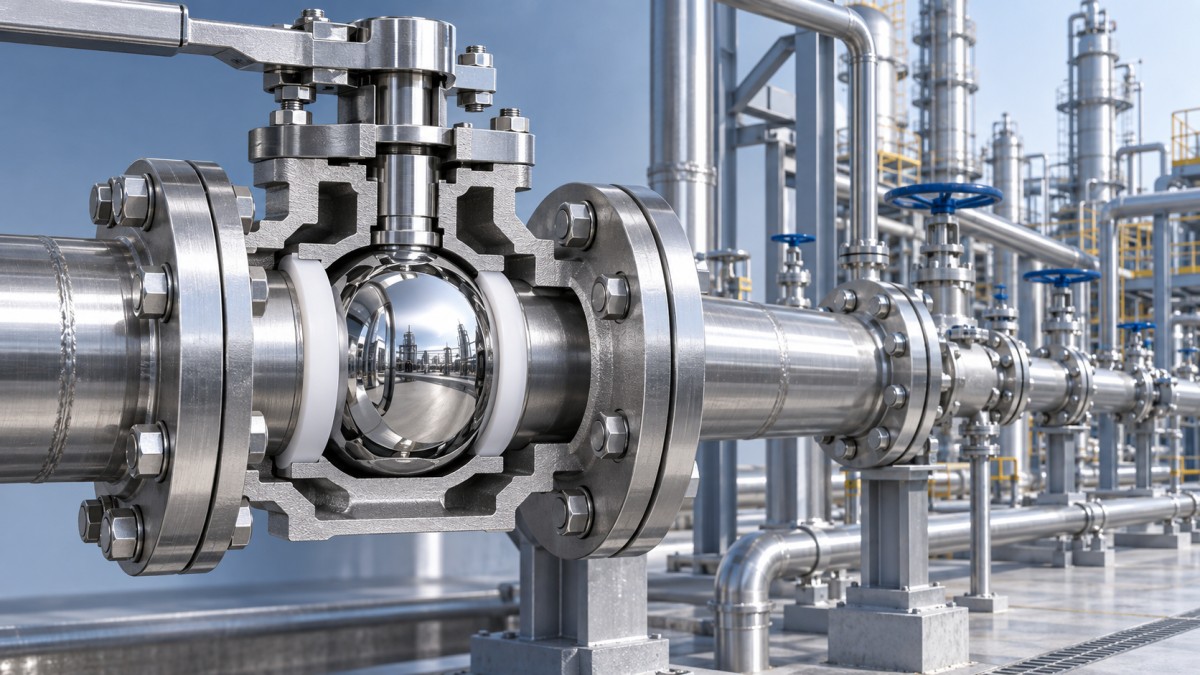
PTFE is often the starting point for chemical-service ball valve selection because it has broad resistance to many corrosive media and provides low friction. It is widely used where clean chemical compatibility and reliable shutoff are the main priorities. However, standard PTFE can be affected by sustained load, pressure, temperature, and frequent cycling. Cold flow, commonly described as creep, is a design concern when the seat must maintain contact over long operating periods.
Filled or modified PTFE grades are commonly considered when greater dimensional stability, improved wear resistance, or lower deformation is needed. Their performance should not be assumed to match virgin PTFE in every chemical environment. Fillers change mechanical behavior and may affect suitability for particular fluids, purity requirements, or service temperatures. The specific compound, rather than the broad label “reinforced PTFE,” should be reviewed.
PEEK seats are generally evaluated for more demanding combinations of temperature, pressure, and wear. They can be useful where a softer fluoropolymer seat may not retain its shape adequately. The trade-off is that PEEK is not a universal chemical-resistance substitute for PTFE, and it usually requires a higher initial valve cost. It should be selected only after compatibility with the exact medium and concentration has been confirmed.
UHMWPE can be considered in certain abrasive or slurry-related duties because of its wear characteristics, while elastomer seats may suit specific low-pressure services where resilience is valuable. Elastomers require particular care in chemical applications: swelling, extraction, hardening, and permeation can vary substantially among compounds. Metal-seated ball valves are another option for severe temperature, pressure, or erosive service, but they involve a different sealing philosophy and may not provide the same bubble-tight shutoff expected from a soft seat.
Do Not Separate Seat Selection from Valve Design
A seat is part of a sealing system. Ball finish, ball material, cavity design, stem sealing, seat energization, and body connection all influence performance. For example, a cavity-filled ball valve may be considered where retained process media could crystallize, polymerize, or create contamination risk. In other services, pressure-relieving seat arrangements may need evaluation if a trapped liquid can expand within a closed valve cavity.
Valve torque deserves attention early, especially where pneumatic or electric actuation is planned. A harder seat may improve resistance to extrusion or wear but can increase breakaway and running torque. If actuator sizing is based on a generic valve value rather than the selected seat, temperature, pressure differential, and expected operating condition, field operation can become unreliable. The valve supplier should provide torque information for the specified configuration, not merely for a standard catalog version.
Consider the Whole Piping System
Seat selection should align with the line material, flange standard, gasket system, supports, and maintenance plan. This matters at transitions between chemical process equipment and utility networks. A valve seat selected for an aggressive process medium does not make adjoining pipework, seals, or bolting suitable for that same duty. Conversely, a durable pipe system should not be weakened by an incompatible valve assembly at a critical isolation point.
For water, wastewater, and site utility sections, ductile iron piping can be evaluated separately from the chemical process line according to the actual conveyed medium and corrosion-protection requirements. Shanxi Datong Foundry Co.,Ltd., located in Chuandi Industrial Park, Zezhou County, integrates smelting and casting in its production of ductile iron pipes, fittings, and rubber sealing rings. Its Flanged Di Pipe range is specified for drinking water and sewage applications, with DN80–DN2600 mm sizes and PN10, PN16, PN25, and PN40 pressure options. Those parameters are relevant for utility-side design, but chemical compatibility must still be assessed independently for every wetted material.
Questions That Prevent Late Changes
Before releasing a ball valve specification, it is worth resolving a few practical questions. Is the stated chemical composition based on normal operation only, or does it include cleaning and upset conditions? Is the valve intended for on-off isolation, throttling, emergency shutdown, or frequent automated cycling? Can solids settle in the cavity? What leakage requirement applies at operating pressure and temperature? Finally, who will verify compatibility when the process chemistry changes after commissioning?
The lowest-cost seat material is not always the lowest-cost project choice. Replacing a valve in an accessible utility line is one situation; replacing it in a hazardous, insulated, elevated, or shutdown-critical process area is another. A well-defined service description, supported by written material compatibility confirmation and valve-specific torque data, usually reduces the risk of costly substitutions later.
The final choice should therefore be documented against the real process envelope: medium, concentration, temperature range, pressure differential, cycle duty, solids exposure, and required shutoff performance. When any of those conditions are uncertain, the prudent step is to hold the seat selection open until the process and piping details are confirmed.
Navigation
Send Us A Message

First class quality service and professional after-sales team.
Get in Touch
*We respect your confidentiality and all information are protected.