Why Ball Valves Leak After Cycling and How Operators Can Fix Them
A ball valve that holds pressure when newly installed but leaks after repeated opening and closing is rarely failing for one simple reason. Cycling changes the contact conditions between the ball, seats, stem seals, packing, and actuator. The leak location matters: a body-joint leak, stem leak, and downstream seat leak point to different faults and require different corrective actions.
The most important rule is to identify where the leakage occurs before tightening bolts, adding packing, or replacing the entire valve. A valve that passes fluid when closed has a sealing-surface problem. Fluid emerging around the stem indicates packing, O-rings, or stem-surface damage. Leakage at flanges, threaded ends, or the body joint is usually an installation, gasket, bolting, or pressure-boundary issue rather than a failure of the ball itself.
Why cycling changes valve sealing performance
A ball valve seals when resilient seats are pressed against the polished spherical surface of the ball. During each cycle, the ball rotates across those seats. Under clean, compatible service conditions, that motion is controlled and low-wear. In actual systems, particles, pressure fluctuations, temperature movement, excessive operating torque, and unsuitable materials can progressively damage the sealing interface.
Many leaks appear after cycling because the valve has been operated under differential pressure, not merely because it has reached a certain number of cycles. A valve closing against high pressure must force the ball through a much greater seat load. If the actuator is oversized or the manual handle is extended for extra leverage, the stem and ball can be driven past the position needed for secure seating. This can deform soft seats, score the ball, or overload the stem packing.
Frequent partial operation creates another problem. Standard ball valves are designed principally for on/off isolation. Holding the ball partly open for throttling can generate high local velocity and turbulence at the seat edge. In liquids carrying solids, this accelerates erosion. In gas service, pressure drop across a partly open valve may produce noise, vibration, and seat damage. Once the sealing edge is eroded, the valve may appear to close normally while allowing internal bypass.
Match the leak pattern to the likely fault
A short inspection under safe, isolated conditions can prevent unnecessary replacement. Depressurize, drain or vent the line as required by the service, and confirm that stored actuator energy has been released before dismantling any pressure-containing part.
- Leakage through the closed valve: The usual causes are worn or chemically swollen seats, scratched ball surfaces, debris trapped between ball and seat, incorrect valve orientation for the service, or damage caused by closing under excessive torque.
- Leakage around the stem during movement: This often indicates loose packing adjustment, worn packing, damaged stem O-rings, a scored stem, or stem deflection caused by actuator misalignment.
- Leakage from the body joint: On two-piece or three-piece designs, inspect body seals, fastener condition, bolt tightening sequence, corrosion at the joint, and whether thermal cycling has reduced gasket compression.
- Leakage at end connections: Flange gasket damage, uneven bolt loading, pipe strain, poor thread sealing, weld heat effects, or misalignment are more likely than an internal valve defect.
Do not assume that a small external leak is harmless. Stem leakage can worsen rapidly if the packing is abraded each time the valve is cycled. Internal leakage can also create operational risk when isolation is assumed before maintenance, sampling, or downstream equipment work.
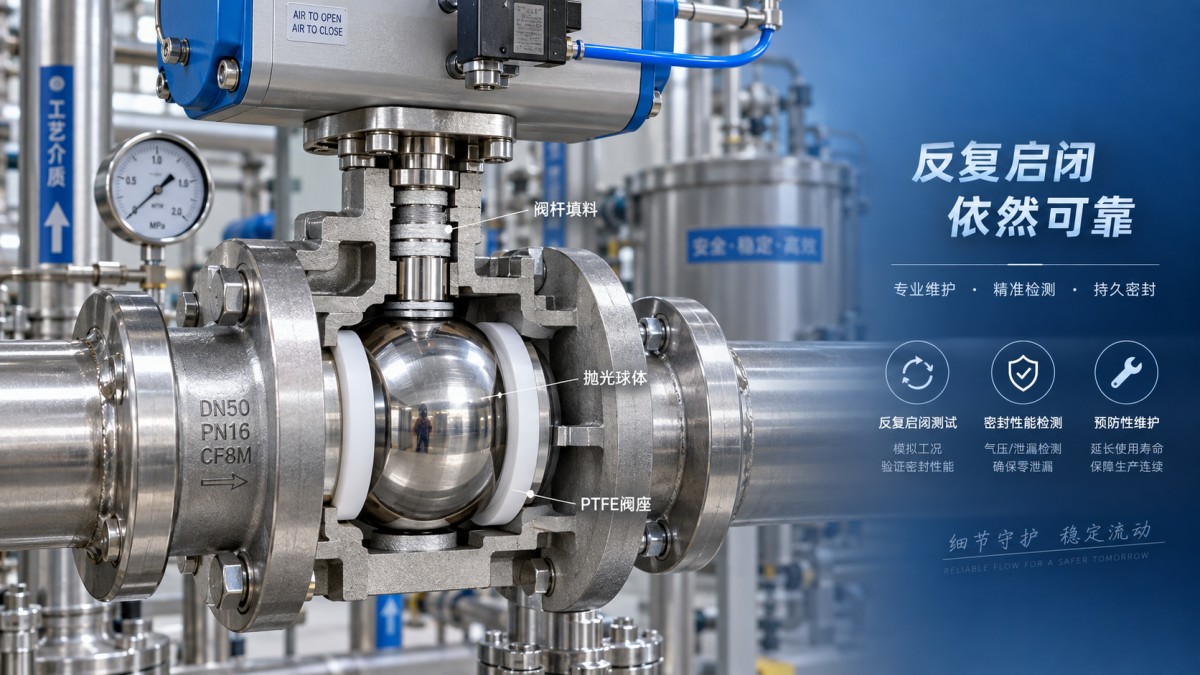
Seat wear is often the real cause of internal leakage
Soft seats such as PTFE and other polymer-based materials provide reliable shutoff in many services, but their performance depends on chemical compatibility, pressure, temperature, and media cleanliness. A seat may become too soft at elevated temperature, harden or lose resilience after chemical exposure, or cold-flow under sustained load. None of these changes is always obvious from the outside of the valve.
Abrasive solids are especially damaging. Scale, weld slag, rust, sand, catalyst fines, and fragments from upstream gaskets can be trapped between the turning ball and seat. One hard particle can leave a circumferential scratch on the ball. Because the ball rotates through the same sealing zone on every operation, a scratch becomes a leak path that no amount of handle force will correct.
When inspection reveals a clean ball with no visible scoring but the valve still bypasses, examine the seat profile and seat pocket. A flattened, extruded, cracked, or permanently compressed seat no longer maintains uniform contact. In a repairable valve, replacing the seats and body seals may restore performance. In a non-repairable design, replacement is generally more dependable than attempting to compensate with higher torque.
Stem leakage: tightening is not always a repair
Stem packing is intended to create controlled compression around the stem while still allowing rotation. If a gland nut or packing follower is adjustable, a small and even adjustment may stop minor leakage. Tightening should be gradual and limited to the manufacturer’s instructions. Excessive compression increases operating torque, accelerates packing wear, and can make an actuator appear undersized.
If leakage persists after a modest adjustment, inspect the stem condition rather than continuing to tighten. A stem with scoring, corrosion, deposits, or bending will damage new packing quickly. Stem deflection is particularly important on automated valves. Poorly aligned mounting brackets, loose couplings, or side loads from an actuator can cause uneven loading as the valve turns. The result may be intermittent leakage that appears only at certain positions.
For valves in thermal service, packing relaxation can occur after temperature changes. Rechecking packing load during scheduled maintenance is sensible, but repeated adjustment without determining the temperature and material cause only postpones failure.
Torque problems can damage an otherwise suitable ball valve
Operating torque should not be treated as a convenience issue. A sudden increase in handle force or actuator current can signal fouling, seat swelling, lack of lubrication in the drive train where applicable, misalignment, or pressure-related loading. Forcing the valve through a hard cycle can twist the stem, damage the stem-to-ball connection, or distort seats.
Automated assemblies need particular attention. An actuator that is too small may stall before the valve reaches its fully seated position, leaving a narrow internal leak path. An oversized actuator can apply damaging torque if travel stops are not properly set. The actuator must also deliver adequate torque at the actual differential pressure and temperature, not only under no-load bench conditions.
Before changing actuator settings, confirm whether the valve is full-port or reduced-port, the direction of pressure, the medium, and the shutoff duty. A ball valve used as a control device may need a different valve type or a purpose-designed control arrangement. In systems that mainly require compact isolation with lower pressure drop but do not need full-bore flow, a Butterfly Valve can be evaluated separately; it should not be treated as a direct cure for contamination, pipe stress, or actuator misalignment.
Media compatibility is a maintenance issue, not only a selection issue
When a ball valve begins leaking after exposure to a new cleaning chemical, solvent, inhibitor, or process fluid, review every wetted sealing material. The valve body may remain intact while seats, O-rings, and packing lose strength, swell, shrink, or become brittle. Temperature can change the compatibility outcome, so a material that performs in ambient service may not perform in heated service.
Pressure cycling also matters. Rapid pressure changes can push seat materials into clearances or create repeated stress at the seat edge. In gas service, trapped cavity pressure in a closed valve may require a cavity-relief design depending on the valve construction and operating conditions. This is a design and safety question that should be checked against the valve documentation rather than addressed by field modification.
A practical correction sequence
Start with operating records. Note whether leakage appeared after maintenance, a process change, actuator replacement, unusual temperature exposure, or a line-cleaning event. Then verify the valve’s actual closed position and confirm that the handle, gear operator, or actuator travel stops are not preventing full closure.
For internal leakage, flush the line only when the process and valve manufacturer’s limits permit it. A controlled flush can remove loose debris, but it will not repair a scored ball or deformed seat. If leakage remains, isolate the valve and inspect the ball, seats, stem, and body seals. Replace damaged parts using materials suited to the real pressure-temperature-media combination, not simply the original materials if the service has changed.
For external leakage, examine flange bolts, packing adjustment, body fasteners, and pipe support before removing the valve. Pipe strain can distort a valve body or joint and repeatedly defeat new gaskets. Correcting alignment and support is essential; otherwise, the same leak can return soon after reassembly.
After repair or replacement, cycle the valve under controlled conditions and test for both external leakage and shutoff performance at the relevant pressure. The useful outcome is not merely a dry valve at rest, but stable sealing after repeated operation. When the root cause is identified—seat damage, contaminated media, packing failure, excessive torque, incompatible materials, or installation stress—the corrective action becomes specific and repeatable rather than another temporary adjustment.
Navigation
Send Us A Message

First class quality service and professional after-sales team.
Get in Touch
*We respect your confidentiality and all information are protected.