How EN 545 Compliance Changes Lifecycle Cost in Municipal Pipe Tenders
A municipal pipe tender can look competitive on paper while quietly creating cost exposure for decades. The usual pressure point is the unit price: a lower-priced offer may appear to protect the capital budget, especially when several bids meet the stated diameter and pressure requirements. Yet where potable-water networks, pumped mains, or wastewater transmission lines are involved, the real comparison begins after award. Joint performance, coating suitability, pipe strength, documentation quality, installation tolerance, and future repair access all affect the cost carried by the municipality rather than the supplier.
The practical judgment is straightforward: EN 545 compliance should be evaluated as a lifecycle-cost control, not as a pass/fail line in the technical schedule. Properly specified and verified EN 545 ductile iron pipe can reduce uncertainty in tender evaluation because the standard gives buyers a framework for assessing dimensions, materials, coating systems, joints, testing, and product traceability. It does not eliminate the need to define project conditions, but it makes bids easier to compare on risks that can otherwise emerge only during installation or service.
Why the lowest pipe price can distort a municipal tender
Pipe procurement often separates material cost from civil works, commissioning, and maintenance budgets. That division can make a cheaper pipe offer appear attractive even when it introduces additional work at the trench, more demanding inspection, or a higher likelihood of future intervention. A small difference in delivered pipe cost can be outweighed by delays caused by inconsistent socket dimensions, unsuitable coatings for site soils, incomplete test records, or joint components that do not match the stated system.
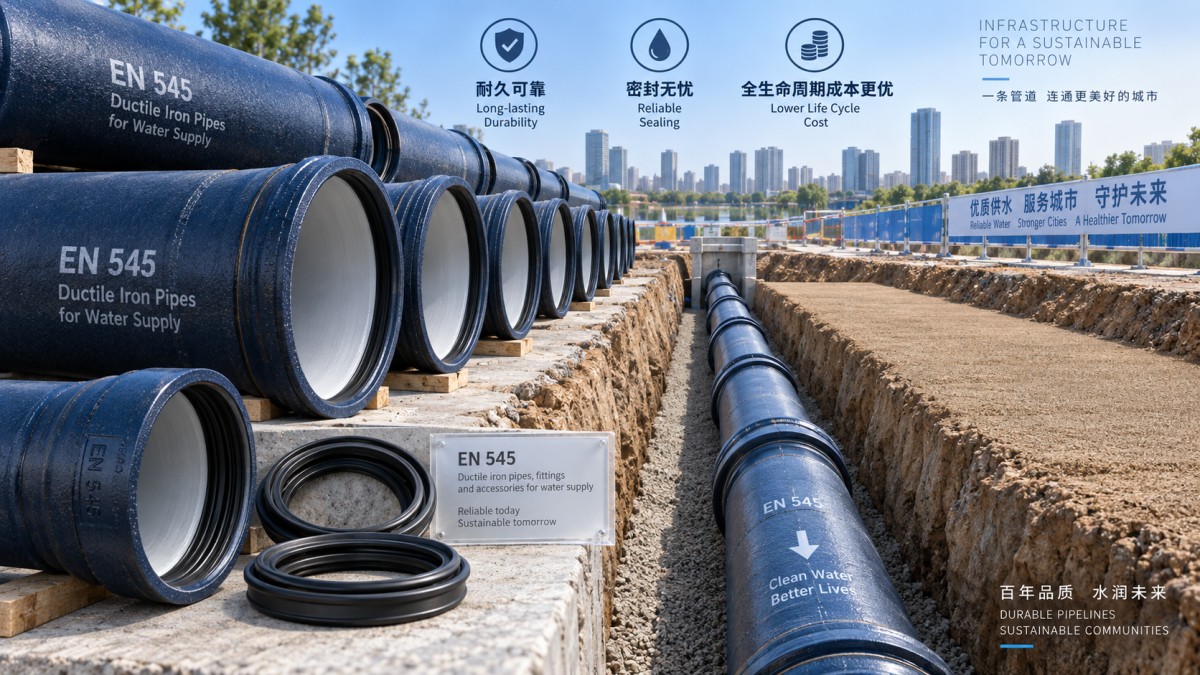
EN 545 gives procurement teams a common technical baseline for ductile iron pipes, fittings, joints, and accessories used in water pipelines. In tender terms, it helps move the discussion beyond “does the pipe fit the nominal diameter?” toward questions that carry cost consequences:
- Are the pipe wall class, pressure requirements, and external-load conditions aligned?
- Is the joint system supplied as a matched assembly, including compatible rubber sealing rings?
- Does the specified lining suit potable-water service and the expected water chemistry?
- Is the external protection appropriate for the installation environment rather than merely listed in a brochure?
- Can the supplier provide traceable evidence for the actual production lot delivered to site?
A bid can state compliance without giving enough detail to verify these points. The purchasing decision should therefore distinguish between a generic declaration and a complete, project-relevant compliance submission.
Compliance changes cost before the pipeline is even installed
The first lifecycle savings may occur during bid review. When the tender clearly requires EN 545 conformity together with project-specific schedules, evaluators can compare offers on equivalent technical grounds. This reduces the risk of accepting a low initial price that depends on exclusions, ambiguous coating language, or later variations for components assumed to be included.
Procurement documents should avoid treating “EN 545” as the entire specification. The standard is essential, but it cannot determine local soil aggressiveness, installation method, surge conditions, traffic load, groundwater exposure, or the required restraint arrangement. These must be identified in the tender so bidders price the same scope.
In practice, the cost benefit is not that every compliant product will be identical. It is that material differences become visible early enough to price, approve, or reject them deliberately. That is a much better position than finding a mismatch after excavation has started.
Installation cost is strongly tied to system consistency
Installation teams encounter the consequences of procurement choices immediately. A pipe system that has been specified only by nominal size may leave unanswered questions about insertion depth, joint restraint, gasket type, allowable cutting, field repair procedures, or transition connections. Each uncertainty creates a chance for site stoppages, extra approvals, or improvised substitutions.
With EN 545 ductile iron pipe, purchasers should request the technical details that the contractor will need before materials arrive: pipe and fitting dimensions, joint assembly instructions, gasket identification, coating repair guidance, handling limits, and documentation for any restrained or special joints. This does not turn procurement staff into site engineers. It prevents the contract from leaving critical compatibility decisions until the work is underway.
Jacking, crossings, deep excavations, and pumped pipelines deserve additional attention because the loading conditions differ from a straightforward gravity trench installation. A K8 Jacking Pipe made from spheroidal graphite cast iron may be relevant where enhanced wall thickness, strong mechanical performance, and higher pressure capability are required. Its suitability still depends on the jacking method, drive length, ground conditions, thrust loads, joint design, and the applicable design review. Purchasing teams should not assume that a pressure classification alone confirms suitability for a trenchless installation.
Leakage and intervention costs are where weak specifications become expensive
A municipal water asset does not incur cost only when a pipe fails structurally. Recurrent leakage investigations, valve operations, road opening, traffic management, water loss, emergency crews, and customer disruption can all be more costly than the pipe component being repaired. The same is true for wastewater systems, where leakage or infiltration can affect network operation and create difficult access conditions.
EN 545 compliance supports leakage control by establishing requirements around product consistency and joint-related performance. But buyers should verify that the tender also defines pressure testing, acceptance responsibilities, and the treatment of damaged coatings or lining at site. Factory conformity cannot compensate for poor storage, incorrect joint assembly, contaminated gaskets, excessive angular deflection, or unapproved field modifications.
A useful tender approach is to allocate responsibilities clearly. The supplier should provide compliant products and supporting records; the contractor should follow handling and assembly instructions; the project team should define inspection hold points and acceptance criteria. When these obligations are blurred, parties may disagree over defects after the line has been buried, increasing both dispute cost and restoration cost.
Service life depends on conditions that should be priced openly
Ductile iron is valued for mechanical strength and long-term durability, yet an expected service life is not created by the pipe material alone. Soil conditions, stray current exposure, groundwater, backfill quality, pressure cycling, water chemistry, and maintenance practices all influence asset performance. A procurement package that asks only for a standard certificate can unintentionally shift these risks into later operating budgets.
Instead, require bidders to identify the protective system included in their price and any site conditions that need further confirmation. Ask whether supplementary protection is assumed, optional, or excluded. Request clear information on how cut ends, fittings, field damage, and connections to other materials will be protected. These questions are particularly valuable when the project includes mixed pipe materials or when a new main connects to an older network with unknown conditions.
For pressure lines serving municipal potable water, firefighting supply, industrial process water, or pumped transmission, pressure fluctuations should also be addressed at design stage. Higher pressure ratings and robust mechanical properties can provide useful safety margins, but they do not replace surge analysis or correctly selected valves, anchors, and restrained sections.
A bid-review method that keeps lifecycle cost visible
Rather than scoring technical compliance as a single yes-or-no item, procurement teams can ask bidders to submit a structured compliance matrix. Each line should identify the tender requirement, the offered product characteristic, the evidence supplied, and any deviation or assumption. This makes exclusions visible before commercial ranking is finalized.
- Set the operating envelope. Confirm conveyed medium, pressure range, transient conditions, diameter, burial depth, external loading, installation method, and anticipated soil or groundwater exposure.
- Define the complete system. Include pipes, fittings, joints, gaskets, coatings, linings, restraints, transitions, and repair materials where relevant.
- Request evidence by delivered scope. Certificates alone are not enough; require product identification, inspection records, dimensional information, and documentation tied to the supply.
- Evaluate exceptions commercially. A deviation may be acceptable, but its design review, installation effect, and future maintenance implication should be costed rather than overlooked.
- Protect handover records. Retain batch information, installation records, pressure-test results, and location data for future maintenance teams.
The final award decision should therefore compare more than the delivered price per metre. A technically complete EN 545 offer may carry a higher initial figure while reducing exposure to variations, installation disputes, leakage response, and premature asset intervention. The relevant question is not whether compliance costs more at purchase; it is whether the tender has made the long-term consequences of non-equivalent offers visible before the municipality commits to them.
Navigation
Send Us A Message

First class quality service and professional after-sales team.
Get in Touch
*We respect your confidentiality and all information are protected.