External vs Internal Pipe Coatings for Reliable Potable Water Protection
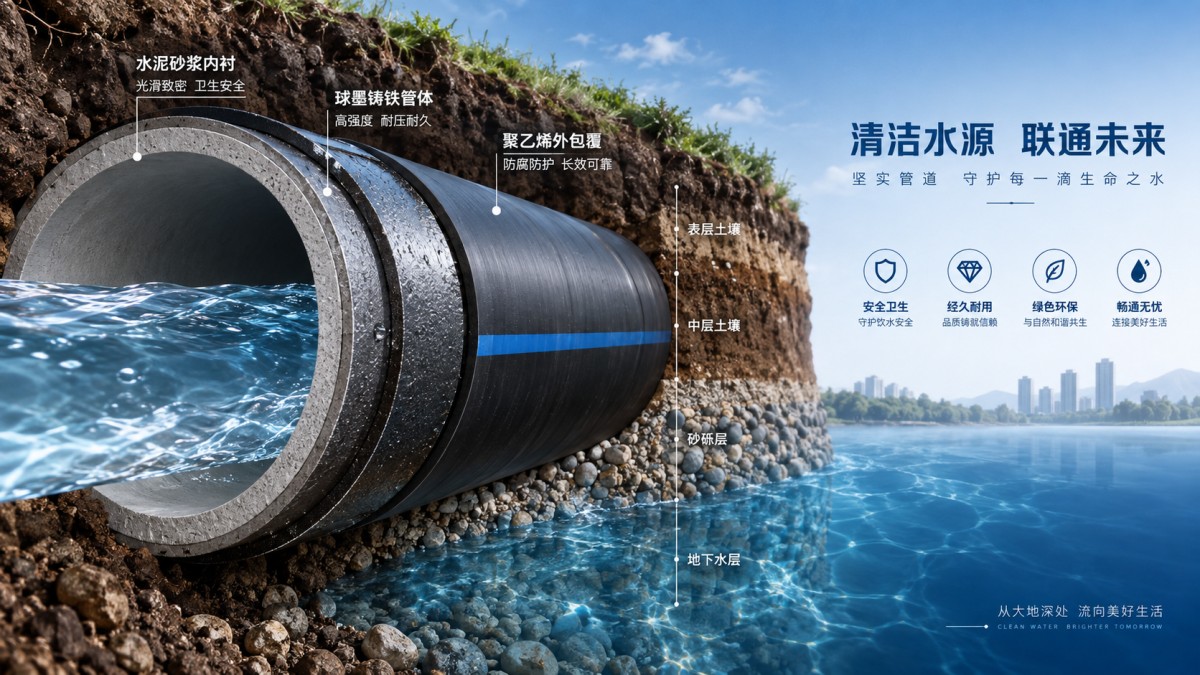
For potable water pipelines, external and internal protection solve different failure modes and should be specified as a coordinated system. External coatings protect ductile iron from the surrounding soil, groundwater, stray electrical effects, and installation damage. Internal linings protect conveyed water quality, preserve hydraulic performance, and limit corrosion products inside the pipe. Treating one layer as a substitute for the other leaves a gap in the protection strategy.
For quality and safety teams, the practical question is not simply which coating is “better.” It is whether the selected combination matches the actual water chemistry, soil environment, storage conditions, jointing method, and inspection capability of the project. The wrong choice may remain visually acceptable at delivery while creating difficult-to-diagnose water-quality or asset-life problems later.
Internal lining protects the water-facing surface
The internal lining is the potable-water barrier. Its purpose is to keep the pipe wall from reacting with water and to avoid roughening that can reduce flow capacity or create sites for deposits. In ductile iron pipe systems, cement mortar lining is widely used because it provides an alkaline barrier between the water and the iron substrate. Other linings may be selected where water chemistry, operating conditions, or project specifications call for a different resistance profile.
The most important internal-lining decision is driven by the water, not by the exterior installation environment. Water with aggressive characteristics can challenge a lining through dissolution, softening, permeability changes, or localized attack at damaged areas. A lining that performs well with relatively stable treated water may need closer evaluation where the source water varies, where treatment processes change, or where the pipeline will operate intermittently.
Quality checks should therefore extend beyond confirming that a lining is present. Inspectors should look for continuity, cracking, poor adhesion, exposed substrate, thin areas, and damage around cut ends or field modifications. Pipe handling is relevant here: impact during unloading or installation can damage an internal lining even when the external coating appears intact.
Internal protection also needs to be considered at interfaces. Valves, fittings, flange connections, repair sections, and transition pieces can introduce different wetted materials into the same pipeline. Where an isolation assembly includes an Eccentric Hemispherical Valve, the specification should verify that the valve's wetted surfaces and any applicable lining system are suitable for the same potable-water duty as the adjacent ductile iron pipe. The pipe lining alone cannot control the performance of every component in the water path.
External coating is a soil-corrosion decision
External protection addresses a different exposure entirely. Once buried, ductile iron pipe may encounter soils with varying moisture retention, resistivity, chloride content, sulphate content, organic material, industrial contamination, or electrical interference. A standard external coating can provide handling and initial environmental protection, but it should not automatically be assumed sufficient for every soil condition.
Among the commonly discussed Ductile Iron Pipe Coating Types, external systems may include factory-applied metallic layers, finishing coats, and supplementary polyethylene encasement or other specified barriers. Their roles differ. A metallic coating can provide sacrificial protection and support corrosion resistance in ordinary buried conditions. A finishing layer can improve handling resistance and reduce surface deterioration. Polyethylene encasement creates a physical separation between the pipe and the soil environment when external corrosion risk needs additional control.
The choice should be based on a project soil assessment rather than a generic preference for the thickest or most familiar coating. Thickness alone does not establish suitability. A coating system may be robust in appearance but vulnerable where it is cut, scratched, poorly repaired, or installed in a soil condition outside its intended service range. Conversely, a well-selected system can lose much of its value if the encasement is torn, joints are left exposed, or backfill contains sharp material that damages the protective layer.
Do not confuse appearance with protection continuity
A common inspection mistake is to evaluate internal and external protection mainly by visual uniformity at the factory gate. Visual review matters, but it does not answer several questions that determine field reliability: Was the lining properly cured? Is the coating bonded or applied consistently? Are cut ends protected according to the design? Will the selected joint configuration preserve the protection system after assembly? Has damage been identified before the trench is closed?
For external coatings, the most vulnerable locations are often practical rather than theoretical:
- pipe ends and spigot areas affected by handling or field cutting;
- areas scraped by lifting equipment, rollers, or unsuitable storage supports;
- joints where encasement overlaps, tapes, or closure methods are incomplete;
- connections to fittings, valves, chambers, and structures with different corrosion conditions;
- sections exposed to standing water, contaminated fill, or possible stray-current influence.
For internal linings, attention should focus on damage caused by transport, cutting, tapping, drilling, joint assembly, and cleaning. Field repairs should follow the applicable project procedure and should be compatible with the lining already applied. An improvised patch that changes the wetted surface chemistry or sheds material under flow can create a potable-water concern even if it restores the visual appearance of the pipe wall.
Specification should separate the two protection functions
A reliable specification states the internal and external requirements separately. Combining them under a broad phrase such as “corrosion-protected ductile iron pipe” can create ambiguity during procurement and inspection. The internal requirement should identify the lining type, intended water service, surface condition expectations, treatment of ends and field repairs, and relevant acceptance criteria. The external requirement should define the coating or encasement system, the environmental basis for its selection, allowable damage, repair method, and installation controls.
This separation is especially important when pipe is supplied with fittings, seals, valves, and fabricated connections from more than one production route. Material compatibility, dimensional fit, and hydraulic design are necessary, but the protective systems must also align. For example, a pipeline may have suitable pipe lining yet use an unprotected wetted fitting, or it may use external encasement on straight pipe while leaving high-risk fitting assemblies inadequately protected.
Installation controls often determine the result
Even an appropriate factory-applied system depends on field discipline. Pipe should be stored on supports that avoid point loading and coating abrasion. Lifting methods should prevent impact and avoid direct contact that can chip edges or scrape protective layers. Before placement, crews should inspect each length rather than assuming that the delivered condition remains unchanged.
For buried pipe, the trench and backfill are part of the protection system. Sharp stones, construction debris, saturated zones, and poor compaction practices can damage external coatings or encasement. Where polyethylene encasement is specified, continuity at overlaps, closures, and penetrations deserves explicit inspection. A small opening can allow the soil environment to contact the pipe in an area that was intended to remain isolated.
On the water side, flushing and commissioning procedures should avoid introducing debris that can abrade or contaminate repaired lining areas. Quality teams should retain records of any field cuts, lining repairs, coating repairs, and deviations from the original protection specification. These records make later integrity investigations more precise and help distinguish a material issue from an installation issue.
The decision is about exposure mapping, not a universal coating hierarchy
External and internal pipe protection should be selected after mapping two environments: the water that will flow through the system and the soil that will surround it. Where either environment is uncertain or variable, the project should define how that uncertainty will be managed through testing, design allowances, supplementary protection, or inspection controls.
For potable water assets, the best result is usually a specified combination that can be verified before burial and maintained through installation. Internal linings protect the public-health and hydraulic side of the pipeline. External coatings protect the buried asset from its surroundings. Both require clear acceptance criteria, disciplined repair practices, and consistent treatment at joints and appurtenances.
Navigation
Send Us A Message

First class quality service and professional after-sales team.
Get in Touch
*We respect your confidentiality and all information are protected.