How Ball Valve Bore Design Influences Pressure Drop and Pump Energy Use
A ball valve can look like a simple isolation device, but its bore geometry can materially change the hydraulic behavior of a pumped pipeline. The difference is most visible when a valve is undersized, installed in a high-flow duty, or left in a system where pump operating costs matter over many hours of operation.
For operators, the practical rule is straightforward: a full-port ball valve usually creates less pressure loss than a reduced-port design of the same nominal pipe size. That lower resistance can reduce the head the pump must overcome. It does not automatically justify specifying full-port valves everywhere, however. Flow rate, velocity, pipe diameter, valve duty, available pump head, and maintenance requirements all affect whether the additional bore area produces a meaningful operating benefit.
Why bore diameter changes pressure drop
Pressure drop occurs whenever fluid passes through a restriction, changes direction, accelerates, or encounters internal surface resistance. In a ball valve, the most important restriction is the relationship between the valve bore and the inside diameter of the connected pipe.
A full-port valve has a bore close to the pipe's internal flow area. When fully open, the fluid path is comparatively direct, so there is less contraction and expansion of the flow stream. A reduced-port valve has a smaller opening than the adjoining pipe. Fluid accelerates as it enters the narrower bore, then decelerates as it exits. Both transitions add turbulence and energy loss.
Pressure loss is not determined by bore size alone. It rises sharply as flow velocity rises, which is why a modest reduction in opening can have a larger effect than expected in high-flow service. A reduced-bore valve that performs acceptably on an intermittent branch line may become a persistent source of head loss on a continuously pumped main.
In ductile iron pipe systems, this distinction deserves attention because the pipe itself is often selected for durable, long-term water or fluid conveyance. If the line is carefully sized but a restrictive valve is installed at a major control point, part of the expected hydraulic performance is lost at the valve.
Full-port and reduced-port designs serve different duties
Full-port ball valves are generally the better hydraulic choice where flow capacity and pump energy are important. They are commonly suited to main-line isolation, pump discharge lines, transfer lines, bypasses that must carry substantial flow, and locations where the valve may remain open for long periods.
Reduced-port designs can still be reasonable where compact dimensions, lower initial cost, or lower flow demand takes priority. They may fit small service connections, auxiliary lines, low-flow chemical or utility lines, and installations where the pump has ample available head and the valve is not a material bottleneck.
The terms can be misleading if treated as absolute. A “full-port” valve should be checked against the actual pipe internal diameter, particularly where wall thickness, lining, end connection type, or pipe class affects the available flow area. Nominal size alone does not prove that the open valve presents a smooth, full-area passage.
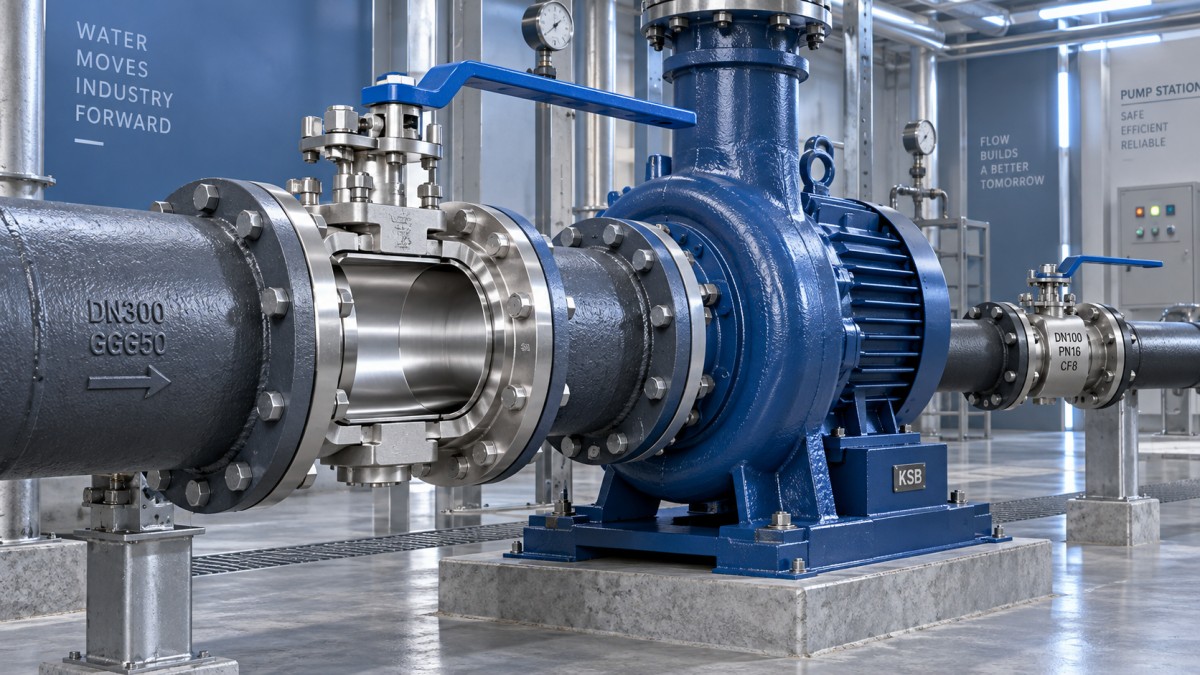
Pump energy: the valve is one part of the system curve
Pumps consume energy to produce flow and head. Every source of friction or local resistance adds to the system head requirement. If a ball valve has a smaller bore, the pump may need to operate at a higher head for the same target flow. Depending on the pump curve and control method, that can increase power demand, reduce delivered flow, or move the pump away from its preferred operating region.
The energy effect should be assessed at the system level. One reduced-port valve on a long, large-diameter pipeline may have limited influence because pipe friction, elevation change, filters, meters, bends, and other fittings dominate the total head. Several restrictive valves in series, or a single valve close to a pump discharge, can be more consequential.
Variable-speed pumping makes the evaluation more important. When a control system attempts to maintain flow or pressure, added resistance can cause the pump to run at a higher speed. That response can increase electricity use and may change noise, vibration, and wear conditions. In fixed-speed systems, the same resistance may instead reduce flow, which can affect downstream filling, flushing, process supply, or pressure stability.
Operators should avoid assuming that a larger bore always produces a proportionate energy saving. The useful question is: how much of the total differential head is attributable to this valve at the expected flow range? A hydraulic calculation using the valve's published flow coefficient or loss coefficient provides a more defensible answer than selecting by nominal size or visual bore appearance.
Check the valve at operating flow, not only at design flow
Valve selection often starts with a maximum design flow, but pumping systems rarely stay at one condition. A valve may be fully acceptable at normal daily flow and become restrictive only during peak transfer, emergency bypass operation, or flushing. Conversely, specifying a large full-port valve for a line that normally operates at a low flow may produce little measurable benefit.
For a useful comparison, operators and designers should identify:
- The actual fluid, including temperature, solids content, viscosity, and any tendency to deposit material.
- Normal, minimum, and maximum flow rates rather than one nominal flow figure.
- Pipe internal diameter and lining condition at the valve location.
- The pump curve, duty point, and available pressure margin.
- Whether the valve is strictly for isolation or must support cleaning, draining, bypassing, or temporary high-flow operation.
- The manufacturer’s stated flow coefficient, pressure rating, and bore dimensions for the exact valve model.
Water service can tolerate a relatively simple comparison. Fluids containing suspended solids, fibrous material, scale, or abrasive particles require a wider view. A constricted opening may increase velocity and local wear. Deposits near the bore transition can further reduce effective area over time. In such cases, a full-port configuration may support both hydraulic performance and easier passage of debris, though seat material and valve construction still need to match the service.
Do not confuse low pressure drop with a complete valve selection
A low-loss bore does not resolve every operating risk. Ball valves are normally intended for open-or-closed isolation unless the specific valve design is rated and selected for throttling. Using a standard isolation ball valve partially open to regulate flow can create high local velocity at the seat, unstable control, erosion, noise, and premature damage. The open-bore advantage applies chiefly when the valve is fully open.
Actuation also matters. A valve that is correctly sized hydraulically but cannot reliably reach the fully open position can impose more resistance than expected. Operators should verify travel stops, actuator torque, position indication, and the effect of differential pressure on operation. Periodic functional checks are particularly useful on seldom-used emergency isolation or bypass valves.
Installation details can also dilute the benefit of a full-port valve. Abrupt reducers immediately upstream or downstream, protruding gasket material, poorly aligned flanges, or a severely fouled strainer can create losses that exceed the valve’s own contribution. The valve should be evaluated as part of the local assembly rather than as an isolated catalog item.
Where this matters in ductile iron pipe installations
Ductile iron pipe networks often include buried mains, pump stations, valve chambers, branch connections, and access structures. At important isolation points, the selected bore should support the intended pipeline duty for the life of the installation, including occasional high-flow conditions. A valve chamber also needs practical access for operation and inspection; components such as a Ductile Iron Manhole Cover8 may be part of that access arrangement, but cover selection does not replace proper consideration of valve location, operating clearance, and drainage.
For a pumped ductile iron main, full-port isolation is often easiest to justify where the valve sits near the pump discharge, on a critical transfer route, or on a line with limited available pressure. Reduced-port valves can remain appropriate on smaller branches when calculations show that the added loss does not impair required service.
The sound decision is based on calculated pressure loss at the expected duty range, then checked against the pump curve and the operating purpose of the valve. Bore design is a relatively small specification detail on a datasheet, but in a pumped pipeline it can influence flow reliability and energy use for as long as the valve remains in service.
Navigation
Send Us A Message

First class quality service and professional after-sales team.
Get in Touch
*We respect your confidentiality and all information are protected.