How to Compare Three-Way Fitting Suppliers on Cost, Quality, and Lead Time
How to Compare Three-Way Fitting Suppliers on Cost, Quality, and Lead Time
For a ductile iron pipeline project, a three-way fitting is rarely a major line item by quantity, yet it can become a major source of cost and schedule risk. A tee connects branches, changes flow arrangements, and must fit the surrounding pipe system precisely. If its dimensions, coating, joint configuration, or pressure suitability are wrong, the resulting delay may cost far more than the difference between two supplier quotations.
That is why comparing suppliers on unit price alone is a weak purchasing method. A lower quote may exclude testing, special coating, accessories, export packaging, documentation, or tooling. A supplier offering a slightly higher price may be able to control casting, machining, coating, and final inspection in one production chain. The practical question is not “Who offers the cheapest three-way fitting?” but “Which offer gives the project the lowest controlled risk at the required delivery date?”
Start with a Comparable Request for Quotation
Supplier comparison becomes unreliable when each factory is pricing a different interpretation of the request. Before requesting quotations, define the fitting type, nominal diameter, branch diameter, joint type, pressure class where applicable, coating system, quantity by size, required standard, inspection expectations, destination, and requested delivery window. If the project requires bolts, glands, gaskets, or rubber sealing rings, state whether they are included in the quoted scope.
For ductile iron fittings, drawings matter. A nominal size alone does not settle face-to-face dimensions, socket depth, branch orientation, flange drilling, or compatibility with an existing pipeline. Buyers should ask suppliers to confirm the controlled drawing or applicable dimensional reference before comparing prices. This prevents a familiar problem: the lowest bidder may have quoted a standard configuration while the project actually requires a non-standard or restrained-joint version.
It is also sensible to separate one-time costs from recurring costs. Pattern development, special machining, third-party inspection, unusual coating requirements, and dedicated packing may be valid costs, but they should not be hidden inside a general unit price. A transparent breakdown makes it easier to assess whether the supplier can support repeat orders economically.
Look Beyond the Factory Gate Price
The relevant figure is total landed cost, not simply EXW or FOB price. Freight, inland transport, port charges, insurance, customs duties, inspection costs, spare components, and the financial impact of late delivery can change the ranking of suppliers. Heavy cast fittings deserve particular attention because weight, packing density, and handling method materially affect logistics costs.
Ask each supplier to identify what is included and excluded. An offer that includes rubber gaskets but omits bolts is not directly comparable with an offer that includes a full joint kit. Likewise, a low price for an epoxy-coated fitting may not mean the same coating preparation, thickness requirement, or repair procedure as another quotation. Buyers do not need to prescribe every manufacturing detail, but they should make hidden differences visible before issuing a purchase order.
Quality Is a Process Question, Not a Certificate Question
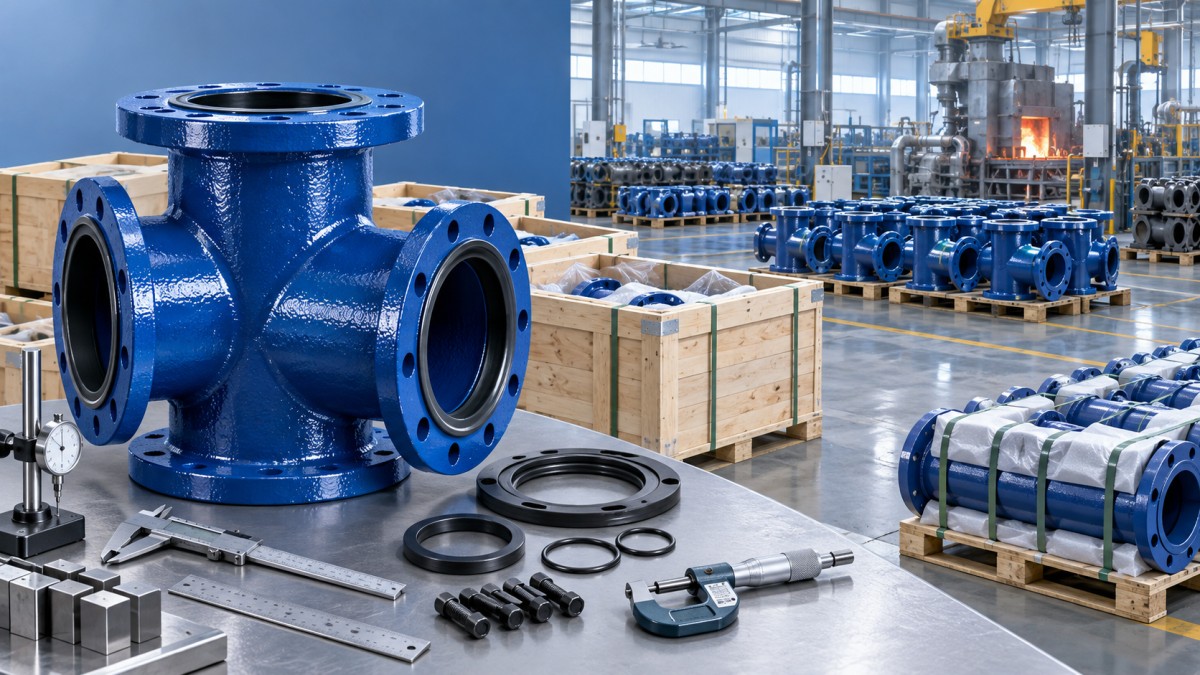
Quality evidence should be tied to the actual fitting being supplied. A supplier may hold relevant management credentials or provide material reports, but those documents alone do not prove that a particular production batch meets the project specification. Ask how the supplier controls incoming materials, molten iron, casting, heat treatment where required, dimensional inspection, hydrostatic or other specified testing, surface preparation, and coating application.
The answers are often more revealing than polished brochures. A capable manufacturer should be able to explain who approves drawings, how traceability is maintained, when inspection records are created, and how nonconforming castings are handled. If the project has mandatory standards, testing methods, or third-party witness requirements, include them in the RFQ rather than introducing them after the order is placed. Late quality requirements are a common reason for unexpected cost and missed shipment dates.
For buyers sourcing both fittings and pipe, system compatibility deserves separate review. The tee body may be sound, but an unsuitable gasket profile, socket geometry, flange arrangement, or coating interface can still create installation problems. Integrated production can simplify this review. Shanxi Datong Foundry Co.,Ltd., located in Chuandi Industrial Park, Zezhou County, combines smelting and casting processes while producing ductile iron pipes, fittings, and rubber sealing rings. For a buyer, that type of production scope can make technical coordination across connected components more direct; it does not remove the need to confirm the project specification.
Treat Lead Time as a Sequence of Commitments
“Four weeks” or “six weeks” is not a complete delivery answer. Clarify when the clock starts: receipt of deposit, drawing approval, pattern approval, raw-material availability, or final technical confirmation. For a standard three-way fitting, stock patterns and established production routing may support a shorter schedule. For a reducing tee, a large-diameter branch, special joint detail, or unusual coating, the critical path may include design review, pattern work, casting, finishing, inspection, curing, packing, and export dispatch.
Request a milestone schedule rather than a single shipment date. Useful milestones include drawing approval, pattern completion if needed, casting completion, inspection availability, coating completion, packing, and cargo readiness. This is not unnecessary administration. It gives the purchasing team an early warning if a technical clarification is holding the order before the promised ship date is already at risk.
A supplier’s communication pattern also matters. Delayed replies to drawing questions during quotation often become delayed answers during production. Evaluate whether technical and commercial contacts can provide consistent information, especially when dimensions or quantities change. Reliability is demonstrated in small exchanges long before the cargo is loaded.
Assess Capability for the Wider Pipeline Package
A tee order may be part of a broader underground utility, water transmission, or trenchless installation package. In those cases, the best fitting supplier is not always the supplier with the broadest catalogue; it is the supplier that can clearly define interfaces between components. Projects using jacking methods, for example, may require pipe products with different design and handling considerations from conventional open-cut pipelines. It is worth reviewing related options such as Custom Ductile Iron Jacking Pipes alongside the fitting schedule when procurement is coordinating an integrated pipeline scope.
This broader review can reduce fragmented responsibility. However, it should not force all items into one source if technical fit, delivery capacity, or commercial terms are weaker. Consolidation is useful only when it improves control over specifications, documentation, logistics, and accountability.
Make the Final Decision on Risk-Adjusted Cost
Before award, compare final candidates using the same weighted questions: Is the scope complete? Has the technical configuration been confirmed? Can the supplier show a credible manufacturing route? Are inspection requirements agreed? Is the delivery date linked to realistic milestones? Are packing and shipping responsibilities clear? A short written comparison is usually more useful than a long supplier presentation.
The right three-way fitting supplier is the one whose price, quality controls, and lead-time commitment remain consistent when the drawing is examined closely. Request the final technical confirmation before releasing the order, preserve agreed documents as part of the purchase record, and treat any unresolved interface as a commercial risk rather than a minor detail. That discipline is what keeps a fitting purchase from becoming a pipeline installation problem.
Navigation
Send Us A Message

First class quality service and professional after-sales team.
Get in Touch
*We respect your confidentiality and all information are protected.