Sizing Ductile Iron Pipe for Municipal Water Demand and Pressure Zones
Sizing Ductile Iron Pipe for Municipal Water Demand and Pressure Zones
Sizing ductile iron pipe correctly is critical to maintaining reliable flow, controlling pressure, and reducing lifecycle risk in municipal water systems.
For project managers, Ductile Iron Pipe for Municipal Water Projects should be selected using demand forecasts, pressure-zone requirements, elevation changes, surge conditions, installation constraints, and long-term operating priorities.
Start With the Decisions That Drive Pipe Size
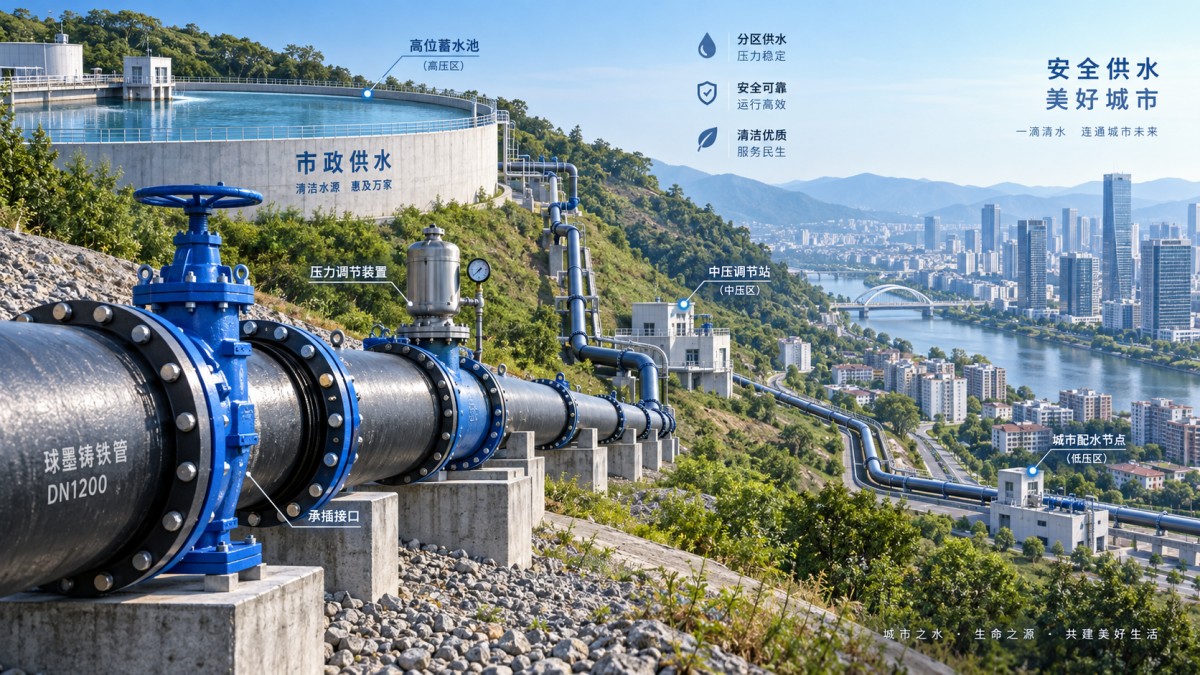
The correct diameter is not simply the largest affordable pipe or the smallest size that meets a preliminary flow calculation.
Project teams should begin by defining the system’s required service outcomes: daily demand, peak demand, fire flow, pressure consistency, water quality, expansion capacity, and acceptable operating costs.
For municipal networks, average demand provides only a starting point. The design must also account for peak-hour consumption, seasonal population variation, commercial demand, institutional users, and emergency supply requirements.
Project managers should confirm whether the pipeline is a transmission main, distribution main, pressure-zone feeder, reservoir connection, or fire protection supply line.
Each application has different hydraulic priorities. A transmission main may prioritize delivery volume, while a distribution line may require balanced pressure and reliable local service connections.
A practical design review should document the demand assumptions clearly. This prevents later disputes when a pipe diameter appears oversized, undersized, or inconsistent with projected development.
Future demand must be evaluated realistically. Oversizing without a credible growth basis can create low velocities, higher stagnation risk, and unnecessary capital expenditure.
Conversely, selecting a diameter based only on current consumption may require expensive parallel mains, pumping changes, or network rehabilitation sooner than expected.
Calculate Flow Requirements Before Selecting Nominal Diameter
Hydraulic sizing normally starts with the required design flow rate. This value should reflect the specific duty of the pipeline rather than a generic municipal allowance.
For distribution networks, engineers often assess average day, maximum day, and peak-hour demand. Fire flow requirements may govern in industrial districts, dense residential areas, or critical facilities.
For trunk mains, the required flow may be based on reservoir filling cycles, treatment plant output, interconnection transfers, or planned supply to developing pressure zones.
Velocity targets should be considered alongside flow. Excessive velocity increases headloss, energy consumption, noise, transient exposure, and wear at fittings, valves, and bends.
Very low velocity can also be undesirable, particularly where water residence time, sediment deposition, or chlorine residual management affects service quality.
The final diameter should therefore be checked under several operating scenarios. These include normal demand, peak demand, low demand, fire flow, pump failure, and alternate supply conditions.
For Ductile Iron Pipe for Municipal Water Projects, this multi-scenario approach gives decision makers a more reliable basis than a single steady-state calculation.
Hydraulic modeling software can help compare alternatives, but its output is only as reliable as the demand data, elevation survey, roughness assumptions, and boundary conditions provided.
Design Pressure Zones Around Real Elevation and Operating Conditions
Pressure-zone planning is often the factor that determines whether a pipe class, valve arrangement, or separate supply main is appropriate for a municipal project.
Elevation differences can create substantial static pressure variation. A pipeline serving low-lying areas may experience pressures far above those measured near an elevated reservoir or service boundary.
Project managers should request a pressure profile along the route, not merely a pressure value at the source or endpoint.
The profile should include reservoir levels, pump operating points, high points, low points, proposed connections, pressure reducing valves, and anticipated future zone extensions.
Static pressure, working pressure, and transient pressure are different design considerations. A pipe that performs adequately during normal operation may still be exposed during shutdown or valve events.
Where pressure zones are separated by pressure reducing valves, the team should verify downstream minimum pressure during peak flow and upstream maximum pressure during low demand.
This is particularly important when future development could increase elevation range or alter the balance between zones.
Clear zone boundaries also improve operations. They simplify pressure management, leakage monitoring, district metering, emergency isolation, and phased network expansion.
Choose Wall Thickness Class for Pressure, Loads, and Installation Risk
Nominal diameter alone does not define pipeline suitability. Wall thickness class must be selected according to internal pressure, surge allowance, external loading, trench conditions, and installation practices.
Ductile iron pipe is available in classifications such as K7, K8, K9, K12, C25, C30, and C40, depending on applicable standards and project requirements.
Higher pressure ratings are not automatically the correct choice everywhere. The selected class should correspond to the actual design envelope and documented risk conditions.
Internal pressure considerations include normal operating pressure, pump shutoff conditions, pressure reducing valve behavior, and expected surge levels from rapid operational changes.
External load considerations include cover depth, traffic loading, rail crossings, poor bedding, trench width, rock excavation, groundwater, and possible future surface upgrades.
A project specification should also identify locations requiring special attention. These may include bridge crossings, deep trenches, high-pressure pump discharge sections, and areas prone to settlement.
For a balanced option, Ductile Iron Pipe K9C40C30C25 can be evaluated against the project’s pressure profile, installation conditions, and relevant ISO, EN, or AWWA requirements.
Material strength supports this risk-based approach. Spheroidal graphite ductile iron commonly provides tensile strength of at least 420 MPa and yield strength of at least 300 MPa.
Include Surge Analysis Before Finalizing the Specification
Pressure surge is one of the most overlooked risks in water pipeline sizing. It can result from pump trips, power loss, valve closure, pump starts, or rapid flow changes.
Even a pipeline with moderate normal operating pressure can experience damaging transient conditions if the system response is not properly evaluated.
Surge analysis should consider pipe length, elevation profile, flow velocity, pump characteristics, valve operating time, air valve performance, and available surge protection measures.
Air release and vacuum valves deserve particular attention at high points. Incorrect sizing or placement can contribute to column separation, vacuum conditions, or damaging pressure recovery.
Project managers should ensure the surge study informs both pipe class selection and appurtenance design. Treating them as separate decisions can leave critical vulnerabilities unresolved.
Where surge exposure is substantial, options may include controlled valve closure, surge vessels, non-slam check valves, bypass arrangements, pressure relief devices, or adjusted pumping strategies.
The cost of these measures should be assessed against the potential consequences of pipe rupture, service interruption, road damage, property claims, and emergency repair work.
Evaluate Lifecycle Cost Instead of Purchase Price Alone
Municipal water projects are typically judged over decades of operation. Pipe selection should therefore compare total installed and lifecycle cost, not material purchase price alone.
Relevant cost elements include excavation, bedding, hauling, jointing, fittings, thrust restraint, corrosion protection, testing, restoration, maintenance, energy use, and expected service life.
Ductile iron systems can provide operational value through structural integrity, leak-resistant joint systems, compatibility with fittings, and resilience under external loads.
Socket-and-spigot joint configurations can also support practical field installation, particularly where route conditions require gradual alignment adjustments or restrained joint design.
For aggressive soils or unusual groundwater conditions, the project should evaluate corrosion protection requirements early. Delayed decisions can affect procurement, construction schedules, and installed cost.
Specification compliance matters as well. Standards such as ISO 2531, EN 545, EN 598, and AWWA C151/C150 provide important references for dimensions, performance, and quality expectations.
When suppliers are compared, project teams should confirm the available DN range, standard pipe lengths, coating options, rubber sealing ring quality, testing records, and documentation traceability.
Create a Clear Approval Checklist Before Procurement
Before issuing procurement documents, consolidate the hydraulic model outputs, pressure-zone profile, surge results, soil data, route constraints, and construction methodology into one review package.
The package should state required diameters, pressure ratings, wall thickness classes, joint types, lining and coating requirements, fittings, valves, testing obligations, and acceptance standards.
It should also distinguish between standard route sections and exceptional locations. This helps avoid blanket over-specification while maintaining adequate protection where risks are higher.
For pipes ranging from DN80mm to DN2600mm, confirm that selected lengths, such as 5.5 m, 6 m, or project-specific cut lengths, fit transport and installation plans.
Construction teams should verify trench geometry, bedding material, compaction procedures, thrust restraint locations, and access requirements before pipe delivery begins.
Finally, ensure the supplier can support the required schedule and quality controls. Manufacturing capability should cover pipe, fittings, sealing rings, inspection, and traceable compliance documentation.
Conclusion: Size for the Whole Operating Envelope
Successful municipal pipe sizing combines demand forecasting, hydraulic calculations, pressure-zone planning, surge control, structural assessment, and lifecycle cost evaluation into one coordinated decision.
For project managers, the strongest specification is one that explains why each diameter and pressure class is required under realistic present and future operating conditions.
Ductile Iron Pipe for Municipal Water Projects delivers the greatest value when it is matched to the full operating envelope, rather than selected from nominal flow alone.
By documenting assumptions early and checking exceptional conditions before procurement, teams can reduce change orders, improve network reliability, and protect long-term municipal investment.
Navigation
Send Us A Message

First class quality service and professional after-sales team.
Get in Touch
*We respect your confidentiality and all information are protected.