Three-Way Fittings: When to Use Tee, Wye, or Lateral Pipe Connections
A three-way fitting should be selected from the flow path outward, not from the drawing symbol inward. A tee, wye, and lateral can all connect one main pipe to a branch line, but they impose different changes in direction, require different installation space, and create different hydraulic and operational consequences. The wrong choice may still fit physically, yet create unnecessary headloss, sediment-prone zones, difficult valve access, or a layout that conflicts with thrust restraint and maintenance clearances.
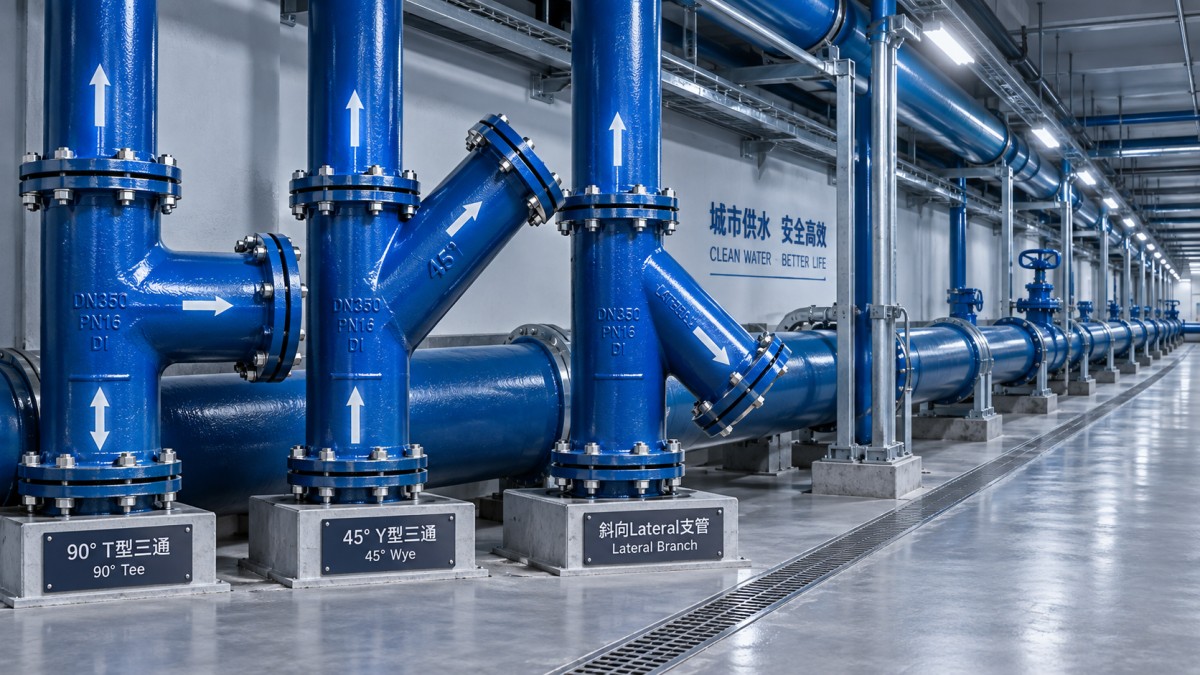
For ductile iron water networks, the first distinction is straightforward: use a tee where the branch must leave the main at approximately 90 degrees; use a wye where flow should divide or merge through a smoother angled path; use a lateral where the branch angle is driven by route geometry rather than a standard perpendicular or symmetrical split. The detail behind that distinction determines whether the selected fitting supports the project’s hydraulic, construction, and lifecycle requirements.
A tee is a layout fitting before it is a hydraulic fitting
A tee creates a branch at right angles to the run pipe. It is normally the practical choice when a distribution main must feed a side street, service zone, hydrant lead, process line, or valve chamber located perpendicular to the transmission or distribution route. In buried municipal work, that geometry often matches road grids and plot boundaries, which is why tees remain common even where an angled connection would produce a gentler flow transition.
The principal limitation is the abrupt turn. Water entering the branch must change direction sharply, while flow continuing through the run passes the branch opening. This generates greater local turbulence than an angled branch and can produce a higher minor loss coefficient. That loss is not automatically decisive: on a short branch with low or intermittent flow, it may have little influence on system performance. It matters more when the branch carries substantial continuous flow, when available pressure is limited, or where pumps must overcome cumulative losses across a long network.
A tee also deserves closer review where reverse flow, frequent flow reversals, or transient conditions are expected. The branch and run should not be treated as hydraulically equivalent simply because their nominal diameters are similar. The design calculation needs the intended flow direction, branch demand, valve position, and operating scenarios. For a large branch on a transmission main, the tee’s geometry may affect pressure distribution enough to justify a different arrangement or a more gradual transition.
From an execution standpoint, the tee is often the least complicated three-way fitting to set out. Its branch orientation is easy to establish, and perpendicular connections can simplify chamber layouts. But the apparent simplicity can conceal a restraint issue. Internal pressure acts on the branch and changes in pipe direction create unbalanced forces. Joint restraint, thrust blocks, or other approved anchoring arrangements must be designed for the actual fitting configuration, pressure class, soil conditions, and any possibility of test pressure exceeding normal operating pressure.
Why a wye is not simply a “better tee”
A wye joins or separates flow through angled legs, commonly around 45 degrees, although the available configuration depends on the fitting system and project specification. Its smoother path reduces the severity of directional change compared with a 90-degree tee. That makes it useful where a branch is expected to carry meaningful flow and the physical route can accommodate the angle.
Typical applications include a pipeline split that follows diverging corridors, a gravity-related arrangement where smoother merging is important, or a pressurized network where reducing local disturbance is worth the additional footprint. For water transmission work, a wye can be preferable when a branch is not merely a small take-off but an operationally significant line that must receive or return flow with manageable energy loss.
However, a wye changes the civil layout. A 45-degree branch extends farther along the main than a tee branch and may intrude into a road crossing, easement boundary, valve pit, or utility separation zone. It can also move valves and maintenance points away from the location assumed in the original plan. A hydraulic improvement does not justify a fitting that forces unacceptable excavation width, conflicts with existing utilities, or prevents access to isolation valves.
The term “wye” can also be misleading in procurement documents. Some parties use it broadly for any angled branch, while manufacturers and standards may distinguish between equal wyes, reducing wyes, and specific angle fittings. Drawings should state the nominal diameters of run and branch, required angle, end connection type, pressure requirement, coating or lining requirement, and relevant standard—not merely identify a component as a wye.
Laterals solve alignment problems, but the angle must be specified
A lateral is an angled branch fitting used when the branch does not leave the main at 90 degrees. In many specifications, “lateral” refers particularly to a 45-degree branch, but the word alone is not sufficient engineering information. A project may require a 30-degree, 45-degree, or other defined branch angle to align with a corridor, avoid an obstacle, enter a chamber, or connect to a line that cannot be repositioned.
The practical value of a lateral is that it can reduce the number of bends needed to reach the branch alignment. Fewer fittings may shorten installation time, reduce joint count, and simplify the restraint arrangement. Yet this benefit should be confirmed against the actual chainage and elevation profile. An angled branch can solve a plan-view conflict while creating an elevation problem, especially where cover depth, crossing clearance, or air-release requirements are tight.
Laterals are often selected late in design after a utility clash is identified. That is risky if the replacement is treated as a drafting adjustment. Changing a tee to a lateral changes branch centerline location, available spool length, valve position, excavation geometry, and thrust direction. It may also require revised pipe-cut lengths and shop drawings. The decision should therefore be closed before material release, not left for field improvisation.
Evaluate the fitting in the direction of actual flow
Three-way fitting selection becomes more demanding where the pipeline can operate in more than one direction. A configuration that works well as a diverging branch may be less favorable when two flows merge, particularly at unequal velocities. The design team should identify normal flow, emergency supply direction, flushing direction, pump duty cases, and any planned interconnection use. This is especially important for systems designed for sectional isolation, because a branch that is normally a low-flow spur may become a supply route during maintenance or outage conditions.
Hydraulic modelling should include fitting losses where the branch is material to pressure performance. Generic loss assumptions should not be transferred without checking that they represent the relevant geometry, flow split, and flow direction. The difference between an equal tee, reducing tee, wye, and lateral is not limited to the branch angle; diameter ratio and velocity distribution also influence local losses.
Material compatibility is a project-control issue
For ductile iron pipelines, the fitting must match the pipe system at the joint as well as in nominal size. Confirm socket, flange, mechanical joint, or restrained-joint compatibility; pipe outside diameter range; gasket type; coating and lining; pressure class; and corrosion-protection requirements. A fitting that is dimensionally close but outside the specified system can disrupt installation sequencing or require unplanned transition pieces.
This is particularly relevant when connecting Ductile Iron Water Pipe to a branch with different diameter, pressure duty, or end connection. A reducing branch is not an afterthought. The reduction should be assessed with the expected branch velocity, valve arrangement, and maintenance requirement in mind. An undersized branch may satisfy a short-term demand calculation while creating excessive velocity or limited future operating flexibility.
Standards referenced in project documents should be followed exactly. Depending on the market and system, ductile iron pipes and fittings may be specified under standards such as ISO 2531, EN 545, AWWA C110/A21.10, or AWWA C153/A21.53. These references do not remove the need to verify the actual fitting dimensions, allowable pressure conditions, and joint details. Mixing components from different standard families without a documented compatibility review is a recurring source of site delay.
The decision should be made before the bill of materials is frozen
A useful decision sequence begins with the branch function. If the branch is perpendicular and hydraulically modest, a tee is generally the direct solution. If a substantial flow must divide or merge on an available diagonal route, a wye deserves evaluation. If the route dictates a specific non-perpendicular departure, a lateral may eliminate unnecessary bends, provided its exact angle and all downstream geometry are defined.
Before approval, the selected three-way fitting should be checked against four drawing realities: the hydraulic duty in both normal and contingency operation; the physical branch centerline and elevation; valve, chamber, and access requirements; and the restraint design at the fitting. That review is more valuable than choosing based on the fitting’s initial unit cost. The least expensive component can become the costliest option if it produces an avoidable chamber redesign, additional fittings, difficult installation, or persistent hydraulic restriction.
Tees, wyes, and laterals are not interchangeable symbols. They are decisions about how the pipeline will carry flow, absorb pressure forces, occupy the site, and remain serviceable after the trench is closed.
Navigation
Send Us A Message

First class quality service and professional after-sales team.
Get in Touch
*We respect your confidentiality and all information are protected.