Potable Water Compliance Checks for Municipal Ductile Iron Pipe Systems
Potable-water compliance for municipal ductile iron pipe systems begins with a controlled chain of evidence: the pipe body, lining, external coating, fittings, gaskets, valves, storage conditions, and installation records must all support the intended drinking-water service. A pipe can meet dimensional and pressure requirements while still creating a potable-water concern through an unsuitable lining, contaminated gasket storage, damaged coating, or unverified repair material.
For Ductile Iron Pipe for Municipal Water Projects, compliance should be evaluated as a system condition rather than a document attached to a shipment. Product documentation establishes the starting point, but receiving inspection and installation controls determine whether the materials remain suitable before the network is placed into service.
Start with the wetted surfaces
The internal surfaces in contact with drinking water require the closest review. For cement-mortar-lined ductile iron pipe, inspect the lining for continuity, curing condition, adhesion, and damage at cut ends, spigots, and field-modified sections. A sound-looking lining can still be unsuitable if it has been contaminated by fuel, oil, soil, standing water, or unapproved repair compounds during transport or handling.
Small defects should not be assessed by appearance alone. A shallow surface mark may be limited to the lining face, while a crack that reaches the metal substrate creates a different concern. The repair method must match the lining system and the service condition. Applying a generic coating or mortar without confirming its compatibility with potable water can introduce an avoidable compliance gap, even when the repair restores a smooth surface.
Where the pipe has an alternative internal lining, confirm that the lining designation matches the design water chemistry and disinfection regime. Water chemistry affects more than corrosion behavior. Parameters such as pH, alkalinity, disinfectant residual, temperature, and stagnation time can influence lining stability, surface condition, and the release behavior of materials in contact with water. A lining appropriate for one treatment and operating profile should not be assumed appropriate for every municipal supply.
Documentation must identify the delivered material
Mill records, material declarations, coating records, gasket information, and traceability marks should be linked to the actual pipe, fitting, or accessory received. Batch-level documentation loses value when lot numbers cannot be connected to individual delivery units or when mixed stock is unloaded without segregation.
Traceability is especially important for fittings and rubber sealing rings because they are often unpacked, stored separately, and introduced into the installation sequence later. A gasket that has the correct nominal size is not automatically the correct gasket for potable-water duty. Verify its stated application, material identification, storage status, and compatibility with the joint geometry. Rings exposed to direct sunlight, petroleum products, excessive heat, or deformation in storage should be isolated until their condition is assessed.
The review should also distinguish between documents that address mechanical performance and those that address contact with drinking water. Pressure class, tensile strength, and hydrostatic test records do not by themselves establish that all wetted materials are suitable. Conversely, a potable-water declaration does not replace confirmation of wall thickness, joint dimensions, or pressure capability.
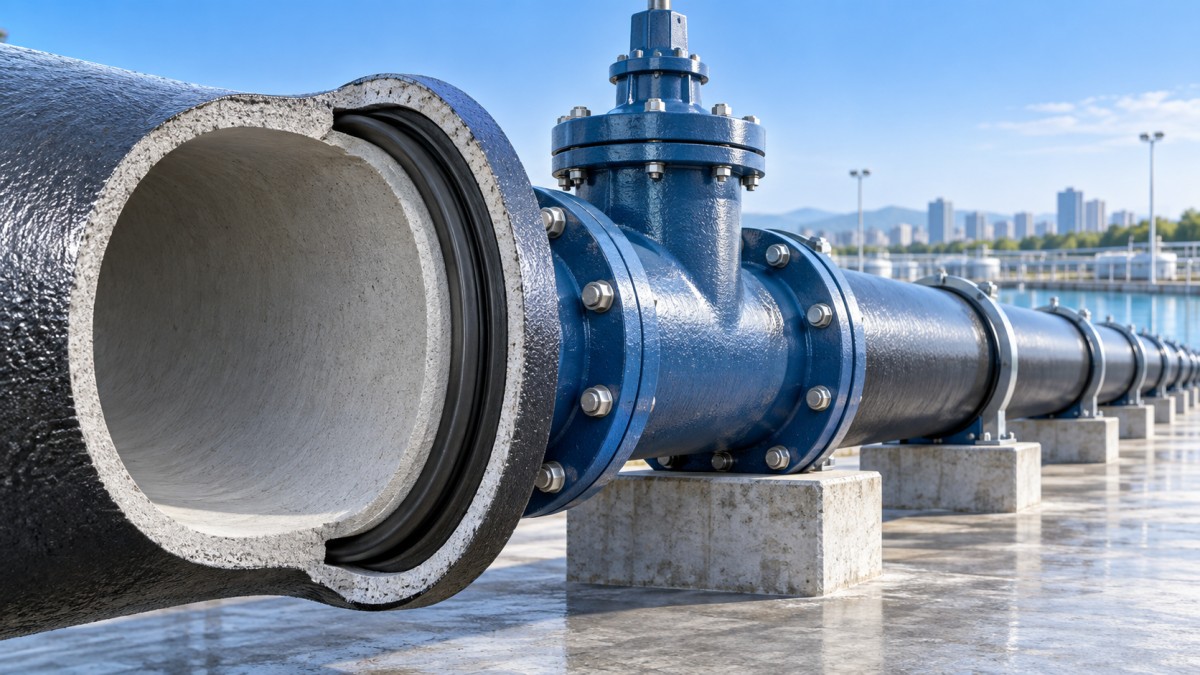
Coatings protect the pipe but can create inspection blind spots
External coatings are not normally a drinking-water contact surface, yet their condition remains relevant to potable-water reliability. Corrosion damage that progresses to wall loss or joint distress can lead to leakage, pressure instability, and conditions that increase the chance of intrusion from surrounding soil or groundwater. The compliance connection is indirect, but it is real.
Inspect coating damage with attention to location. Damage on the barrel may be repairable under the specified field procedure; damage at a socket, spigot, joint restraint area, or fitting interface can affect assembly or leave a difficult-to-protect zone. Loose coating, embedded grit, moisture trapped under wrapping, and unapproved touch-up materials deserve more scrutiny than superficial abrasion on an accessible barrel section.
Do not confuse a visually continuous external coating with adequate corrosion protection for the installed environment. Soil resistivity, moisture, chlorides, stray current exposure, and the selected protection system affect the result. These site conditions belong in the installation record because they explain why an otherwise acceptable delivery may require supplemental protection or a different repair decision.
Joint integrity is a potable-water control point
Municipal ductile iron joints are designed to seal under defined geometry, cleanliness, lubrication, and insertion conditions. Dirt in the gasket seat, an incorrectly seated ring, excessive lubricant, a damaged spigot, or an insertion depth outside the marked range can create a leak path or reduce joint reliability. The problem may remain hidden until pressure testing, backfill movement, or a later pressure transient.
Lubricant selection requires the same discipline as gasket selection. The product used during assembly must be suitable for the joint system and drinking-water application. Substituting an available grease, oil, or general-purpose assembly compound can damage elastomeric components or introduce substances that do not belong in the water-contact environment.
At connections involving valves, fittings, restrained joints, or transitions to other pipe materials, confirm the interface rather than relying on nominal diameter alone. Bolt patterns, flange faces, gasket type, restraint components, and torque practices must correspond to the actual assembly. A nominally compatible connection can fail when component standards, pressure ratings, or face configurations differ.
A branch arrangement that includes a Fully Encapsulated True 3-Way Valve should be reviewed as part of the complete hydraulic and hygienic assembly. Confirm the valve's flow path, sealing interfaces, end connections, and accessible cleaning or commissioning requirements against the approved system design. Encapsulation does not remove the need to verify the materials and cavities that will contact potable water.
Receiving inspection should separate transport damage from manufacturing issues
Inspect each delivery before it becomes mixed with accepted stock. Check pipe ends for chips, cracks, distortion, lining damage, foreign material, and moisture accumulation. Examine fittings for damaged faces, incomplete coating coverage at functional surfaces, and impact marks around flanges or sockets. Packaging should protect gaskets from ultraviolet exposure and contamination, but packaging alone is not proof that the contents remain clean and undamaged.
- Pipe identification: record the markings that connect each group of pipes to its diameter, class, lining, coating, and production traceability.
- Cleanliness: reject or quarantine components containing soil, animal matter, oily residues, loose debris, or pooled water that cannot be removed under the approved cleaning procedure.
- End protection: confirm that caps or plugs remained in place where specified; missing protection is a prompt for internal inspection, not an automatic conclusion that the pipe is unusable.
- Segregation: keep accepted potable-water components away from non-potable materials, cutting areas, fuel storage, and repair compounds until installation.
Field cutting and repairs need explicit acceptance criteria
Field cuts remove factory-prepared surfaces and may expose bare metal or interrupt the lining. The cut must be square enough for the selected connection, thoroughly cleaned, and treated using an approved method for the pipe system. Grinding dust and metal filings should not remain inside the pipe. Before closing the joint, inspect the bore under adequate light rather than assuming that flushing will remove all debris.
Repair records should state the location, defect type, material used, surface preparation, curing conditions where relevant, and inspection result. This level of detail matters when repairs occur at several points over a project. Without it, later investigations cannot distinguish between a factory condition, handling damage, and a field-applied repair.
Commissioning confirms the assembled system, not just the components
Pressure testing demonstrates structural and joint performance under the approved procedure, but it does not replace cleaning, flushing, disinfection, and water-quality verification where these are required. These activities serve different purposes. A system may pass pressure testing while retaining construction debris, stagnant water, or disinfectant conditions that require further control before the line enters potable service.
Dead ends, temporary bypasses, valve chambers, branch connections, and sections with delayed completion deserve particular attention because they can retain water or debris longer than the main run. Sequence the commissioning work so that temporary materials are removed, connections are finalized, flushing routes are established, and sampling points represent the water that will enter service.
The final acceptance file should preserve the link between approved materials, receiving observations, field modifications, test records, cleaning and disinfection documentation, and any outstanding corrective actions. That record supports future maintenance decisions and provides a defensible basis for confirming that the ductile iron pipeline was installed as a potable-water system rather than merely assembled as a pressure pipeline.
Navigation
Send Us A Message

First class quality service and professional after-sales team.
Get in Touch
*We respect your confidentiality and all information are protected.