Understanding EN 545 Ductile Iron Pipe Requirements for Drinking Water Networks
For quality control and safety professionals, EN 545 ductile iron pipe compliance is a practical safeguard for drinking water quality, network reliability, and project accountability.
The standard is not simply a material specification. It creates a verification framework covering pipe performance, factory controls, protective systems, joints, markings, documentation, and acceptance testing.
When procurement teams treat EN 545 as a checklist rather than an integrated system, hidden risks can enter the project through incompatible components or weak inspection evidence.
The most important conclusion is straightforward: compliant pipe must be assessed as a complete pressure-pipeline product, not only by wall thickness, price, or nominal diameter.
Quality teams should therefore confirm the applicable EN 545 edition, project-specific requirements, supplier capabilities, and traceable inspection records before releasing products for installation.
This approach reduces the likelihood of coating failure, leakage, water contamination concerns, premature corrosion, and disputes over whether supplied materials meet contractual drinking water requirements.
What EN 545 Requires From a Drinking Water Pipeline
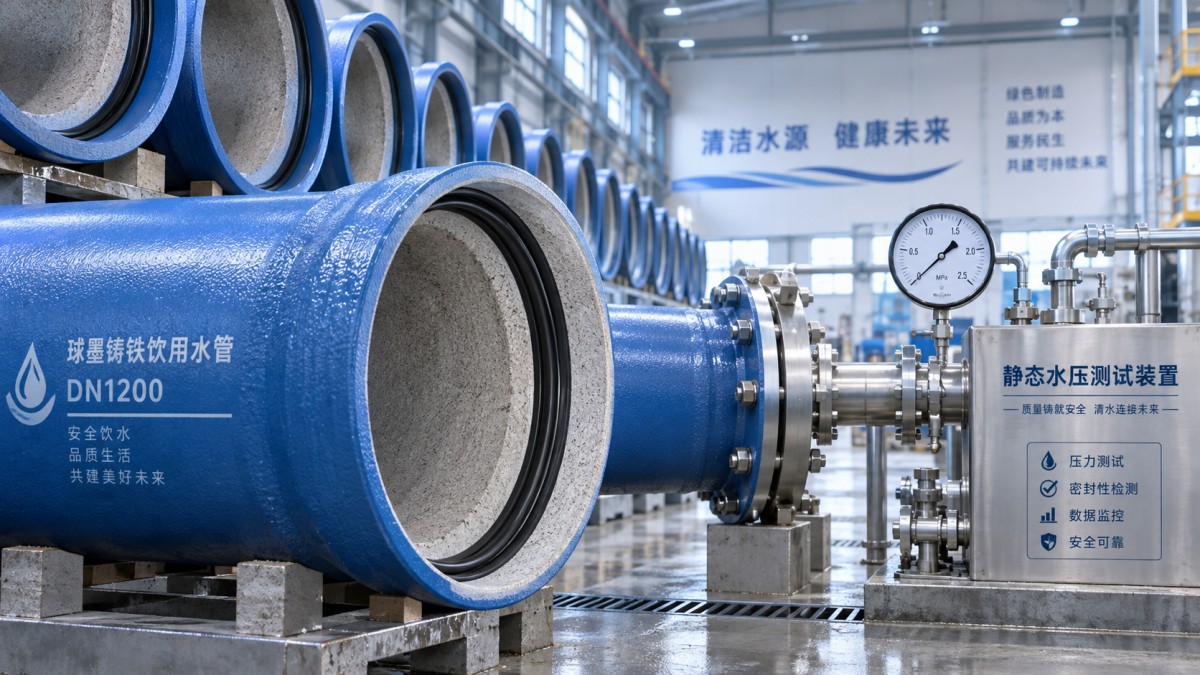
EN 545 specifies ductile iron pipes, fittings, accessories, and joints intended for water pipelines. Its focus includes service performance under internal pressure and operational conditions.
For drinking water networks, the standard helps purchasers define consistent technical expectations where pipes must resist pressure, ground loads, handling damage, corrosion, and long-term operational stresses.
It also establishes common terminology and requirements that allow municipalities, contractors, consultants, and manufacturers to compare products using documented and repeatable acceptance criteria.
However, EN 545 compliance alone does not replace the project specification. Local water regulations, utility standards, soil conditions, pressure ratings, and installation methods may add requirements.
Quality personnel should review the complete procurement package, ensuring that pipe class, diameter, joint type, lining, coating, fittings, gaskets, and testing obligations are aligned.
A supplier statement without supporting records is insufficient. The buyer should be able to connect every delivered product batch to defined production, inspection, and conformity evidence.
Material Quality: Verify the Ductile Iron Before Looking at Surface Finish
Ductile iron provides the strength and toughness needed for buried water infrastructure, but these benefits depend on controlled chemical composition, metallurgical treatment, and casting consistency.
EN 545 ductile iron pipe requirements address mechanical characteristics that demonstrate the material can tolerate normal service loads, installation handling, and certain ground movement conditions.
Quality inspectors should request test evidence for tensile strength, elongation, and other required mechanical properties. These values should correspond with the supplied product and production lot.
Visual appearance cannot prove metallurgical compliance. A smooth-looking pipe may still have internal defects, unsuitable material properties, or inadequate process control that affects service reliability.
Inspection plans should include review of melt records, test sampling methods, test frequency, laboratory equipment calibration, and procedures for handling nonconforming castings.
Traceability is particularly important when projects involve multiple sizes or pressure classes. Clear markings and batch identification prevent accidental mixing of products with different specifications.
Dimensions, Pressure Class, and Wall Thickness Need Project-Level Checks
Pipe dimensions influence joint compatibility, hydraulic capacity, installation clearances, thrust design, and the pipe’s ability to withstand internal pressure and external loading.
Do not assume that a larger wall thickness automatically means a suitable product. The selected pressure class must match operating pressure, surge pressure, installation depth, and design assumptions.
Inspectors should compare nominal diameter, outside diameter, effective length, socket geometry, and wall thickness tolerances against approved drawings and the relevant EN 545 requirements.
Dimensional verification should use calibrated instruments and defined sampling frequencies. Measurements taken only from one visible pipe end cannot establish batch-wide conformity.
Particular attention is needed at spigots and sockets, where dimensional deviation can compromise joint assembly, gasket seating, insertion depth, and eventual leak-tightness.
Where trenchless construction applies, loading conditions differ from conventional open-cut installation. Products such as Custom Ductile Iron Jacking Pipes should be evaluated against the specific jacking design.
Jacking forces, alignment tolerances, intermediate stations, lubrication methods, and ground conditions may require additional engineering checks beyond standard water-pipe dimensional acceptance.
Internal Linings Protect Water Quality and Hydraulic Performance
Internal lining is a major quality-control concern because it separates the conveyed drinking water from the iron substrate and supports stable hydraulic performance over time.
Cement mortar lining is widely used for ductile iron drinking water pipes. Its quality depends on correct application, thickness, curing, surface continuity, and resistance to damage.
Inspectors should look for incomplete coverage, cracking, soft areas, poor adhesion, excessive roughness, or damage around pipe ends that may require repair before installation.
The approved lining must be compatible with the expected water chemistry. Aggressive water conditions can require a different lining system or additional protective measures.
Project documents should identify whether the lining material has appropriate drinking water contact approvals for the destination market and the utility’s stated regulatory framework.
Field handling is equally important. Dropping pipes, dragging spigots, or using unsuitable lifting equipment can damage internal lining after factory inspection has already been completed.
Receiving inspections should therefore include representative internal visual checks, photo documentation, and a clear process for evaluating and repairing acceptable localized damage.
External Coatings Must Match Soil and Installation Conditions
External protection prevents corrosion of the pipe body in contact with soil, groundwater, backfill, and potentially corrosive environmental conditions throughout its service life.
EN 545 commonly addresses external coating systems, but the appropriate selection depends on the site. Normal soils and highly aggressive soils do not present identical risks.
Quality and safety teams should review the soil investigation, resistivity data, moisture conditions, stray current risk, chloride exposure, and utility corrosion policy before approving protection systems.
Common acceptance checks include coating coverage, continuity, uniformity, adhesion, thickness where applicable, and the absence of bare metal, blistering, severe scratches, or handling damage.
Polyethylene sleeving or enhanced coating systems may be specified as additional protection. Their effectiveness depends heavily on correct installation and avoidance of tears or gaps.
Site inspectors should document coating repairs before burial. Once the pipe is backfilled, defects are difficult to identify and expensive to correct.
Joints, Rubber Gaskets, and Fittings Are Critical Leakage Controls
A compliant pipe body cannot compensate for an improperly selected or installed joint. Joint performance is central to leakage prevention, hygiene, and network resilience.
EN 545 ductile iron pipe systems commonly use flexible push-in joints, but project requirements may also include restrained, flanged, mechanical, or other specialized connections.
Rubber sealing rings must be compatible with drinking water service and the joint design. Verify gasket type, size, storage condition, certification, and manufacturing traceability.
Before assembly, crews should clean sockets, spigots, and gasket grooves. Dirt, stones, excess lubricant, or damaged surfaces can prevent the gasket from seating correctly.
Inspectors should confirm insertion marks, allowable joint deflection, lubrication practice, and alignment. Excessive deflection can create stress concentrations or compromise sealing performance over time.
Fittings require the same level of control as pipes. A mismatch in pressure rating, coating, lining, flange drilling, or joint geometry can create a weak point.
Receiving documentation should identify fittings separately, rather than treating them as minor accessories. They often represent the most complex components in a distribution network.
Factory Testing, Marking, and Documentation Should Be Auditable
Testing verifies that manufacturing controls translate into reliable products. Quality professionals should understand both the required tests and the records that prove they were completed.
Hydrostatic pressure testing is a key control for identifying leakage or structural weakness before shipment. Test parameters should be traceable to pipe size and class.
Inspection records should also cover visual examination, dimensional checks, lining and coating controls, mechanical testing, and any applicable joint or gasket verification activities.
Each pipe should carry durable identification markings that support receiving inspection. Markings commonly help confirm manufacturer identity, standard reference, diameter, class, and production traceability.
Documentation review should compare purchase-order requirements with certificates, test reports, packing lists, and actual product markings. Inconsistencies should trigger quarantine and clarification.
Supplier quality assessments are more reliable when they examine process capability, calibration controls, personnel competence, corrective-action history, and control of subcontracted materials.
A Practical Receiving and Installation Inspection Workflow
At delivery, first verify quantities, product identity, visible condition, and document completeness. Separate damaged or questionable items before they can be issued to installation crews.
Use a risk-based sampling plan for dimensions, coating condition, lining integrity, gasket identification, and markings. Increase sampling when lots, suppliers, or transport conditions change.
Record nonconformities with photographs, pipe identification, location, description, and disposition. Clear evidence supports supplier discussions and prevents unauthorized use of rejected materials.
Before trench installation, confirm that excavation, bedding, lifting equipment, and handling methods follow the approved method statement and do not damage protective systems.
During jointing, verify cleanliness, gasket placement, lubrication, alignment, and insertion depth. During pressure testing, monitor test pressure, duration, leakage observations, and safety controls.
Final handover records should include installed locations, pipe and fitting traceability, pressure-test results, repair records, disinfection evidence where required, and approved deviations.
Conclusion: Treat EN 545 Compliance as a Controlled Quality System
For drinking water networks, EN 545 ductile iron pipe selection should be based on verified material quality, dimensions, protective systems, joint integrity, and documented test evidence.
The strongest quality outcome comes from linking factory approval, receiving inspection, installation supervision, and final records into one traceable control process.
When these checks are applied consistently, quality and safety teams can make defensible acceptance decisions while protecting public health, reducing leakage risk, and supporting long-term network performance.
Navigation
Send Us A Message

First class quality service and professional after-sales team.
Get in Touch
*We respect your confidentiality and all information are protected.