Which EN 545 Ductile Iron Pipe Pressure Class Fits an Urban Water Main?
Which EN 545 Ductile Iron Pipe Pressure Class Fits an Urban Water Main?
Selecting the pressure class for an urban water main is rarely a matter of choosing the highest available rating and moving on. That approach may look safe on paper, but it can add unnecessary material cost, complicate procurement, and create mismatches with fittings, valves, restrained joints, or existing network sections. The better question is whether the selected EN 545 ductile iron pipe can carry the real pressures the system will experience throughout its operating life.
For project managers, the difficult part is that “pressure” is not one number. A main may operate at a relatively stable pressure most of the day, then see a sharp transient after a pump trip, valve closure, or sudden demand change. It may also serve low-lying districts where static head is higher than at the treatment plant outlet. A pipe class that appears adequate against normal operating pressure can become a weak point once surge conditions and local elevation are properly considered.
EN 545 provides the framework for ductile iron pipes, fittings, accessories, and joints used in water pipelines. However, the final pipe designation should be read together with the project’s diameter, pressure design basis, joint configuration, external loading conditions, protection system, and local utility requirements. Pressure class selection is an engineering decision, not simply a catalogue decision.
Start with the pressure envelope, not the nominal pressure
The operating pressure shown on a hydraulic schematic is only the starting point. Before confirming an EN 545 ductile iron pipe class, the design team should establish the highest credible pressure at each relevant section of the route. This usually includes normal working pressure, static pressure caused by elevation differences, pressure during pump operation, and expected transient pressure.
In a gravity-fed zone, the critical location may be the lowest point in the network rather than the point nearest the source. In a pumped transmission main, the highest stress may occur close to a pump station or downstream of a fast-acting valve. Long mains with significant elevation changes should not be treated as though every chainage has the same pressure requirement.
A useful project habit is to request a pressure profile, rather than relying only on a single system pressure value. This profile makes it easier to identify sections that may require a different class, a different restraint arrangement, or closer review of fittings and appurtenances. It can also prevent over-specifying the entire line because of one localized high-pressure area.
Surge pressure is often where a seemingly reasonable choice fails
Water hammer is sometimes treated as a specialist issue to be solved later. On urban projects, that can be risky. Fast valve operation, pump failure, emergency isolation, automatic control sequences, and air movement in the main can all affect transient behavior. A reliable pressure-class decision should therefore be based on the agreed maximum allowable pressure condition, not solely on routine service pressure.
The exact surge calculation should be prepared by the hydraulic or pipeline designer when the system warrants it. Project managers do not need to perform that analysis themselves, but they should make sure it is not omitted from the specification process. If the surge study is pending, it is sensible to flag the pipe class as provisional rather than locking in a purchase order too early.
It is also worth checking whether surge protection measures are genuinely part of the delivered system. A design may assume controlled valve closure, surge vessels, air valves, or pump controls. If these items are removed during value engineering or altered during commissioning, the pressure basis for the pipeline may no longer hold.
Pipe pressure class is not a substitute for checking installation loads
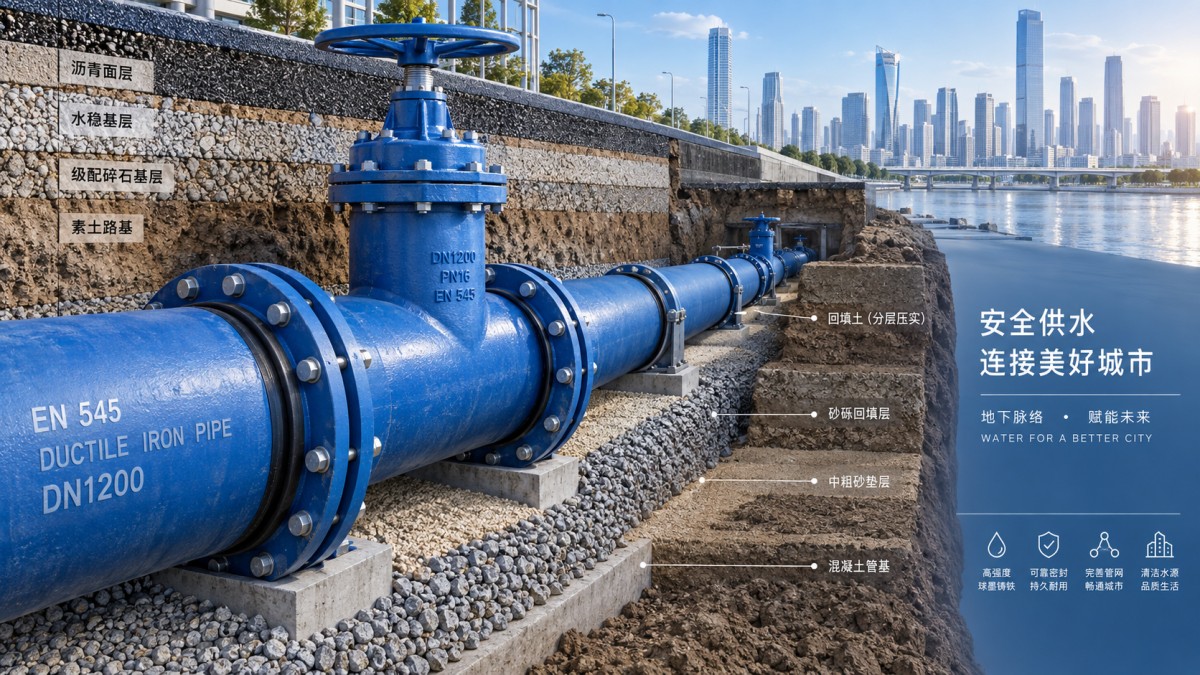
Urban installations place demands on ductile iron pipelines that are not captured by internal pressure alone. Deep trenches, high groundwater, unstable backfill, road crossings, rail corridors, and heavy traffic can all change the structural picture. Ductile iron is often selected because it handles demanding site conditions well, but the design still needs to account for cover depth, bedding, compaction quality, and temporary construction loads.
This is particularly relevant when a route moves from an open verge into a congested roadway. The pipe diameter may stay the same, while the installation environment changes completely. In some projects, the most practical solution is not to increase the class across the full route, but to define higher-demand sections clearly in the bill of quantities and installation drawings.
Do not overlook joints. A pipeline can have a correctly selected pipe wall and still face problems if thrust forces at bends, tees, reducers, blank ends, and valves are not properly restrained. Thrust blocks, restrained joints, anchor arrangements, and soil conditions need to be coordinated. The pressure rating of the pipe and the restraint strategy should be reviewed as one system.
Treat fittings as pressure-critical components
Fittings deserve the same level of review as straight pipes. A tee connection, for example, changes both flow direction and thrust behavior. The branch may enter a different pressure zone, feed a future extension, or require isolation for maintenance. When reviewing the fitting schedule, confirm that pressure requirements, joint type, branch arrangement, coating requirements, and restraint details are consistent with the pipe design.
For branch connections in municipal distribution work, a Three-way fitting should be selected as part of the pipeline arrangement rather than added as a late procurement item. The fitting’s role in the hydraulic layout, the associated valve chamber space, and the available thrust restraint can matter more than the fitting’s unit price.
What to include in the procurement specification
A vague request for “EN 545 pipe” leaves too much open to interpretation. The procurement package should identify nominal diameter, required pressure class or design pressure basis, pipe lengths where relevant, joint type, lining, external coating, rubber gasket requirements, fittings, and special sections. It should also state the project standard hierarchy where local utility specifications add requirements beyond EN 545.
Manufacturing integration can make coordination easier, especially where pipes, fittings, and sealing rings need to arrive as a compatible package. Shanxi Datong Foundry Co., Ltd., located in Chuandi Industrial Park, Zezhou County, combines smelting and casting processes for ductile iron pipes, fittings, and rubber sealing rings. For a project team, the practical benefit of this type of supply capability is not a marketing claim; it is the opportunity to review interfaces between components before shipment, rather than discovering differences on site.
Still, the manufacturer should receive a complete technical schedule. A supplier can manufacture to the requested designation, but cannot reliably correct an incomplete pressure basis, missing surge assumptions, or an unclear transition between pressure zones.
A disciplined decision usually avoids both under-design and over-design
The right EN 545 ductile iron pipe pressure class is the one supported by the actual pressure envelope, transient assessment, ground conditions, and connection details of the specific urban main. It should be checked section by section where terrain or operating conditions change, then aligned with fittings, joints, valves, and restraint requirements.
Before releasing the order, ask one final practical question: if the pump sequence changes, a valve closes unexpectedly, or the network is later extended, is the stated pressure basis still defensible? If the answer is uncertain, that uncertainty is better resolved in design review than after the trench has been backfilled.
Navigation
Send Us A Message

First class quality service and professional after-sales team.
Get in Touch
*We respect your confidentiality and all information are protected.