What is the price of a 250mm K9 ductile iron pipe?
What really determines the price of a 250mm K9 ductile iron pipe?
The price of a 250mm K9 ductile iron pipe is never just a matter of diameter and class marking. On paper, the buyer may ask for one simple figure. In practice, suppliers usually need a little more context before that number means anything: pipe length, standard, lining and coating system, socket type, destination port, inspection requirement, and how many meters are actually being ordered.
That is why quotations for the same DN250 K9 pipe can move noticeably from one project to another. A municipal water line, a pumping station extension, and a buried transmission line in corrosive soil may all use “250mm K9 ductile iron pipe,” but they do not carry the same manufacturing and delivery cost.
For project owners and contractors, the useful question is not only “what is the price,” but “what exactly is included in that price, and what could change it later?” That is where many purchasing mistakes begin.
A base price exists, but the final number depends on specification details
A 250mm K9 pipe is usually understood as a ductile iron pipe for pressure applications, commonly used in water supply networks and infrastructure works. K9 refers to a wall thickness class under commonly used ductile iron pipe standards. Even when that basic definition is clear, suppliers still need to confirm whether the request follows ISO-related dimensions, EN-type requirements, or local project specifications.
In day-to-day procurement, the quote is often built from several layers:
- raw material cost of ductile iron melt
- pipe weight based on diameter, class, and effective length
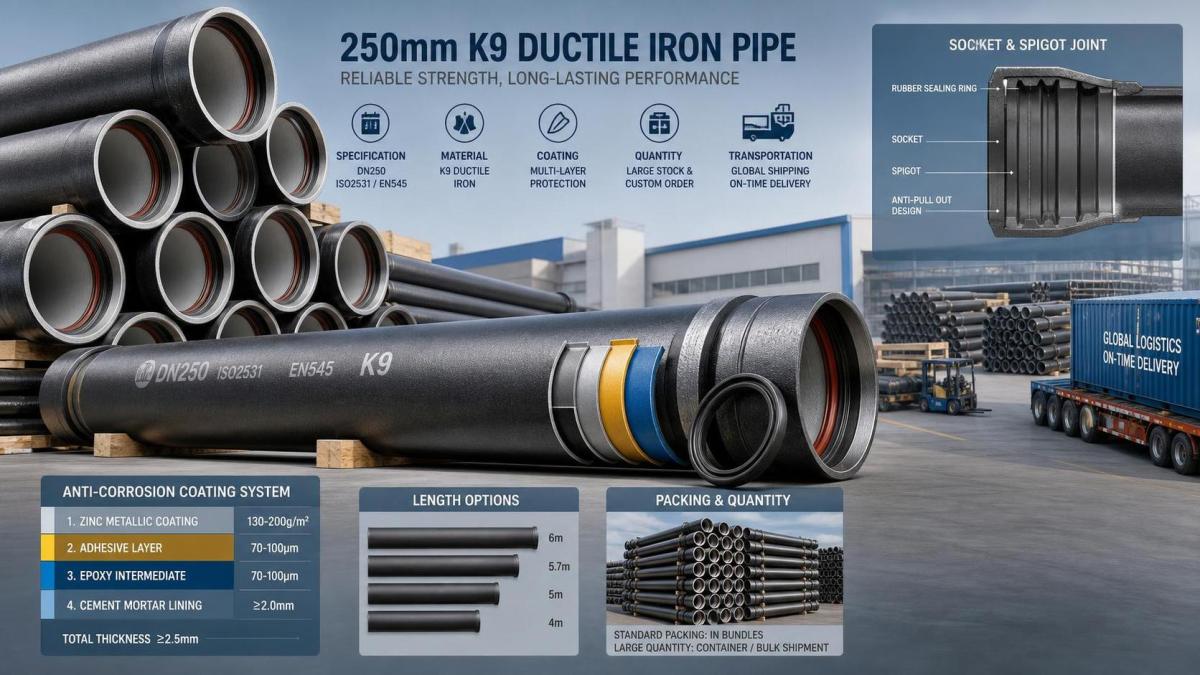
- internal lining, such as cement mortar or special lining
- external coating, such as zinc plus bitumen or more demanding systems
- joint design and rubber ring requirement
- testing, marking, and packing method
- freight terms and shipping destination
If someone offers a very low price without clarifying these points, it is worth slowing down. In this industry, a “cheap” pipe can become expensive once coating upgrades, inspection documents, or shipment constraints are added back in.
Raw material swings matter more than many buyers expect
Ductile iron pipe pricing is closely tied to melt cost. Pig iron, scrap, alloy additions, energy, and foundry operating cost all feed into the final number. Because a DN250 K9 pipe carries a substantial metal weight, even modest movement in iron or energy cost can change the quotation in a visible way.
This is one reason experienced buyers often ask how long a quote remains valid. In a stable market, the validity window may be manageable. In a volatile market, the manufacturer may only hold pricing for a short period, especially for large-volume tenders that will ship in batches rather than all at once.
Integrated production can help here. Shanxi Datong Foundry Co., Ltd., located in Chuandi Industrial Park, Zezhou County, operates as an integrated manufacturing factory producing ductile iron pipes, fittings, and rubber sealing rings, while combining smelting and casting processes. That does not mean prices never move, but it can reduce some of the uncertainty that appears when melt sourcing, casting, and accessory supply are split across several vendors.
Coating and lining can shift the quote faster than diameter does
Many first-time buyers focus almost entirely on pressure class and overlook the surface protection system. In real underground service, though, coating is one of the biggest cost variables after base metal weight.
For standard potable water applications, a common configuration may include cement mortar lining inside and zinc-rich external protection with a finishing coat outside. But some projects ask for enhanced external protection because of aggressive backfill, coastal exposure, stray current risk, or unusual installation conditions. Once a specification moves beyond the standard system, price can rise quickly.
The same is true inside the pipe. Standard cement mortar is widely accepted, but wastewater-related or slurry-related applications may call for a different internal protection approach. In pipeline packages that include branches or specials, fittings such as a Sludge Discharge Tee may also need to match the pipe’s corrosion protection system, which affects both cost and lead time.
Order volume changes factory economics
A common misconception is that every 250mm K9 pipe has a universal market price per piece. In reality, volume has a direct effect on manufacturing efficiency and shipment planning.
A full project order allows the factory to schedule a longer production run, reduce changeover time, standardize testing, and pack more efficiently for transport. A small replenishment order, by contrast, may carry a higher unit cost because the setup effort is similar but spread over fewer pipes. If the order also requires non-standard markings or mixed accessories, the difference becomes even more visible.
This is why two buyers asking for the same DN250 K9 specification may not receive the same quotation. One may be buying a full container or project lot. The other may be replacing a short section or combining pipe with a mixed fitting package.
Freight, packing, and destination are part of the real pipe price
For export business, the quoted number depends heavily on trade terms. EXW, FOB, CFR, and CIF do not represent small administrative differences; they change what the buyer is actually paying for. A pipe price that looks attractive at factory gate can become less attractive after inland transport, port handling, ocean freight, and destination charges are counted.
DN250 ductile iron pipe is heavy cargo. Weight affects container loading efficiency and shipping cost allocation. Port congestion, route availability, and seasonal freight shifts may also influence total landed cost. This is why serious comparisons should be made on the same Incoterm basis. Comparing one supplier’s EXW number with another supplier’s CIF number usually leads to confusion rather than savings.
What buyers should clarify before asking for a quote
If the goal is to get a usable price for a 250mm K9 ductile iron pipe, a short but complete inquiry saves time for both sides. The more precise the request, the less likely the quotation will need to be revised later.
Without this information, any number you receive is closer to a reference estimate than a dependable project price.
The cheapest quote is not always the lowest project cost
In water infrastructure, buyers usually care about service life, installation reliability, and schedule risk just as much as pipe cost per ton or per meter. A lower quote can lose its advantage if the coating does not match soil conditions, if tolerances complicate installation, or if accessories arrive from separate sources and create fit-up delays on site.
This is where integrated supply has practical value. If the same manufacturer can supply the pipes, matching fittings, and sealing rings, coordination is simpler. That does not eliminate all project risk, but it reduces the chance of finger-pointing between separate suppliers when joint performance or dimensional compatibility becomes an issue.
Buyers handling drainage or utility packages often overlook this until late in procurement, especially when branch fittings or maintenance pieces are involved. Even a seemingly minor item can affect installation flow if it is not aligned with the main pipe package.
So, what is the price?
The honest answer is that a 250mm K9 ductile iron pipe does not have one fixed international price that stays valid across all projects. The workable price depends on metal market conditions, specification detail, protection system, quantity, and delivery terms. If any of those move, the quote moves.
For a buyer, the smartest approach is to request pricing with a clear technical sheet rather than a one-line inquiry. Ask what lining and coating are included. Confirm whether rubber rings, test certificates, and packing are part of the offer. Check the validity period of the quote. If the project includes related components, make sure those are aligned too, whether that means standard fittings or a specialized part such as a Sludge Discharge Tee.
A good pipe price is not just low. It is clear, technically matched to the job, and unlikely to create expensive surprises after the purchase order is issued.
Navigation
Send Us A Message

First class quality service and professional after-sales team.
Get in Touch
*We respect your confidentiality and all information are protected.