K9 Ductile Iron Pipe
The demand for durable, high-pressure infrastructure solutions continues to grow worldwide, making K9 ductile iron pipe a go-to material for engineers and contractors. Combining the natural corrosion resistance of cast iron with the impressive tensile strength and flexibility of steel, K9 pipes deliver reliable performance under severe environmental and mechanical stress.
What Is K9 Ductile Iron Pipe and Where Is It Used?
A K9 ductile iron pipe is a heavy-duty pressure pipe specifically designed for high-stress liquid transportation. The designation "K9" refers to a traditional wall thickness class under international standards, signifying a thicker wall profile compared to lighter classes like K7, K8, or Class C.
Because of its structural integrity, K9 pipe is widely deployed across essential civil and industrial infrastructure:
Drinking Water Networks: Safely transporting potable water at high pressure over long distances.
Wastewater & Sewage: Transporting domestic sewage and aggressive industrial effluent without cracking.
Agricultural Irrigation: Managing high-volume, continuous water flow for large-scale farming.
Firefighting Systems: Supplying pressurized water to high-demand fire hydrant networks.
K9 Ductile Iron Pipe Specifications: Size, Thickness and Weight Guide
Understanding the physical specifications of K9 piping is essential for hydraulic design and structural engineering.
Nominal Diameter (DN): Typically available from DN80 up to DN2600.
Wall Thickness: Ranges from 6 mm for smaller diameters up to 13.5 mm or more for large-diameter lines.
Weight Profile: Due to thicker walls, K9 pipes offer superior ring stiffness and external load resistance compared to lower classes, ensuring minimal deformation under heavy traffic or deep earth fills.
K9 Ductile Iron Pipe Pressure Rating and Performance Explained
K9 ductile iron pipes excel in applications requiring extreme internal pressure resistance. They generally operate safely under working pressures ranging from 16 bar to over 40 bar (42 to 60 kg/cm²), depending on the pipe diameter and joint configuration. The spheroidized graphite structure of ductile iron allows the pipe to absorb hydraulic surges, water hammer, and localized ground movements without catastrophic failure.
K9 Ductile Iron Pipe Standards: ISO 2531 and EN 545 Explained
Global procurement relies on standardized manufacturing to guarantee quality and interchangeability:
ISO 2531: The primary international standard governing ductile iron pipes, fittings, and accessories for pressure pipelines. It defines the mathematical formula for the "K" factor wall thickness classification.
EN 545: The European standard specifically focused on ductile iron pipes and fittings intended for water pipelines.
Compliance with these standards ensures uniform tensile strength (minimum 420 MPa), elongation capacity, and strict dimensional tolerances.
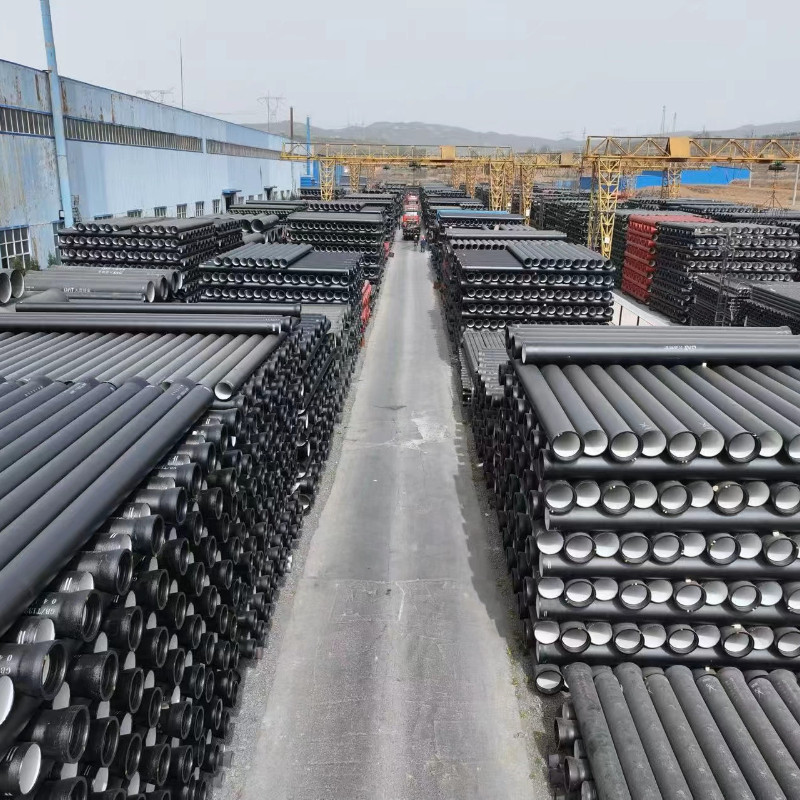
K9 vs K8 Ductile Iron Pipe: Key Differences for Buyers
When evaluating piping options, buyers often weigh K9 against lighter classes like K8:
Wall Thickness: K9 features thicker walls, offering higher mechanical strength and safety margins.
Pressure Tolerance: K9 handles significantly higher working pressures than K8.
Cost Efficiency: K8 uses less raw material and costs less per meter, making it suitable for moderate-pressure utility lines, whereas K9 is preferred for heavy-duty main transmission lines.
How to Choose the Right K9 Ductile Iron Pipe Size for Water Projects
Selecting the optimal pipe size involves balancing flow velocity, head loss, and internal pressure requirements.
Calculate Flow Demand: Determine peak daily flow rates to select an appropriate nominal diameter (DN).
Evaluate Operating Pressure: Match expected working pressure and transient surge pressure against K9 rating charts.
Account for Burial Depth: Ensure ring stiffness matches trench backfill loads and live traffic loads.
K9 Ductile Iron Pipe Coating Options for Water Supply Systems
Internal and external protection extends a pipe's lifespan beyond 100 years:
External Coatings: Metallic zinc coating (typically $130text{ g/m}^2$ to $200text{ g/m}^2$) covered by a finishing layer of bituminous paint or blue epoxy.
Internal Linings: Blast furnace slag or high-sulfate-resistant Portland cement mortar, creating a smooth surface that prevents tuberculation and maintains low hydraulic friction over time.
K9 Ductile Iron Pipe Joint Types and Installation Requirements
Proper joining methods ensure leak-free operation and quick site installation:
Tyton / Push-On Joints: The most common push-fit rubber gasket joint, offering quick assembly and angular deflection.
Mechanical Joints: Utilizes bolts and glands for connections requiring enhanced restriction.
Flanged Joints: Used primarily in valve chambers, pump stations, and above-ground installations where rigid, detachable connections are necessary.
During installation, maintaining proper trench bedding and protecting rubber gaskets from contamination are vital steps.
K9 Ductile Iron Pipe for Municipal Water Supply Projects
Municipal utility authorities favor K9 ductile iron pipe because it offers an ultra-long service life with minimal maintenance overhead. Its ability to withstand underground shifting, soil subsidence, and heavy overland vehicle loads makes it one of the safest investments for urban water grid backbones.
K9 Ductile Iron Pipe Quality Testing and Inspection Guide
To meet strict project specifications, manufacturers perform rigorous quality assurance tests before delivery:
Hydrostatic Pressure Test: Every individual pipe length is tested in-factory to verify pressure resistance without leakage.
Tensile & Hardness Testing: Confirms material ductility and mechanical strength.
Dimension & Thickness Checks: Ultrasonic thickness gauges ensure strict adherence to ISO 2531 wall parameters.
Lining & Coating Thickness Inspection: Verifies uniform coverage of cement mortar and zinc/bitumen layers.
What Affects K9 Ductile Iron Pipe Price?
Several dynamic factors influence the market price of K9 piping:
Pig Iron & Scrap Metal Costs: Raw material price fluctuations directly impact base manufacturing expenses.
Coating Specifications: Specialized internal linings (e.g., polyurethane) or heavy zinc coatings increase production costs.
Freight and Logistics: Pipe weight and volume significantly impact container loading and shipping costs.
How to Buy K9 Ductile Iron Pipe From a China Manufacturer
Sourcing K9 ductile iron pipes directly from top Chinese manufacturers offers competitive pricing and large production capacity. Follow these procurement steps for a seamless import experience:
Verify Factory Certifications: Ensure the supplier holds ISO 9001, ISO 2531, EN 545, and WRAS (Water Regulations Advisory Scheme) certifications.
Request Third-Party Inspection: Engage independent agencies like SGS or Bureau Veritas to conduct pre-shipment inspections.
Clarify Packaging & Logistics: Confirm standard bundles, protective end caps, and bulk vessel vs. container shipping arrangements.
Navigation
Send Us A Message

First class quality service and professional after-sales team.
Get in Touch
*We respect your confidentiality and all information are protected.