A Procurement Checklist for Ductile Iron Pipe in Municipal Water Projects
Municipal water pipe procurement fails when the bid comparison treats ductile iron pipe as a commodity defined only by diameter, quantity, and unit price. The lowest quoted pipe can become the highest-cost option if its pressure class is mismatched to the hydraulic design, its coating system is unsuitable for local soil conditions, its joints are incompatible with specified fittings, or the supplier cannot maintain traceability through delivery.
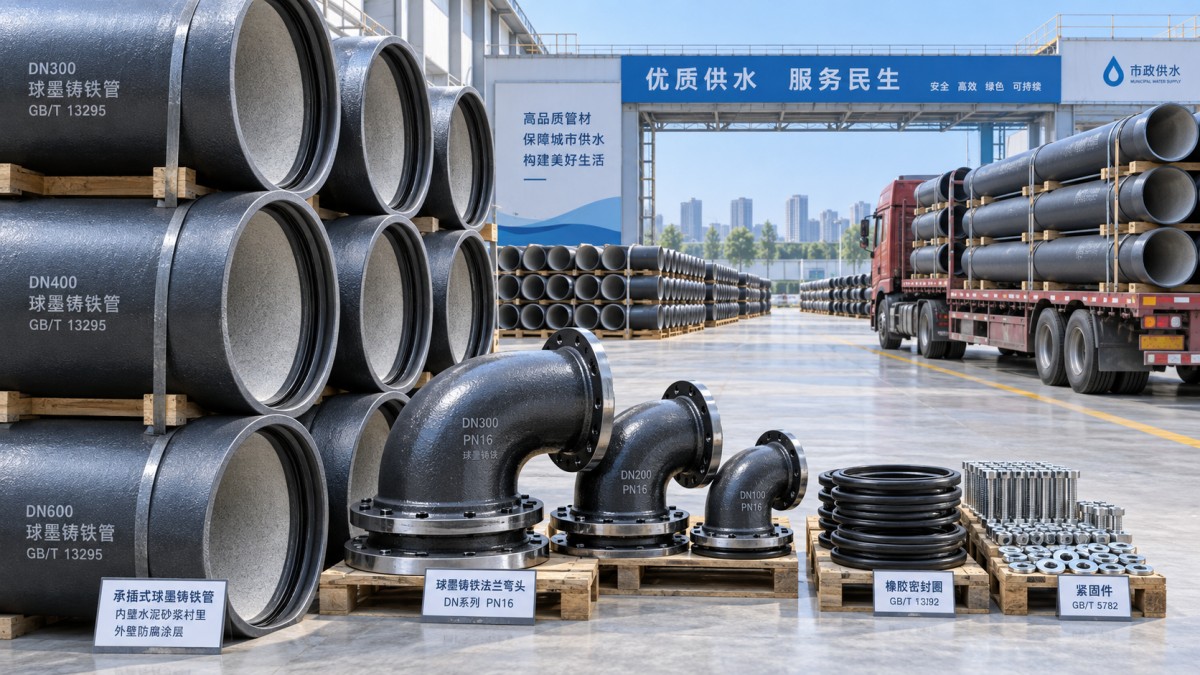
For Ductile Iron Pipe for Municipal Water Projects, the purchasing decision should convert the design specification into verifiable supply requirements. A complete package includes more than pipe barrels: it must cover joints, gaskets, fittings, lining and coating, testing records, packing, logistics, and provisions for later repair. The practical question is not whether a supplier can quote ductile iron pipe, but whether the delivered system will meet the project’s operating conditions throughout installation and service.
Start with the governing standard and the actual design basis
Procurement documents should state the required standard rather than relying on general descriptions such as “municipal-grade” or “high-pressure pipe.” Ductile iron pipe may be supplied to different national or regional standards, and these standards can differ in dimensional series, pressure classification, joint geometry, coating provisions, test methods, and marking requirements. A pipe described as DN300 under one system is not automatically interchangeable with a DN300 pipe supplied to another.
The purchase specification should identify the applicable standard, required nominal diameters, pipe lengths, pressure or wall-thickness class, joint type, internal lining, external coating, and any project-specific requirements. It should also make clear which party is responsible for confirming compatibility between pipe, fittings, valves, restrained joints, and existing network connections.
Pressure selection deserves particular attention. Static pressure alone is not an adequate basis for choosing a pipe class. The procurement requirement should reflect operating pressure, expected pressure fluctuations, surge or water-hammer allowance, elevation changes, and any exceptional conditions defined by the hydraulic design. A supplier quotation that simply substitutes a lower class because it is “commonly used” should not be accepted without the designer’s confirmation.
Check the entire pipeline system, not only the pipe barrel
Joint performance often determines whether installation remains controlled or becomes a source of delay and claims. Buyers should require an explicit description of the joint configuration, gasket type, locking or restraint method where applicable, allowable angular deflection, and relevant assembly instructions. The gasket material must be appropriate for potable-water service and for the water treatment chemicals or operating environment identified by the project.
Fittings require a separate review. Their pressure capability, lining, coating, flange drilling, socket dimensions, and connection method may differ from straight pipe. A quotation with a competitive pipe rate but incomplete fittings, glands, bolts, gaskets, or adapter requirements cannot be evaluated as a complete system cost.
Compatibility is especially important for rehabilitation or extension work. Existing infrastructure may use a different standard, older socket profile, or a nonstandard flange arrangement. The cost and lead time of transition fittings, dismantling joints, flange adaptors, and restraints should be identified before the order is released, not after materials reach the site.
Assess lining and coating against the installation environment
A standard cement mortar lining is widely specified for water transmission and distribution duties, but the procurement review should still confirm the lining type, thickness requirement, curing condition, and repair procedure for damaged areas. Where water chemistry, service conditions, or project specifications require a different lining, the requested system should be clearly named rather than left to supplier interpretation.
External protection requires more than asking whether the pipe is “coated.” Zinc-based protection and finishing layers may be appropriate under many conditions, but aggressive or variable soils can require additional measures. Soil resistivity, moisture, chloride or sulfate exposure, stray-current risk, groundwater conditions, and the presence of contaminated fill can influence the protection approach. If a geotechnical or corrosion assessment exists, it should be incorporated into the procurement package. If it does not, the buyer should avoid assuming that a supplier’s default coating is suitable for every route section.
The same discipline applies to handling damage. Specifications should state how coating and lining defects will be inspected, accepted, and repaired. Site teams need compatible repair materials and instructions; otherwise, a technically compliant coating at factory dispatch may be compromised during unloading, cutting, or installation.
Compare offers on a landed and installed basis
Unit price per metre is useful, but it is not the project cost. A meaningful comparison separates the quotation into measurable elements:
- pipe by diameter, class, length, and joint configuration;
- fittings by type, angle, branch size, pressure rating, lining, and coating;
- gaskets, glands, bolts, restraints, and transition components;
- factory testing, inspection access, certificates, and third-party verification where required;
- packing, loading, inland transport, freight terms, insurance, duties, and port or destination charges;
- spares, field-repair materials, and documentation for installation and maintenance.
Weight is another cost variable that should be audited. Ductile iron pipe mass affects steel or iron content, freight cost, lifting plans, and installation productivity. Buyers should compare the supplier’s stated mass per length against the selected standard and class, rather than comparing only a price per metre. An unusually light offer may be based on a different wall-thickness class, dimensional standard, or unapproved tolerance assumption.
Freight planning should account for loading configuration and delivery sequence. Long pipe lengths may improve the number of joints installed but can affect container loading, transport permits, site access, unloading equipment, and laydown space. The preferred pipe length is therefore a project logistics decision as well as a material decision.
Turn quality claims into documents that can be checked
“Quality certificate available” is not a sufficient acceptance condition. The contract should define the documents needed for each lot and the point at which they must be submitted. Typical records may include material or heat traceability, dimensional inspection results, hydrostatic test records where required by the governing standard, lining and coating inspection records, gasket compliance documentation, and certificates of conformity.
Traceability should remain intact from casting through shipment. Pipe markings should allow the receiving team to identify the manufacturer, production information, nominal size, class or designation, and applicable standard as required. It is prudent to align packing lists, batch records, markings, and inspection reports before shipment. Reconstructing this chain after mixed loading or site delivery is difficult and may delay acceptance.
Pre-shipment inspection can be valuable when the order is large, technically specific, or destined for a project with strict acceptance procedures. The inspection scope should be agreed in advance. It may cover dimensions, visual condition, markings, lining, coating, packing, quantity, and document review. Inspection is not a substitute for a detailed specification; it verifies the agreed requirement rather than creating one after production.
Evaluate supplier capacity as a delivery-risk issue
Manufacturing capability should be reviewed in relation to the order’s diameter mix, fittings complexity, coating requirement, and required delivery windows. Straight pipe, specialty fittings, and restrained-joint accessories may have different production paths and lead times. A supplier’s ability to make pipe does not automatically establish that all accessories will be ready for a coordinated shipment.
Ask for a production and dispatch plan that identifies manufacturing release, testing, coating or lining stages, packing, inspection hold points, and shipment dates. Contract terms should also address the treatment of rejected materials, short deliveries, damaged goods, documentary nonconformity, and changes to the approved bill of quantities. These provisions are more useful when written before production starts than when they are negotiated during a schedule dispute.
Integrated manufacturing can simplify coordination between pipe production and related items, but that advantage should be verified through the supplier’s actual scope, quality controls, and ability to document each component. The same applies to externally sourced fittings or gaskets: their origin and acceptance responsibility should be transparent.
Do not omit repair and maintenance compatibility
New-pipeline procurement should consider foreseeable maintenance requirements, particularly where isolation options are limited. Emergency repair hardware is not normally a substitute for a correctly designed permanent connection, but compatibility planning can reduce disruption after commissioning. Pipe outside diameter, surface condition, working pressure, repair length, and nearby valves or fittings all affect whether a repair clamp can be used safely.
For repairs around valve installations, an Extended Full-Encirclement Repair Clamp may be relevant only after confirming its dimensional range, pressure suitability, sealing arrangement, and clearance around the affected component. Including such items in a maintenance schedule should not obscure the more important task: ensuring that the original pipe system has complete records of dimensions, joint types, and installed locations.
Release the order only when technical and commercial assumptions match
A sound purchase order attaches the approved technical schedule, drawings, bill of quantities, inspection plan, document list, packing requirements, delivery terms, and change-control process. It should not rely on a supplier’s general quotation language where project requirements are more specific.
The final review should confirm that every quoted item corresponds to the approved design, all exclusions are visible, pressure and joint assumptions are documented, protection systems match the installation environment, and the delivery plan supports the construction sequence. That discipline is what separates a low bid from a dependable municipal water supply package.
Navigation
Send Us A Message

First class quality service and professional after-sales team.
Get in Touch
*We respect your confidentiality and all information are protected.