K9 Ductile Iron Pipe Specifications
K9 Ductile Iron Pipe Specifications: What Really Matters in Project Selection
Understanding K9 Ductile Iron Pipe Specifications is essential for engineers, contractors, and buyers seeking reliable water transmission solutions. Shanxi Datong Foundry Co., Ltd., an integrated manufacturer of ductile iron pipes, fittings, and rubber sealing rings, combines smelting and casting processes to deliver consistent quality and performance. This article explores the specification details that usually decide whether a pipe system will work smoothly in the field or turn into a maintenance problem later.
K9 is not just a label. In practice, it points to a strength level used in ductile iron pipe selection, especially where buried water lines, municipal networks, and industrial distribution systems need a balance of pressure resistance, durability, and installability. Buyers often focus on diameter first, but that is rarely the only issue. Wall thickness, coating system, joint type, and the surrounding soil or load conditions can matter just as much.
Why K9 gets specified so often
Ductile iron has become the practical choice in many transmission projects because it gives engineers more room to work with than brittle materials. K9-grade pipe is commonly selected when the project needs dependable pressure performance without moving into heavier, more expensive options unless the design clearly requires it. That is one reason it shows up in water supply lines, distribution mains, pump station connections, and some industrial utility networks.
The important point is that K9 should be read together with the full specification sheet, not treated as a standalone promise. If two suppliers both say K9, that does not automatically mean the same coating thickness, joint design, or quality control process. Field performance depends on the full package, including how the pipe body, lining, external protection, and sealing system are matched.
In many projects, the real decision is less about “which pipe is strongest” and more about “which specification is appropriate for this soil, this pressure class, and this installation method.” That is where many procurement mistakes begin.
The specification points engineers usually check first
When a team reviews K9 Ductile Iron Pipe Specifications, several items usually deserve attention before price comparisons start.
- Nominal diameter and required flow capacity
- Wall thickness and the related strength class
- Pipe length and handling limits on site
- Joint type, especially for leak control and movement tolerance
- Internal lining suitability for potable water or other media
- External coating or wrapping requirements based on soil conditions
- Compatibility with fittings, valves, and sealing rings
These are not cosmetic details. A pipe with a good strength rating but poor joint coordination can still underperform if alignment is difficult during installation. Likewise, a system with acceptable pressure resistance may age poorly if the external protection is not suited to corrosive ground conditions.
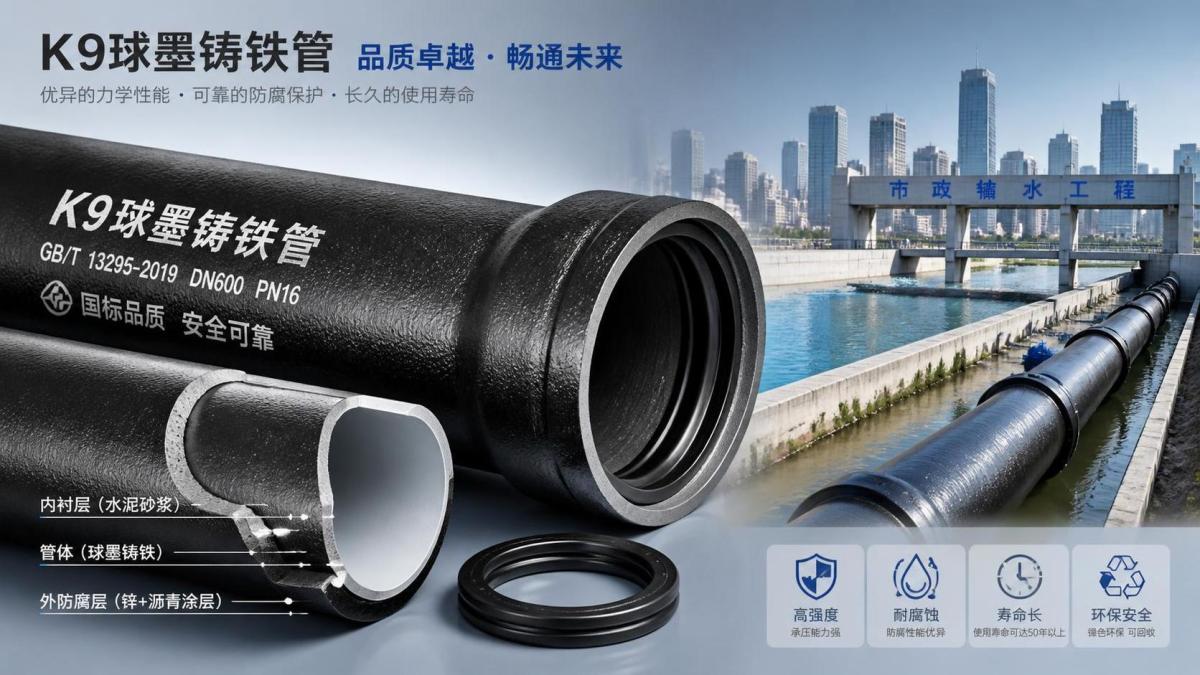
Wall thickness is not the whole story
A common misunderstanding is that thicker always means better. In reality, the useful question is whether the selected wall thickness matches the design pressure, burial depth, traffic load, and installation environment. Overspecifying can increase cost and make handling more difficult without solving the real risk. Underspecifying, on the other hand, can lead to deformation concerns, joint stress, or shortened service life.
This is also why buyers should ask for the governing standard or technical basis behind the K9 designation. Different markets may reference slightly different conventions, and projects sometimes add their own requirements on top of the base specification. If the application is water transmission, local utility rules or engineering documents may be more important than a generic product catalog.
Coatings and linings deserve more attention than they get
In practice, many failures begin at the interface between the pipe and its environment. The internal lining affects water quality and long-term hydraulic behavior, while the external coating helps the pipe survive transport, storage, backfilling, and soil exposure. For aggressive soils or special installations, the coating system may need to be reviewed as carefully as the pipe body itself.
That is one reason integrated production matters. Shanxi Datong Foundry Co., Ltd. combines smelting and casting processes with the manufacturing of ductile iron pipes, fittings, and rubber sealing rings, which helps when a project needs better coordination between components rather than isolated parts from different sources. In pipe systems, compatibility often matters more than any single part’s headline specification.
How the pipe system performs in real installation conditions
Specification sheets are useful, but the field exposes weak points quickly. Contractors usually care about how easily the pipe can be handled, cut, joined, and aligned. Engineers care about whether the selected system tolerates settlement, vibration, pressure fluctuation, and the occasional installation error without becoming fragile.
Joint performance is especially important. A pipe can meet a nominal strength class and still create trouble if the joint design does not support the movement expected in service. In trench work, for example, small alignment problems can magnify into leakage or repeated rework. In that sense, the best specification is the one that fits both the design and the construction reality.
For buyers comparing suppliers, this is where questions should become more specific: what test method is used, how are dimensions controlled, what inspections happen before shipment, and which accessories are included as part of the matched system? These questions are usually more useful than asking only for a quotation.
Where fittings and accessories change the outcome
A ductile iron pipeline is only as reliable as its least considered component. Fittings, rubber sealing rings, and transition pieces can all influence how well the system holds pressure and stays serviceable over time. This is one reason many project teams prefer suppliers who can coordinate multiple components rather than source each item separately and hope the dimensions align.
That kind of integration also affects maintenance planning. For example, when a project includes inspection chambers or access points, even related cast-iron components like Ductile Iron Manhole Cover7 may need to fit the same design logic around durability, loading, and environmental exposure. It is not the same as pipe specification, but it sits in the same infrastructure mindset: compatibility, strength, and long-term serviceability.
Common mistakes when reading a K9 specification
One mistake is treating K9 as enough information by itself. Another is assuming a familiar supplier’s previous pipe will work in a new project without reviewing the local soil, pressure, or lining requirements. A third is ignoring how packaging, loading, and storage can affect coating integrity before the pipe even reaches the trench.
There is also a procurement habit that causes unnecessary trouble: selecting by unit price before confirming the complete technical package. A lower quote can look attractive until the project team discovers missing accessories, mismatched joints, or a coating that does not fit the intended environment. At that point, the “saving” disappears into delays.
A better approach is simple: confirm the operating pressure, burial condition, joint requirement, standards to be followed, and the accessories needed for a complete system. If any of those remain uncertain, it is better to clarify them before the order is finalized.
A practical way to evaluate suppliers
For B2B buyers, supplier evaluation should go beyond brochure claims. Ask how the pipe body is produced, how dimensional consistency is checked, and whether related items such as fittings and sealing rings are made under the same quality logic. A manufacturer with integrated processes often has fewer coordination gaps, especially on projects where multiple components must arrive ready to assemble.
Shanxi Datong Foundry Co., Ltd., located in Chuandi Industrial Park, Zezhou County, is positioned around this kind of integrated production model. For buyers, that does not replace technical review, but it can simplify system matching when the project requires more than one cast-iron component.
The real value of K9 Ductile Iron Pipe Specifications is not in the label itself. It is in how clearly the specification helps you avoid unnecessary risk and choose a system that fits the project, not just the catalog.
Before placing an order, it is worth confirming the standard basis, coating and lining requirements, joint type, and the exact installation conditions on site. That is usually the difference between a pipe that merely arrives and a pipeline that performs as intended.
Navigation
Send Us A Message

First class quality service and professional after-sales team.
Get in Touch
*We respect your confidentiality and all information are protected.