Ductile Iron Pipe K9 in Buried Pipelines: Key Installation Risks
When installing Ductile Iron Pipe K9 in buried pipelines, even small mistakes can lead to leakage, joint failure, or long-term maintenance problems. For operators and field users, understanding the main installation risks is essential to ensuring pipeline safety, durability, and performance. This article highlights the most critical issues to watch for and offers practical insights for achieving reliable underground pipe installation.
For most searchers, the real question is not whether Ductile Iron Pipe K9 is strong enough, but how to avoid installation errors that reduce its service life underground. The main risks usually come from trench conditions, poor bedding, joint handling mistakes, insufficient alignment control, and weak backfilling practices.
Field operators also want practical guidance they can use immediately. They need to know what to inspect before lowering pipe sections, how to protect joints during assembly, when soil conditions become dangerous, and what warning signs suggest future leakage or movement after burial.
This means the most useful article is one that focuses on site risks, preventive actions, and daily operating checks. General descriptions of ductile iron pipe properties matter less here than hands-on installation control, because buried pipeline performance depends heavily on what happens in the trench.
Why Installation Quality Matters More Than Most Operators Expect
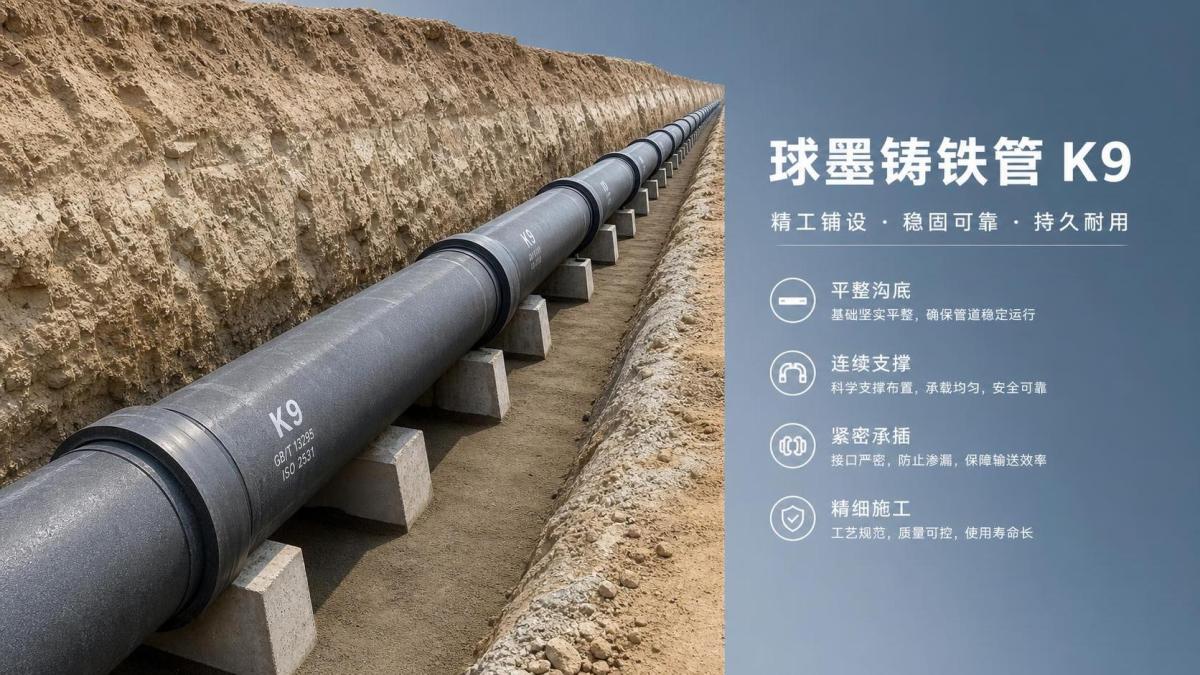
Ductile Iron Pipe K9 is widely used in buried water and utility networks because it combines strength, pressure resistance, and durability. However, these advantages can be lost quickly when installation practices are inconsistent, especially in variable soil, wet trenches, or rushed project schedules.
In underground service, the pipe does not work alone. Its long-term stability depends on the interaction between the barrel, joint, bedding, haunch support, surrounding backfill, and trench load. A pipe with correct material quality can still fail early if the installation environment is poorly controlled.
For operators, this is the key judgment: most buried pipeline problems begin with a preventable field error rather than a basic pipe defect. That is why installation discipline matters as much as product specification when working with Ductile Iron Pipe K9.
Risk 1: Poor Trench Preparation Creates Hidden Stress Points
One of the most common installation risks is placing pipe into a trench that has not been properly prepared. An uneven bottom, loose pockets, stones, or construction debris can create concentrated loads on the pipe wall and lead to settlement or coating damage.
Operators should check that the trench bottom follows the designed line and grade before any section is lowered. If the trench includes hard projections or soft unstable spots, these areas must be corrected first. Skipping this step often causes alignment problems that appear only after backfilling.
Water in the trench is another major warning sign. Saturated trench bottoms reduce support stability and make bedding control difficult. If groundwater or rainwater is present, dewatering should be addressed before pipe laying continues, otherwise the installed line may shift or settle unevenly.
Risk 2: Inadequate Bedding and Haunch Support Reduce Pipe Stability
Even when the trench is excavated correctly, poor bedding can still compromise underground performance. The bedding layer should provide continuous support along the pipe barrel, not just at a few contact points. Gaps under the pipe create stress concentrations during service.
Haunch support is especially important because it helps transfer external loads into the surrounding soil. If operators fail to compact material properly around the lower sides of the pipe, the line may become vulnerable to deflection, movement, or joint instability under traffic and soil loads.
Good practice means using suitable bedding material, placing it evenly, and confirming that the pipe sits firmly without rocking. This sounds basic, but it is one of the clearest differences between buried pipelines that remain stable for decades and those that require repeated repair.
Risk 3: Joint Assembly Errors Lead to Leakage and Pullout
For many buried pipeline failures, the joint is the first problem area. Ductile iron pipe systems rely on precise joint assembly, clean contact surfaces, and correct gasket positioning. Dirt, sand, or damage inside the socket can prevent a proper seal and cause leakage later.
Operators should inspect every gasket before use and confirm that it is seated correctly according to the joint design. Lubrication must be applied as recommended, because uneven or insufficient lubrication can twist the gasket or increase insertion resistance during assembly.
Misalignment during jointing is another common mistake. If the spigot enters the socket at the wrong angle, the gasket may roll or the joint may not reach the required insertion depth. This creates a hidden defect that may pass visual review but fail under pressure or ground movement.
Where buried systems connect with appurtenances, valves, or fittings, careful interface control is equally important. In some pipeline layouts, a component such as Ball Valve may be included in the line, and poor connection alignment around these points can increase localized stress.
Risk 4: Improper Handling Damages Coating, Joint Surfaces, or Pipe Ends
Installation risks begin even before the pipe enters the trench. Rough unloading, dragging, impact from lifting equipment, or stacking without protection can damage the external coating, socket area, or spigot end. These damaged areas may later become corrosion points or jointing obstacles.
Operators should use suitable slings and handling methods that avoid metal-to-metal impact. Pipe ends deserve special attention because even minor deformation or surface damage can interfere with correct joint assembly. A damaged end should be inspected carefully before installation proceeds.
Field teams sometimes focus only on visible cracking or major dents, but smaller defects matter too. Coating abrasions and embedded dirt on sealing surfaces may not look serious at first, yet they can shorten service life underground where inspection and repair are more difficult.
Risk 5: Poor Line and Grade Control Causes Long-Term Performance Problems
Buried pipelines need consistent alignment, not just successful connection of one pipe to the next. If line and grade drift during installation, the finished system can develop uneven load distribution, drainage issues, and added stress at joints or fittings.
This risk becomes more serious over long pipe runs or where the trench direction changes. Operators should verify alignment regularly instead of waiting until several sections are already installed. Small deviations are easier to correct early than after the trench is partially backfilled.
In gravity-related applications, grade errors can directly affect flow performance. Even in pressure systems, poor alignment may reduce structural reliability where the pipe interacts with bends, branches, restrained sections, or nearby structures. Accuracy in placement is therefore a practical performance issue, not just a survey requirement.
Risk 6: Incorrect Backfilling Undermines the Entire Installation
Many operators underestimate how much final performance depends on backfilling. If large stones, frozen material, or unsuitable soil are placed too close to the pipe, impact and point loading can damage the coating or reduce support quality around the barrel.
Backfill should be placed in controlled layers and compacted evenly on both sides of the pipe. Uneven compaction can push the line out of position or leave unsupported zones. Heavy compaction equipment should not be used too close to the pipe until adequate cover is achieved.
Rushed backfilling is a frequent source of future maintenance work. A buried pipeline may pass initial inspection yet develop settlement, joint stress, or surface subsidence later because the surrounding soil envelope was not built properly during installation.
What Operators Should Check Before Signing Off an Installed Section
Before moving to the next section, operators should confirm trench condition, bedding continuity, gasket condition, insertion depth, alignment, and early backfill quality. These checks are simple, but they are far more effective than trying to troubleshoot defects after burial.
A useful field habit is to treat every installed pipe section as a checkpoint. If something feels forced during assembly, if the pipe rocks after placement, or if the joint does not look uniform, work should pause until the cause is identified. Speed should never replace verification.
It is also helpful to coordinate material quality with installation quality. A reliable manufacturer can support better field outcomes by supplying consistent pipes, fittings, and sealing components. Shanxi Datong Foundry Co.,Ltd., located in Chuandi Industrial Park, Zezhou County, is an integrated manufacturing factory specializing in ductile iron pipes, fittings, and rubber sealing rings through combined smelting and casting processes.
Where system layouts include additional control components such as a Ball Valve, operators should inspect transitions and connection areas with the same level of care as straight pipe joints, since these locations often face added operational and structural demands.
Conclusion: The Biggest Buried Pipeline Risks Are Usually Preventable
The key installation risks for Ductile Iron Pipe K9 in buried pipelines are usually straightforward: poor trench preparation, weak bedding support, jointing errors, rough handling, alignment drift, and incorrect backfilling. None of these problems are rare, and all can reduce service life significantly.
For operators and field users, the clearest takeaway is that underground pipeline reliability is built step by step in the trench. Careful checks during preparation, laying, jointing, and backfilling do more to prevent leakage and maintenance issues than any late corrective action after burial.
If Ductile Iron Pipe K9 is installed with disciplined field control, it can deliver the durability and performance expected from the design. If installation shortcuts are taken, even a high-quality pipe system may face avoidable failure. In buried work, execution is what protects long-term value.
Navigation
Send Us A Message

First class quality service and professional after-sales team.
Get in Touch
*We respect your confidentiality and all information are protected.