Ductile Iron Pipe Coating Types Explained: Zinc, Epoxy, and Polyurethane
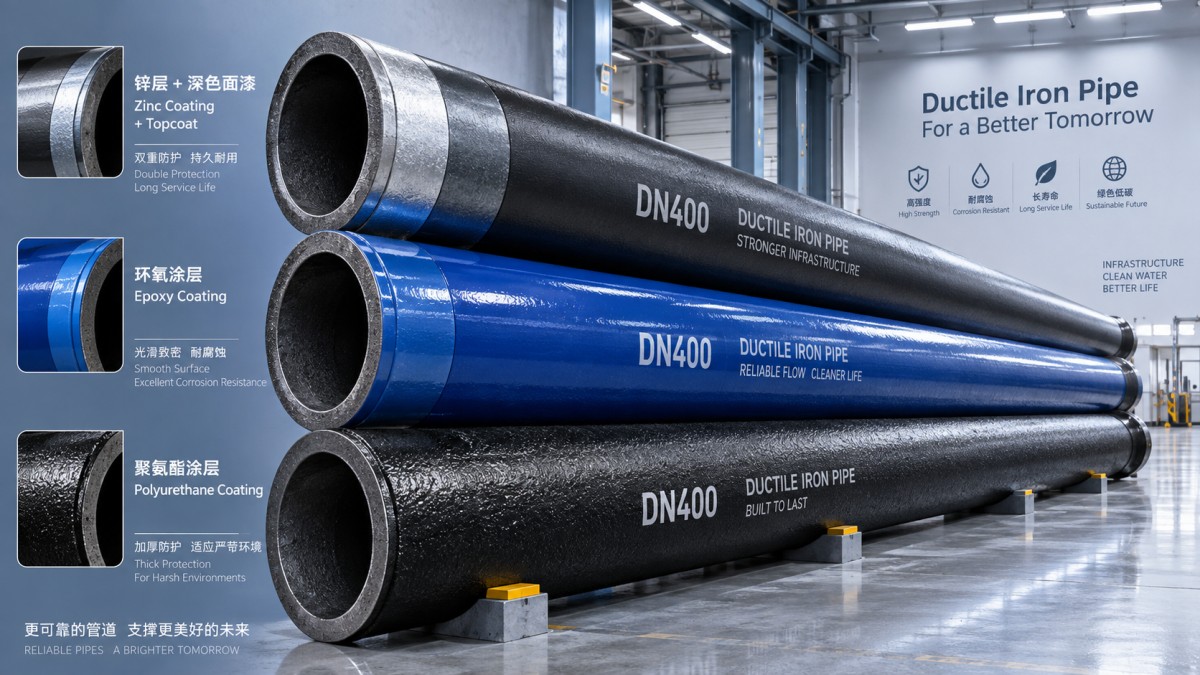
Selecting among ductile iron pipe coating types is less about choosing the “strongest” material and more about matching the coating system to the corrosion mechanism the pipe will face. Zinc-rich external coatings are commonly chosen for buried pipelines because they provide electrochemical protection when minor damage occurs. Epoxy is usually selected where a smooth, chemically resistant barrier is needed. Polyurethane is often considered when severe abrasion, impact, or aggressive industrial exposure is expected.
For operators, the practical question is simple: what will attack the pipe first? Soil moisture and stray current affect the outside of buried mains. Water chemistry, suspended solids, cleaning procedures, and flow velocity affect the internal lining. A coating that performs well against one condition may be a poor fit for another, particularly when surface preparation, joint treatment, and repair practices are overlooked.
Zinc Coatings: Protection for Buried Pipe, Not a Universal Barrier
Zinc is primarily used as an external coating on ductile iron pipe installed underground. Its value comes from sacrificial behavior: when the coating and iron substrate are exposed through a small defect, zinc can corrode preferentially and help protect the underlying ductile iron. This differs from a purely barrier-based coating, where a scratch may expose the substrate directly to corrosion.
That makes zinc particularly relevant where handling damage, minor installation abrasion, or localized coating discontinuities are realistic concerns. It is often paired with a finishing layer that improves coverage and helps isolate the pipe from the surrounding soil environment. The complete system matters. Zinc alone should not be evaluated as though it were a thick, impermeable paint film.
Its limitations are equally important. Zinc coating performance depends on soil conditions, moisture availability, electrical conditions, and the specified coating mass and finishing layer. Highly aggressive soils, unusual contamination, severe stray-current conditions, or poorly designed cathodic protection arrangements may require a more detailed corrosion assessment. It is also not an internal lining solution for water or industrial fluid contact.
During receiving and installation, operators should inspect zinc-coated pipe for obvious handling scars, missing finish coat, damaged ends, and areas where lifting equipment has cut through the coating. Repairs should use the approved system rather than a general-purpose site paint. A repair material that merely covers exposed metal may not restore the intended protection mechanism.
Epoxy: A Barrier Coating for Controlled Internal and External Conditions
Epoxy coatings are used where a dense, adherent barrier is needed between the pipe and the conveyed medium or external environment. In ductile iron systems, epoxy may be specified for internal protection against corrosive water, wastewater, certain industrial fluids, or for external exposure where a conventional buried-pipe coating system is insufficient.
A properly selected epoxy can offer good chemical resistance, a smooth internal surface, and strong adhesion when the substrate is prepared correctly. Smoothness can be useful in systems where deposits, biofilm, or friction losses are operating concerns. However, “epoxy” is a broad material category. Formulation, film thickness, curing method, temperature limits, potable-water suitability, and resistance to the actual fluid all need to be checked against the project specification.
Surface preparation has an outsized effect on epoxy performance. Rust, casting residues, oil, salts, moisture, and inadequate blast profile can prevent proper adhesion even if the coating initially appears uniform. A coating may then blister, delaminate, or corrode beneath the film after the pipe enters service. For this reason, coating inspection should include more than visual appearance. Projects may require checks for dry film thickness, holiday defects, cure condition, and repair quality.
Epoxy also requires disciplined field handling. Sharp impact can create holidays that are difficult to see, especially on dark-colored coatings. Cut pipe ends, flange faces, field joints, and repaired areas need a compatible procedure. An internal epoxy lining is only as continuous as its treatment of these vulnerable locations.
Operators should be cautious about assuming that epoxy automatically solves abrasion problems. Some epoxy systems tolerate moderate wear well, but hard solids, high velocity, slurry service, or frequent cleaning with abrasive media can remove a barrier coating over time. Where abrasion is the dominant failure risk, polyurethane or a specialized abrasion-resistant lining may deserve closer review.
Polyurethane: Where Impact and Abrasion Drive the Decision
Polyurethane coatings are generally considered when ductile iron pipe will encounter substantial mechanical wear, repeated impact, or harsh industrial service. Depending on the system, polyurethane can combine good toughness with flexibility and resistance to abrasion. This can make it suitable for installations involving mineral-bearing water, process fluids with suspended solids, aggressive washdown, or environments where external impact is a recurring concern.
The advantage is not simply hardness. A coating that is very hard but brittle may crack under impact or thermal movement. Polyurethane systems are often valued because they can absorb some deformation while maintaining a protective film. Yet performance varies significantly by formulation. A polyurethane selected for atmospheric external protection is not automatically suitable as an internal lining for a particular fluid or temperature.
Application conditions need close control. Temperature, humidity, substrate cleanliness, mixing ratio for multi-component products, and cure time can all affect the finished coating. Field application may be appropriate for repairs or joints, but only when the contractor can maintain the specified preparation and curing conditions. In demanding service, a factory-applied system with documented inspection is usually easier to control than extensive site coating work.
How to Compare the Three Systems
The table is useful for first screening, but the coating decision should not stop there. Pipe operators should ask for the service conditions in practical terms: fluid composition, solids content, operating temperature, maximum and normal velocity, cleaning chemicals, pressure cycling, soil resistivity where relevant, groundwater condition, and exposure to electrical interference. These inputs determine whether a coating is serving as a corrosion barrier, a wear layer, or part of a broader protection system.
Do Not Separate Coating Choice from Joint and Repair Planning
A frequent weakness in ductile iron pipeline planning is specifying a high-performance factory coating while leaving joints, cuts, fittings, and repairs vague. These locations are where continuity is interrupted. A buried main with zinc-coated barrel sections may need a defined treatment for spigots, field cuts, and fittings. An epoxy-lined water line needs a compatible method for restoring lining continuity after cutting. Polyurethane systems require repair products that bond properly to the original coating and cure under site conditions.
Before installation begins, the operator should have clear answers to four questions:
- Which coating is applied inside the pipe, outside the pipe, or both?
- What service condition is the selected coating designed to resist?
- How will coating damage, cut ends, and joints be inspected and repaired?
- Which acceptance checks are required before the pipe is placed in service?
Those questions are more useful than comparing coating names alone. The same material name can describe systems with very different thicknesses, curing methods, and approved service limits.
Specification Details That Prevent Expensive Misunderstanding
When reviewing ductile iron pipe coating types, specify the protection system in terms that can be inspected. Identify the coating material, location, required surface preparation, nominal thickness or coating mass where applicable, curing requirements, permitted repair method, and inspection criteria. Also state the intended service medium and environmental conditions rather than relying on a generic phrase such as “corrosion resistant.”
For industrial pipework, coating selection may need to be coordinated with adjacent equipment. A process line using grinding or solids-handling equipment can create operating conditions that are much harsher than ordinary water service. Equipment such as Use all-in-one machine1 may support efficient, precise grinding operations, but the pipe coating still needs to be chosen around the actual material stream, solids characteristics, flow regime, and cleaning practice.
The most reliable choice is therefore conditional. Zinc is often a sensible external defense for buried ductile iron pipe. Epoxy is often appropriate where fluid isolation and chemical resistance are the priority. Polyurethane becomes more compelling when abrasion and impact dominate. A sound specification connects that choice to the operating environment, verifies the complete coating system, and gives the installation team a workable plan for joints and repairs.
Navigation
Send Us A Message

First class quality service and professional after-sales team.
Get in Touch
*We respect your confidentiality and all information are protected.