What type of pipe is ductile iron?
Ductile iron pipe is a pressure pipe made from cast iron that has been treated with magnesium to change the graphite structure from flakes to nodules. That metallurgical change gives the pipe much higher strength, better impact resistance, and more flexibility than traditional gray cast iron, which is why it is widely used in water supply, drainage, fire protection, and municipal pipeline networks.
For most readers searching this topic, the real question is not only what ductile iron pipe is, but whether it is the right choice for a project that needs durability, long service life, and dependable performance under load. In practical terms, ductile iron pipe is best understood as a heavy-duty infrastructure pipe designed for demanding buried service where pressure capacity, mechanical strength, and joint reliability matter.
What exactly makes ductile iron pipe different?
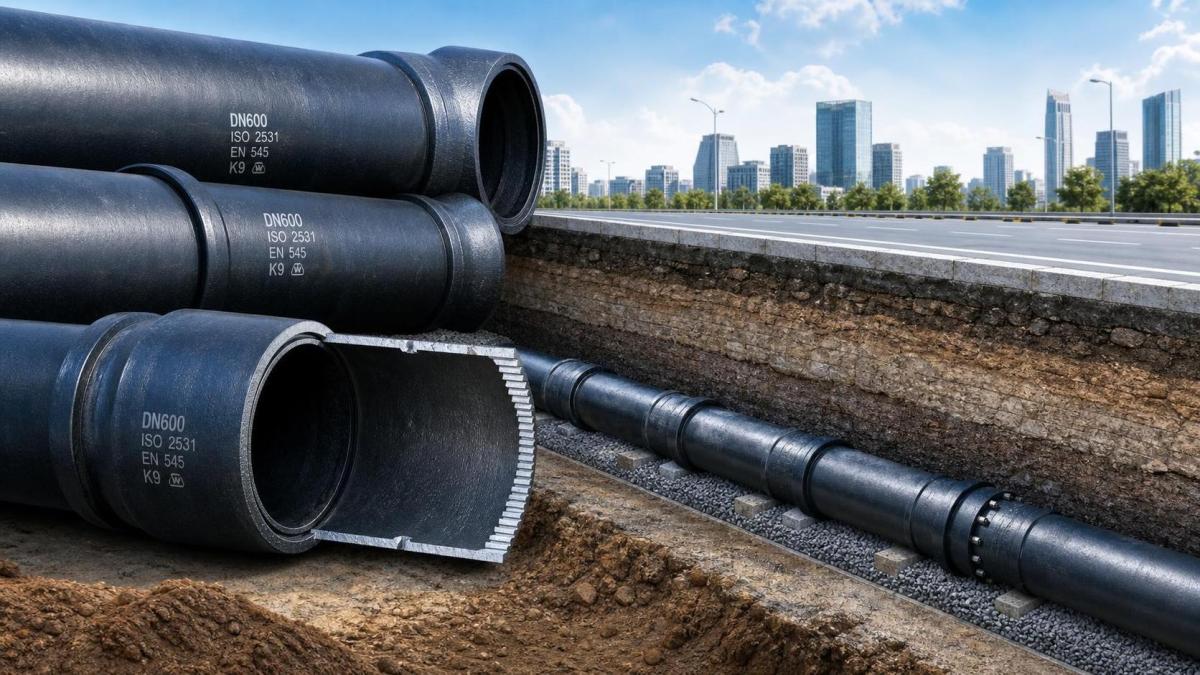
Ductile iron pipe belongs to the family of cast iron pipes, but it is not the same as older brittle cast iron products. The key difference is its microstructure. During production, molten iron is treated so that carbon forms as spherical graphite nodules instead of sharp flakes.
This change matters because graphite flakes create stress concentration points, which make conventional cast iron more prone to cracking. Spheroidal graphite, by contrast, improves elongation and toughness. As a result, ductile iron pipe can tolerate external loads, internal pressure fluctuations, transportation stress, and ground movement more effectively.
That is why engineers often classify ductile iron pipe as a pressure-rated, high-strength metallic pipe for underground infrastructure. It combines the structural advantages of iron with enough ductility to perform reliably in installations where rigid and brittle materials may create greater risk over time.
What type of pipe is ductile iron in practical use?
From a practical project perspective, ductile iron pipe is usually considered a municipal and industrial utility pipe. It is widely selected for potable water transmission, water distribution systems, wastewater force mains, raw water intake lines, irrigation networks, and fire water systems.
It is especially common in buried applications where the pipeline must resist soil loads, traffic loads, surge pressure, and long-term service wear. Because it is a metallic pipe with high ring strength, it performs well in installations where trench conditions, backfill quality, or external loading may be less predictable.
So if the question is “what type of pipe is ductile iron,” the clearest answer is this: it is a robust cast-metal pressure pipe engineered for infrastructure service, particularly where strength, durability, and secure joint performance are more important than having the lightest pipe option.
Why is ductile iron pipe trusted for demanding infrastructure projects?
Decision-makers rarely choose pipe material based on definitions alone. They choose based on risk, lifecycle cost, installation environment, and expected service life. Ductile iron pipe continues to be trusted because it addresses these practical concerns in a balanced way.
First, it has high tensile strength and good impact resistance. This helps during transportation, handling, and installation, and it also improves field reliability after burial. In municipal work, this matters because pipe damage often happens long before the line is placed into full service.
Second, ductile iron pipe handles internal pressure very well. Water networks are not static systems. Pumps cycle, valves open and close, and transient events occur. A pipe material that can manage pressure fluctuations without sacrificing long-term integrity is a strong advantage.
Third, it offers dependable jointing options. Push-on joints, mechanical joints, and restrained systems allow engineers and contractors to match the joint design to the project’s needs. Joint reliability directly affects leakage control, maintenance cost, and long-term system stability.
Fourth, ductile iron pipe is compatible with protective linings and external coatings that improve corrosion resistance. With appropriate design, material selection, and corrosion control measures, it can deliver a long operational life even in aggressive service conditions.
How does ductile iron pipe compare with other common pipe materials?
Readers evaluating pipe types usually want a comparison, because the choice is rarely made in isolation. Ductile iron pipe competes most often with PVC, HDPE, steel, and concrete pipe, depending on the application and pressure requirements.
Compared with PVC, ductile iron pipe is heavier and generally more expensive upfront, but it provides greater structural strength, better resistance to point loading, and stronger confidence in demanding buried conditions. For municipal buyers, that can justify the higher initial material cost.
Compared with HDPE, ductile iron pipe usually offers higher stiffness and excellent compressive strength, while HDPE may offer advantages in flexibility and certain corrosive environments. The better option depends on installation method, pressure class, soil conditions, and operational demands.
Compared with steel, ductile iron pipe often provides a strong balance between strength, manufacturability, and corrosion-protection systems for underground water infrastructure. Steel can be highly effective, but ductile iron is often preferred where standardized municipal water applications require proven, repeatable performance.
Compared with concrete pipe, ductile iron pipe is far more suitable for pressurized systems. Concrete products are commonly used for gravity flow in stormwater or sewer applications, while ductile iron is the more appropriate choice when pressure containment and mechanical joint integrity are required.
What are the main advantages buyers should pay attention to?
The most important benefit is long-term reliability. A pipeline is usually buried and expected to operate for decades. Once installed, repair is disruptive and expensive. Buyers therefore value materials that reduce the chance of failure and protect total project economics over time.
Another major advantage is load-bearing performance. Roads, intersections, industrial yards, and urban utility corridors all create external loading conditions. Ductile iron pipe has the structural capacity to withstand these environments with confidence when properly specified and installed.
Its service versatility is also important. The same core material platform can be used across water transmission, distribution, fire protection, and certain industrial fluid systems. That simplifies procurement and standardization for utilities, contractors, and infrastructure developers.
In addition, ductile iron pipe is supported by a mature ecosystem of fittings, joints, accessories, and complementary products. Infrastructure buyers often prefer systems with established standards and supply chains because that reduces procurement uncertainty and simplifies maintenance over the pipe’s life.
In related municipal applications, buyers may also source access and surface components made from the same durable material, such as Ductile Iron Manhole Cover4, where load resistance and long-term service are equally important.
What are the common concerns about ductile iron pipe?
One concern is weight. Ductile iron pipe is heavier than plastic alternatives, which can affect transportation, handling equipment, and installation speed. This is a real consideration, especially on projects with difficult access or where labor efficiency is the primary driver.
Another concern is corrosion. Although ductile iron is durable, metallic pipe installed in aggressive soils or exposed to corrosive conditions must be protected correctly. This does not make the material unsuitable, but it does mean corrosion control should be addressed early, not treated as an afterthought.
Cost is also a frequent question. The purchase price may be higher than some competing materials, but material selection should not be based only on unit price per meter. Buyers should evaluate breakage risk, expected maintenance, bedding sensitivity, design life, and replacement cost.
Some readers also ask whether ductile iron pipe is outdated because newer plastic materials are widely marketed. In reality, ductile iron remains a current and highly relevant choice because many water authorities and engineering teams continue to prioritize structural security and proven long-term field performance.
How should buyers judge whether ductile iron pipe is the right choice?
The best decision starts with the application. If the line will carry pressurized water, face external loads, operate in a busy municipal environment, or require long-term mechanical reliability, ductile iron pipe is often a strong candidate.
Next, consider the installation environment. Soil conditions, trench quality, traffic loading, burial depth, and surge pressure all influence whether a stronger pipe body offers practical value. In challenging ground conditions, a more robust pipe can lower lifecycle risk significantly.
Then evaluate system compatibility. A pipe is never used alone. Fittings, joints, sealing rings, and related access products all affect final performance. Buyers benefit from working with manufacturers that understand the full system rather than supplying only one isolated component.
Manufacturer capability also matters. Product consistency depends on foundry control, raw material management, casting quality, dimensional accuracy, and inspection discipline. These factors have a direct effect on how reliably the pipe performs in the field and how efficiently it installs.
Why integrated manufacturing capability matters
For infrastructure buyers, supply confidence is often as important as product specification. A manufacturer that combines smelting and casting processes has better control over chemistry, production stability, and quality consistency than a supplier that depends heavily on fragmented outsourcing.
Shanxi Datong Foundry Co.,Ltd., located in Chuandi Industrial Park, Zezhou County, operates as an integrated manufacturing factory specializing in ductile iron pipes, fittings, and rubber sealing rings. That combination is important because these components must work together as a practical pipeline system.
When a supplier understands both the metal casting process and the sealing interface, it is better positioned to support stable product performance, dimensional fit, and project reliability. For buyers, that can reduce coordination issues and improve confidence during specification and procurement.
This integrated approach also benefits related municipal cast products. In many projects, the same focus on durable material performance extends beyond pipe networks to supporting infrastructure components, including Ductile Iron Manhole Cover4 for surface access and protection needs.
Where is ductile iron pipe most suitable?
Ductile iron pipe is especially suitable for municipal water supply systems, transmission mains, pumping stations, industrial water lines, fire protection networks, and infrastructure zones with heavy traffic or variable ground loading. These are situations where strength and reliability carry clear value.
It is also a strong option when project owners want a material with a long performance record and broadly recognized engineering standards. In public infrastructure, that record matters because owners are accountable for service continuity, maintenance budgets, and long-term asset performance.
By contrast, for some low-load or highly corrosion-specific situations, other materials may be competitive or preferable. The right conclusion is not that ductile iron fits every project, but that it remains one of the most dependable choices where mechanical durability and pressure performance are central requirements.
Conclusion: what type of pipe is ductile iron?
Ductile iron pipe is a high-strength cast-metal pressure pipe designed for serious infrastructure work. It is not simply another version of old cast iron. Its ductile microstructure gives it the toughness, pressure capacity, and service reliability needed for water, drainage, and municipal systems.
For buyers, engineers, and project managers, the more useful takeaway is this: ductile iron pipe is usually the right type of pipe when the project demands structural strength, dependable joints, long service life, and confidence under real-world installation and operating conditions.
That is why it remains a trusted solution across utility networks worldwide. When supported by integrated manufacturing expertise in pipes, fittings, and sealing systems, it offers both technical value and procurement confidence for long-term infrastructure investment.
Navigation
Send Us A Message

First class quality service and professional after-sales team.
Get in Touch
*We respect your confidentiality and all information are protected.