Specifying EN 545 Ductile Iron Pipe for Trenchless Water Main Renewal
Trenchless water main renewal can protect roads, reduce surface disruption, and shorten the period that traffic or nearby operations are affected. It also concentrates risk underground: once installation begins, the pipe must tolerate pulling, jacking, localized ground pressure, alignment changes, and the operating pressure of the renewed main. For that reason, specifying EN 545 ductile iron pipe should begin with the installation method and the verified ground conditions—not with nominal diameter alone.
The core decision is to specify a complete pipe system with an EN 545-compliant pressure pipe, a joint arrangement suited to the expected tensile and angular movement, corrosion protection appropriate to the soil environment, and dimensions compatible with the trenchless method. A strong pipe barrel is important, but renewal performance often depends just as much on joint restraint, installation loads, access-pit geometry, and the transition details at existing connections.
Start with the renewal method, because it changes the pipe requirements
“Trenchless” covers several methods with very different mechanical demands. Pipe bursting, sliplining, horizontal directional drilling, guided boring, and short jacked installations do not load the product in the same way. A specification that works for an open-cut replacement may be incomplete for a pull-in or restrained installation.
- Sliplining: The new pipe is inserted through an existing host pipe. Outside diameter, bell configuration, joint profile, entry-pit space, and friction during insertion become central concerns. The reduced internal diameter after renewal also needs hydraulic review.
- Pipe bursting: The replacement pipe may be exposed to high pulling forces and irregular resistance from the fragmented host pipe and surrounding soil. The design needs a clear load path and a joint system that will not separate under installation tension.
- Directional drilling or guided installation: Curvature, bore stability, pulling loads, drilling-fluid management, and entry angle must be reviewed together. The allowable deflection at each joint does not replace control of the overall bore radius.
- Jacking from pits: Compressive loads, alignment, thrust transfer, and end protection need special engineering attention. Standard push-on joints should not be assumed suitable for transmitting jacking force unless the complete arrangement is designed for that purpose.
Before issuing the procurement specification, ask the installation contractor to identify the proposed method, maximum installation force, expected curvature, pit dimensions, and any anticipated obstructions. These are design inputs, not site details to be resolved after delivery.
Define the operating duty before selecting pressure class and wall design
EN 545 ductile iron pipe is intended for water applications, but the project specification should state the actual duty conditions: normal operating pressure, expected surge pressure, test pressure, static head, and any vacuum or transient conditions that could occur during filling, draining, or pump operation. Pressure class selection should be coordinated with these values and with the diameter, rather than treated as a standard line item.
A K9 pipe configuration can be appropriate where the hydraulic and structural design supports it. The supplied pipe data for Ductile Iron Pipe K9 includes a DN80–DN2600 size range, 1.0–1.6 MPa working pressure, tensile strength of at least 420 MPa, and elongation of at least 10%. Those values are useful starting points, but they do not remove the need to confirm the project’s surge conditions, trenchless installation loads, and connection constraints.
Do not write a pressure requirement without stating whether it refers to continuous service, hydrostatic testing, or transient conditions. Ambiguous pressure language can lead to a pipe that appears adequate in normal operation but has not been assessed for the most demanding part of its lifecycle.
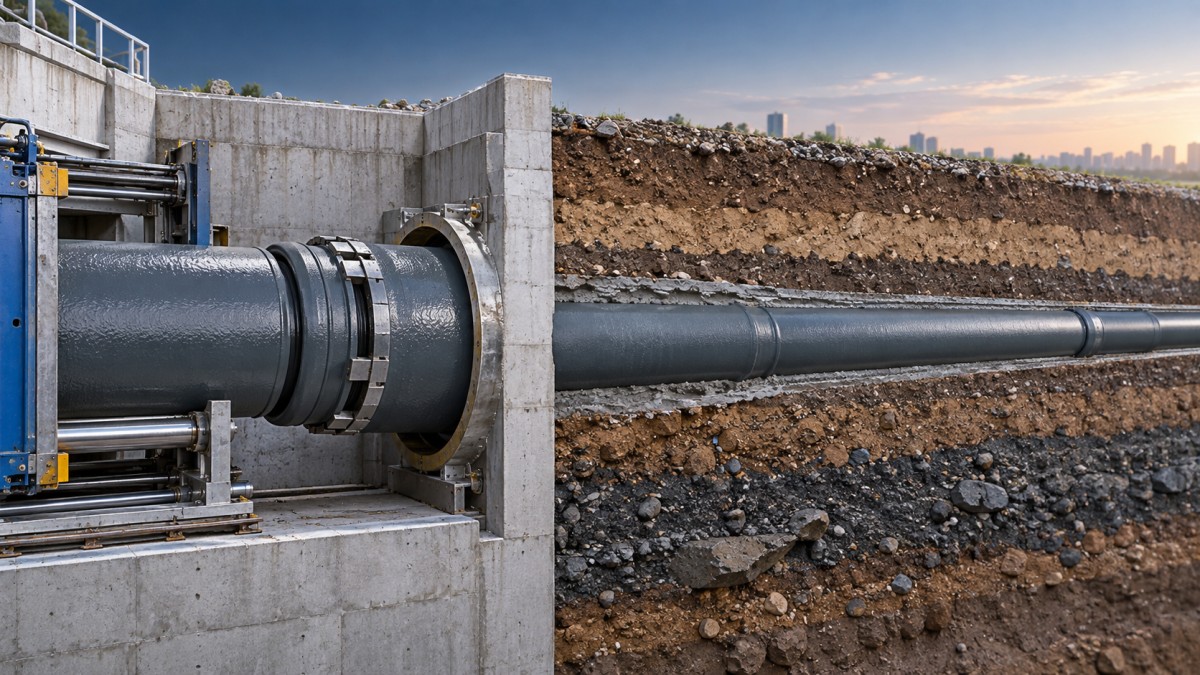
Joint selection is usually the point where trenchless specifications succeed or fail
In conventional buried pipelines, flexible push-on joints can accommodate limited angular deflection and ground movement while maintaining a seal. That flexibility remains valuable in renewal work, especially where access pits are limited or minor alignment adjustments are unavoidable. However, a flexible joint is not automatically a restrained joint.
Where the installation method introduces longitudinal pull, where thrust cannot be resisted by conventional thrust blocks, or where future ground movement may create axial forces, the specification should identify a suitable restraint strategy. This may involve self-restrained joints, designed restrained lengths, or engineered anchorage at bends, tees, valves, and connection points. The required approach depends on the loading case and network layout.
Questions to resolve in the joint schedule
- Will the pipe string be pulled, pushed, or both during installation?
- What is the maximum expected tensile force, including friction and contingency?
- Is joint deflection needed to follow the designed alignment, and what is the permitted deflection per joint?
- Are bends or changes in direction placed within a constrained pit area?
- How will thrust be controlled at valves, hydrant branches, dead ends, and transitions?
- Is the sealing ring suitable for the conveyed water and the specified installation conditions?
State the joint type at each relevant pipeline section rather than listing several alternatives without allocating their use. Push-on, flange, and self-restrained connections serve different functions. Flanged pipe is often useful in chambers, plant connections, or short accessible sections, while a restrained arrangement may be necessary where axial loads must be carried through the pipe string.
Check geometry at the pits, not only along the route
Many trenchless renewal constraints are discovered at launch and reception pits. A pipe length that is efficient for transport and open-cut laying may be difficult to handle where pit length, crane clearance, or insertion angle is restricted. Standard 6 m lengths, including lengths cut to 5.7 m where required, should be assessed against the actual working envelope and the method statement.
Review the outside diameter over the full joint profile, not merely the nominal bore. For sliplining, clearance inside the host pipe can be reduced by deposits, deformation, old joints, offsets, or local repairs. A condition survey may show that a theoretically suitable carrier pipe will not pass a particular section without cleaning, local excavation, or an alternative renewal method.
For curved routes, distinguish between gradual route curvature and abrupt direction changes. Gradual curvature may be managed through allowable joint deflection within the manufacturer’s limits. Abrupt changes generally require fittings or purpose-designed arrangements. Attempting to force a pipeline through a tighter radius than the joint system permits can damage coatings, overstress joints, or create difficult-to-detect sealing problems.
Specify protection as a response to the actual environment
Trenchless work can expose pipe coatings to abrasion during insertion and to unknown soil conditions after installation. The specification should identify the external protection system, any additional protection required by the soil investigation, and the inspection or repair procedure for coating damage at pits and connections.
Internal lining deserves equal attention. Water chemistry, sediment conditions, velocity, and the expected service duty influence lining selection and long-term hydraulic performance. Avoid generic wording such as “standard lining” when the project has known water-quality constraints or when the renewed main will connect to an existing system with different operating characteristics.
Where the alignment passes through aggressive soil, contaminated ground, or areas affected by stray current, the design team should confirm the corrosion-control approach before ordering. These conditions are not solved by simply specifying a higher wall class. Structural capacity and corrosion protection address different risks.
Write a procurement specification that can be checked on delivery
A usable specification allows the project team to verify what arrives on site. It should state the applicable standard, nominal diameter, pressure class or wall requirement, pipe length, joint type, lining, external coating, gasket requirements, fittings, restraint components, and required documentation. It should also set out how cut lengths, special pieces, and transitions to existing materials will be identified.
Coordinate pipe supply with installation sequencing
Even a correctly designed pipe system can create delays when fittings, gaskets, restrained components, and transition pieces are treated as separate late-stage purchases. Build a material schedule around the installation sequence: launch-pit components, intermediate pipe lengths, changes in alignment, receiving-end connections, valves, and commissioning items. Confirm that each component uses compatible dimensions and joint interfaces.
During receipt inspection, verify markings, dimensions, coating condition, joint cleanliness, gasket storage, and the availability of the required restraint hardware. Keep sealing surfaces protected from grit and damage. In a trenchless operation, a small defect at a socket or gasket can become difficult and expensive to access once the pipe has entered the bore or host main.
The most reliable EN 545 ductile iron pipe specification is therefore one that connects operating pressure, installation force, joint behavior, ground conditions, and connection details in a single coordinated package. That approach gives the construction team clear limits to work within and reduces the chance that a suitable pipe is paired with an unsuitable trenchless installation method.
Navigation
Send Us A Message

First class quality service and professional after-sales team.
Get in Touch
*We respect your confidentiality and all information are protected.