Can ductile iron pipe for water supply be installed by pipe bursting?
Can Ductile Iron Pipe for Water Supply be installed by pipe bursting? Yes—but only with a pipe and joint system specifically approved for the proposed pull-in installation. Standard push-on joints should not be assumed suitable. A successful project depends on verified pulling loads, adequate clearance around the pipe bells, compatible bursting equipment, and ground conditions that allow the existing main to be displaced safely.
For a project manager replacing a water main beneath a busy road, the attraction is clear: less continuous excavation, fewer disturbed surfaces, and potentially simpler reinstatement. However, trenchless replacement does not remove construction risk. It shifts much of that risk underground, where investigation, engineering checks, and supplier documentation become especially important.
The deciding factor is the joint, not simply the pipe material
Ductile iron offers strength and durability, but a pipe bursting installation imposes forces different from those experienced during normal water service. The replacement pipeline is drawn behind a bursting or splitting head, placing its joints under axial tension. Ground friction, alignment changes, and interruptions during installation can increase that demand.
A conventional rubber-gasket push-on joint provides a watertight connection but normally does not provide the axial restraint needed for pulling. Likewise, a joint described as “restrained” is not automatically approved for pipe bursting. Restraint intended for operating thrust must not be treated as evidence of suitability for trenchless installation.
Before selecting a system, obtain written confirmation covering:
- The exact pipe size, class, joint design, and installation configuration.
- Allowable axial pulling load and the applicable design safety margin.
- Permitted joint deflection during pulling, including any reduction in capacity at deflected joints.
- Approved pulling-head connection and load-transfer arrangement.
- Assembly, inspection, and coating-protection requirements.
The pulling arrangement must transfer force through the approved restraint system. An improvised attachment that concentrates load on a bell, gasket, or unapproved fitting can undermine an otherwise suitable pipeline.
Match the bursting method to the existing main
The material being replaced matters as much as the new pipe. Brittle pipes can often be fractured by an appropriate bursting head. Ductile materials, including existing ductile iron or steel mains, generally require cutting or splitting equipment rather than an assumption that they will shatter.
Static systems are commonly considered where controlled pulling and cutting are needed, but equipment selection remains project-specific. Pneumatic bursting is not a universal alternative, particularly where vibration sensitivity, nearby utilities, or replacement-pipe restrictions apply. The contractor should establish compatibility among the host pipe, tooling, pulling equipment, and new restrained-joint pipeline.
Investigate repair clamps, valves, tees, encasements, and changes in pipe material along the route. These can stop or complicate a pull, even when most of the existing main appears straightforward. Service connections also need an isolation and reconnection plan; pipe bursting does not eliminate those excavations.
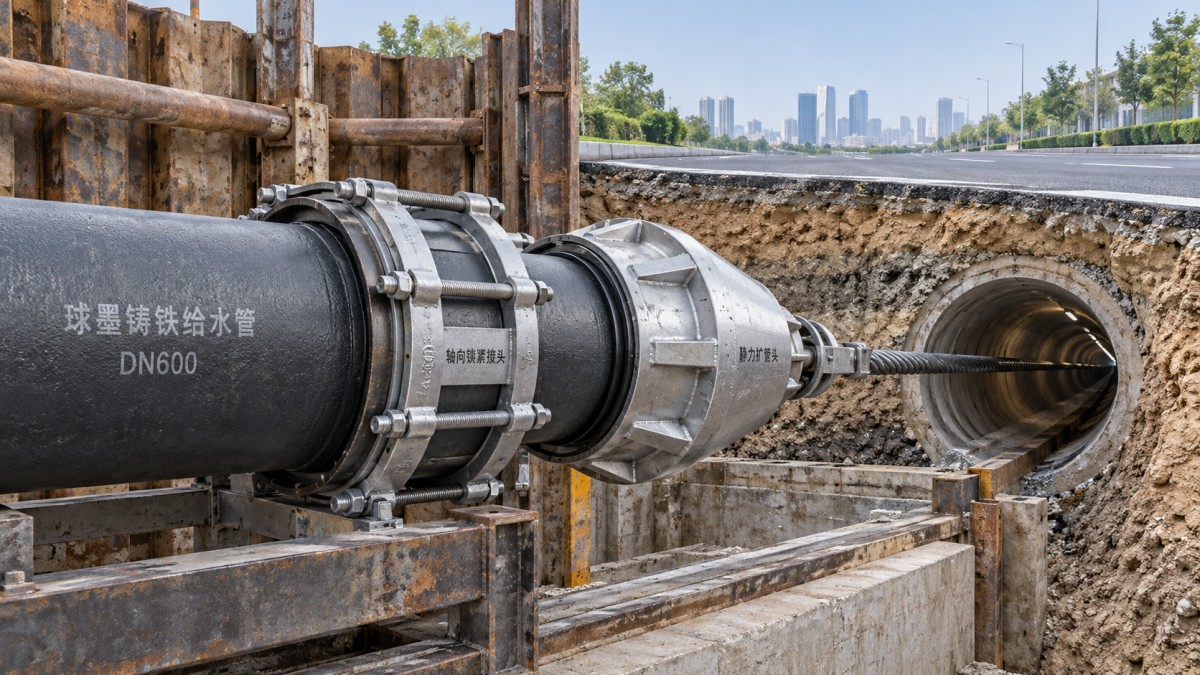
A useful installation drawing should show the bursting head, maximum replacement-pipe envelope, restrained joints, launch and reception pits, and adjacent utilities. That drawing often reveals clearance problems earlier than a nominal-diameter comparison alone.
Engineering checks that determine whether the route is workable
Pulling demand versus system capacity
The installation designer should estimate the pulling demand using the replacement length, ground resistance, pipe weight, alignment, enlargement requirements, and proposed installation method. The pipe supplier’s allowable installation loads must then be checked against that demand, with appropriate margins.
Machine pulling capacity is not the pipeline’s allowable load. A powerful rig may complete the pull while overstressing a joint or attachment. Specify load monitoring and a stop-work threshold below the approved limit, allowing for measurement uncertainty and transient increases.
Clearance around bells and restrained joints
For ductile iron pipe for water supply, the pipe barrel diameter is only part of the clearance calculation. Bells, locking components, and the pulling assembly can create a larger outside envelope. The bursting head and expansion arrangement must provide sufficient space for the largest component without excessive drag or damage.
More enlargement is not automatically better. Increasing the displaced ground volume can raise pulling demand and increase the risk of surface heave or movement near other utilities. Upsizing should therefore be evaluated against actual soil conditions and available separation distances.
Ground conditions and nearby infrastructure
Dense soils, rock, large cobbles, groundwater, and inconsistent backfill can alter installation behavior. Loose ground may present different concerns, including settlement or loss of stable support. Nearby gas lines, cables, foundations, and parallel water mains require location verification and an assessment of potential ground movement.
Use records, surveys, and targeted trial excavations to resolve uncertainty. Where separation is inadequate or consequences of movement are unacceptable, another trenchless method—or a short open-cut section—may be the safer choice.
Plan the installation around rigid pipe sections
Ductile iron is installed in discrete lengths, so site logistics differ from those for a continuous flexible pipe string. Depending on the approved system, sections may be assembled progressively at the launch pit or preassembled where space permits. Either approach needs enough room for handling, joint engagement, inspection, and alignment with the pulling path.
Do not assume joint deflection allows the pipeline to negotiate any convenient entry curve. Each joint has a defined limit, and pulling under deflection may introduce additional restrictions. Launch geometry must respect those limits without forcing the pipe against pit edges or the ground.
Where installation proceeds section by section, agree how pulling will pause for assembly and how restarting resistance will be managed. Safe access, lifting equipment, pit support, and groundwater control belong in the construction plan—not in an improvised solution once the rig is operating.
Keep pipe interiors clean and protect lining, coatings, and joint components during handling. Exterior protection should be compatible with passage through the enlarged bore; wrapping or corrosion-protection systems may need specific installation measures to prevent tearing or displacement.
What to request from the pipe and sealing-ring supplier
Shanxi Datong Foundry Co.,Ltd., located in Chuandi Industrial Park, Zezhou County, manufactures ductile iron pipes, fittings, and rubber sealing rings through integrated smelting and casting operations. For a pipe bursting enquiry, the useful starting point is a project specification rather than a request for pipe diameter alone.
Provide the route length, proposed replacement size, working pressure, existing pipe material, ground information, joint configuration, and estimated pulling demand. Ask for drawings, dimensional tolerances, restraint ratings, installation instructions, and evidence of compliance with the applicable project requirements. General water-pipe compliance does not, by itself, demonstrate approval for pull-in installation.
Sealing rings also require attention. A product listing such as Rubber Ring3 should be evaluated for compatibility with the selected joint, potable-water requirements, service temperature, and specified gasket material. The gasket supplies the seal; it must not be treated as the component providing axial restraint unless the documented joint design explicitly establishes that function.
Make acceptance criteria clear before construction begins
Agree what constitutes an acceptable installation before mobilization. The inspection and test plan should cover joint assembly records, pulling-force records, accessible pipe and coating inspections, pressure testing, flushing, disinfection, and commissioning under the governing specifications. A satisfactory pressure test is important, but it does not replace compliance with installation-load limits.
Also distinguish installation restraint from operating thrust restraint. Bends, tees, valves, and transitions still require an engineered approach to service loads, even if the pulled section uses restrained joints.
Pipe bursting is a viable option when the whole system is verified—not merely when ductile iron pipe is available. If joint approval, pulling capacity, ground clearance, or utility separation remains unresolved, address that uncertainty before procurement. A carefully chosen mixed-method replacement can be more practical than forcing one technique along the entire route.
Navigation
Send Us A Message

First class quality service and professional after-sales team.
Get in Touch
*We respect your confidentiality and all information are protected.