Raw material costs are a key driver of ductile iron pipe price movements, but their impact is rarely a simple, proportional calculation for buyers.
Changes in pig iron, steel scrap, and alloy prices can affect manufacturing costs, quotation validity, and procurement budgets, especially when projects require deliveries over several months.
For business decision-makers, the practical question is whether a supplier’s price adjustment reflects measurable cost pressure, different specifications, or commercial conditions that deserve further negotiation.
Shanxi Datong Foundry Co., Ltd., located in Chuandi Industrial Park, Zezhou County, manufactures ductile iron pipes, fittings, and rubber sealing rings, combining smelting and casting operations.
This integrated production context helps explain how input costs reach finished pipe quotations and what buyers should examine before committing budgets or negotiating supply contracts.
Which Raw Materials Actually Drive Your Pipe Quotation?
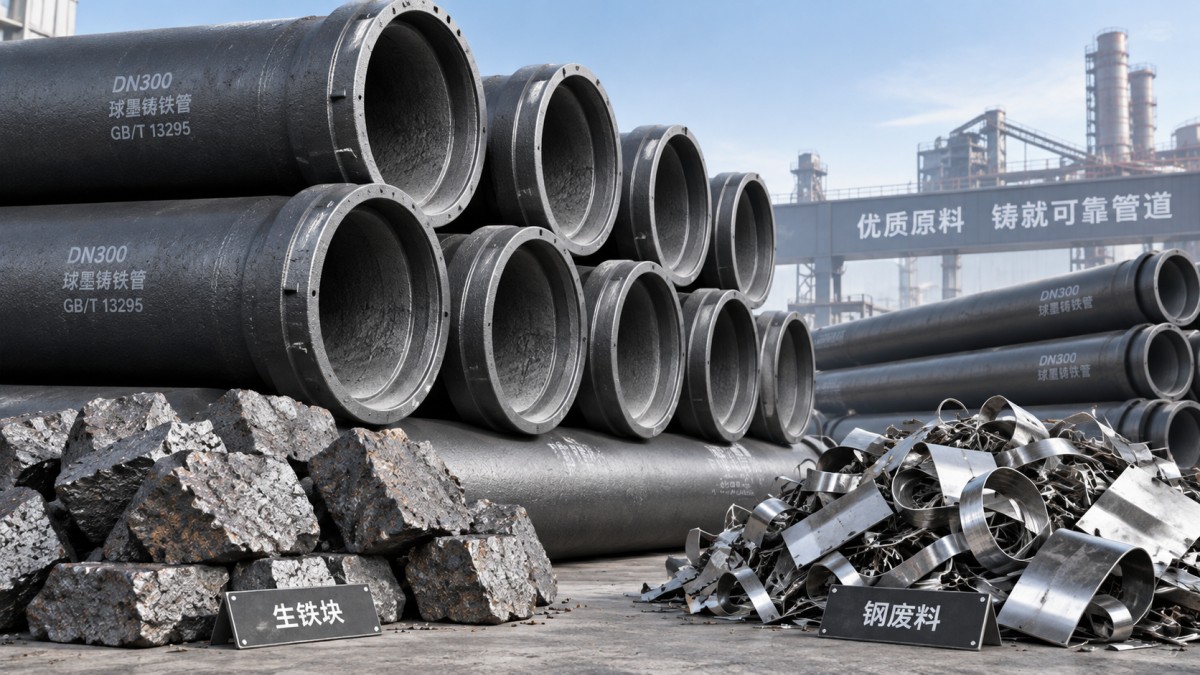
Pig iron and steel scrap supply much of the metallic charge used in ductile iron production. Their relative importance depends on the foundry’s operating practices.
Higher pig iron prices can increase metal costs, particularly where charge recipes depend heavily on pig iron to maintain chemistry and achieve consistent casting quality.
Steel scrap offers another metallic input, but its usefulness depends on grade, availability, contamination levels, and chemistry. Cheaper scrap does not automatically deliver cheaper finished pipes.
Magnesium-bearing treatment materials enable the graphite structure associated with ductile iron. Inoculants and other alloy additions support metallurgical control, although quantities and formulations vary between manufacturers.
These additions generally represent less mass than the main metallic charge, yet sharp price increases can still matter because their use serves essential process requirements.
Buyers should therefore monitor an input basket rather than one headline commodity. A pig iron index alone cannot explain every movement in a finished quotation.
Why a 10% Material Increase Does Not Mean a 10% Pipe Increase
A finished pipe price includes metallic inputs, energy, labor, casting losses, machining, coatings, testing, overhead, and margin. Delivered quotations may also include freight and other charges.
Raw materials influence only part of this total. Their effect depends on the exposed cost share, existing inventory, purchasing arrangements, production efficiency, and supplier pricing decisions.
Consider the following illustrative cost model. These figures explain the calculation; they are not market quotations, verified factory costs, or a forecast for any manufacturer.
In this example, a 10% increase in the entire material basket raises total modeled cost by 5%. Actual selling prices can move differently as margins change.
If only one material rises, the effect becomes smaller unless that input dominates the basket. Request an explanation of the relevant exposure before accepting proportional increases.
A useful budgeting approximation is material exposure multiplied by the expected basket change. Treat the result as a scenario estimate, then assess other costs separately.
When Will Commodity Changes Reach Your Purchase Price?
Price transmission often takes time. A manufacturer consuming previously purchased materials may experience a different immediate cost impact from one buying inputs for each new order.
Quotation strategy also matters. Some suppliers price against expected replacement costs, while others prioritize order volume, inventory turnover, or existing contractual commitments when setting offers.
Consequently, rising commodity prices may shorten quotation validity before they produce a substantial increase. This creates procurement risk when internal approvals take longer than expected.
Falling input prices can reach quotations gradually because manufacturers still hold expensive inventory or face unchanged energy, financing, and processing costs during the same period.
Ask suppliers when a price becomes binding: quotation acceptance, deposit receipt, production scheduling, or another milestone. Ambiguous timing can undermine an apparently attractive commercial offer.
For staged deliveries, clarify whether the agreed price covers the entire order or only individual releases. Delivery dates and price commitments should be documented together.
How Can You Tell Whether Two Quotations Are Comparable?
Before evaluating a ductile iron pipe price difference, align the technical scope. Nominal diameter alone does not establish equivalent weight, performance, manufacturing effort, or delivery requirements.
Compare the applicable standard, pressure designation or wall class, pipe length, joint configuration, lining, external coating, inspection requirements, and supplied accessories across every competing quotation.
For flanged products, confirm flange drilling, facing requirements, and applicable standards. Additional machining and dimensional requirements can change costs independently of movements in pig iron prices.
For drinking water or sewage projects, Flanged Di Pipe lists DN80–DN2600 mm sizes and PN10, PN16, PN25, and PN40 pressure designations for specification review.
Confirm the available diameter and pressure combinations, lining suitability, and required approvals with the supplier. A published product range does not establish every combination’s availability.
The supplied product information states production capacity of 500,000 tons annually. Buyers should confirm the capacity available for their order, scheduling commitments, and dispatch dates.
Normalize quotations to the same currency and delivery basis. Separate freight, taxes, duties, fittings, gaskets, and testing charges before attributing a price gap to materials.
Should You Buy Now, Phase Orders, or Wait?
The strongest purchasing decision balances potential price savings against schedule consequences. Waiting for cheaper materials can become expensive if delayed pipes interrupt construction or commissioning.
Where specifications and installation dates are firm, securing critical quantities can protect the schedule. Assess storage, handling, cash flow, and damage exposure before accelerating purchases.
Where demand remains uncertain, phased orders may limit inventory commitments. However, smaller releases can affect production scheduling, freight efficiency, and exposure to future price adjustments.
Build three budget scenarios using lower, stable, and higher input costs. Add separate assumptions for freight and currency movements rather than hiding them inside material estimates.
Compare possible purchasing savings with financing costs, storage expenses, and the commercial impact of a delay. This converts commodity uncertainty into a decision about project economics.
Track suitable regional material benchmarks and obtain comparable supplier quotations at consistent intervals. Broad trends are more useful than reacting to isolated daily price movements.
What Should a Material-Based Price Adjustment Clause Include?
For longer supply agreements, an adjustment clause can allocate material risk more predictably. Its usefulness depends on transparent mechanics and a benchmark relevant to production inputs.
Define the base date, reference index, exposed price share, calculation interval, and timing lag. Specify the applicable grades, geography, currency, and treatment of discontinued benchmarks.
Use a weighted basket where multiple inputs materially affect costs. Avoid adjusting the entire contract value by a single commodity percentage without a defensible exposure basis.
Include downward adjustments as well as increases. State any thresholds, caps, floors, and supporting documentation requirements so both parties understand how price changes will operate.
Address energy, freight, and exchange rates separately if they warrant adjustment. Overlapping mechanisms can otherwise charge buyers twice for the same underlying movement in costs.
Keep quality requirements fixed throughout negotiations. A lower quotation offers limited value if changed materials, coatings, or inspection arrangements create acceptance problems and project delays.
Make Purchasing Decisions on Total Cost and Evidence
Raw material movements explain an important part of ductile iron pipe price changes, but they become commercially meaningful only when connected to specifications, timing, and contractual exposure.
Before approving an increase, establish what changed, how much of the quotation is affected, and when the impact applies. Then compare equivalent offers and delivery commitments.
The goal is a defensible purchasing decision: secure suitable pipes on a workable schedule, budget for credible cost changes, and negotiate adjustments that remain transparent in both directions.