What drives the K9 ductile iron pipe price premium over K7?
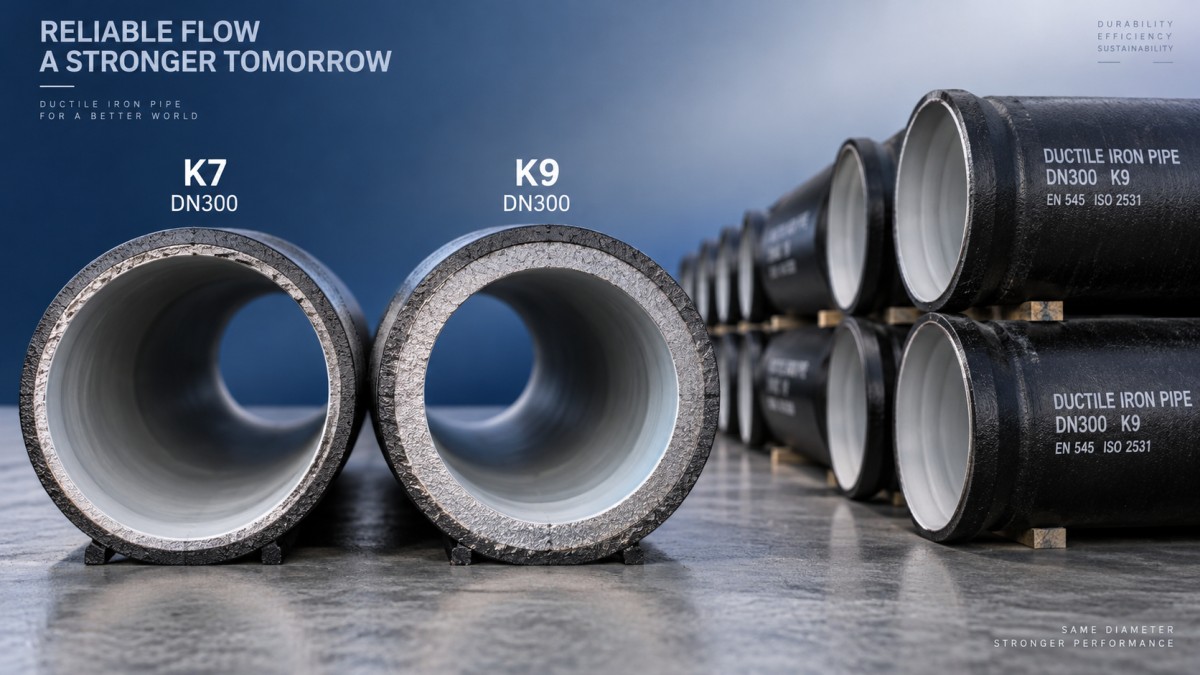
K9 ductile iron pipe generally costs more than K7 because, at the same nominal diameter and under the same applicable specification, its greater nominal wall thickness requires more iron and increases pipe weight. That adds material cost and can raise handling and freight costs. The premium becomes commercially justified when the additional wall thickness satisfies a project requirement or provides a design margin that the engineer has identified as valuable.
There is no reliable universal percentage for the difference. A K9 Ductile Iron Pipe Price comparison only becomes useful when diameter, length, lining, coating, joint type, inspection requirements, quantity, and delivery terms are aligned. Otherwise, the quoted gap may say more about the scope of supply than about the difference between K9 and K7.
How additional wall thickness reaches the quotation
Within the same K-class specification, K9 has a greater nominal wall thickness than K7 at a given diameter. More metal per metre is the main physical reason for the price premium. The foundry must purchase and process that additional material, and the finished pipe carries more weight through storage, loading, and delivery.
The extra cost does not translate directly into a fixed percentage increase in the selling price. A pipe quotation also contains costs that do not rise proportionally with wall thickness: mould preparation, process control, inspection, lining application, documentation, and commercial overhead. Suppliers may allocate these costs differently depending on order size and production scheduling.
A buyer should therefore avoid treating the ratio between the class numbers as either a finished-pipe weight ratio or a price multiplier. Pipe mass also reflects geometry, socket construction, manufacturing tolerances, and any included lining or coating. The most useful evidence is the supplier’s declared mass per pipe or per metre for the exact specification being offered, with a clear statement of what that mass includes.
Commercial evaluators can compare the premium at two levels. Price per usable metre shows the actual purchase consequence. Price per tonne, where comparable mass data are available, helps assess whether the difference is broadly consistent with added material or whether another commercial factor needs explanation. Neither measure replaces the other: a lower price per tonne can still produce a higher installed-length cost.
Transport introduces another variable. Where a shipment reaches its payload limit before its space limit, heavier pipe can reduce the number of metres carried in each load. Where loading space or pipe dimensions set the limit, the freight difference may be smaller. Ask for a loading plan and delivered freight cost rather than assuming that freight rises in direct proportion to pipe weight.
Separate the K-class premium from differences in supply scope
Two quotations headed “K7” and “K9” can conceal substantial differences. Before negotiating the premium, establish that both suppliers are pricing the same project requirements. The applicable standard and edition deserve particular attention because wall-thickness classes and pressure-class designations should not be treated as interchangeable purchasing labels.
A concise comparison sheet should capture the following:
- Pipe dimensions: nominal diameter, effective laying length, nominal wall thickness, applicable tolerances, and declared mass.
- Joint arrangement: joint type, gasket specification, and whether any required restraint is included.
- Protection system: internal lining and external coating, including the specified materials and application requirements.
- Quality scope: required testing, inspection documents, acceptance criteria, and any third-party inspection.
- Commercial basis: quantity, currency, quotation validity, delivery term, packaging, freight, taxes, and included accessories.
Coating and lining differences can materially affect the comparison. If one offer includes a protection system selected for the project’s soil or conveyed fluid and another includes a different finish, the price difference cannot be attributed entirely to K9. Ask the supplier to separate the wall-class change from other specification changes wherever practical.
Order composition also matters. A large, repeated diameter may be priced differently from a small batch spread across several sizes. A supplier’s production schedule, available stock, and quoted lead time can influence the offer independently of the extra iron. Quotes issued at different times may also reflect different material, energy, or freight assumptions.
For pipe fittings such as a Flanged Spigot, compare the specified dimensions, flange drilling, pressure rating, protection, and joint compatibility separately. Changing the straight pipe from K7 to K9 does not automatically establish the suitability of the fittings. Bundled pipe-and-fitting quotations should identify those costs clearly so that a change in accessory scope does not distort the apparent pipe premium.
When does paying for K9 deliver value?
The strongest reason to accept the premium is an engineering requirement supported by the project design. Internal pressure, surge conditions, external loads, installation geometry, bedding support, and handling conditions all contribute to pipe selection. Greater wall thickness may be relevant to that assessment, but the K designation alone does not settle it.
In particular, K9 should not be read as a standalone pressure rating. The allowable operating conditions depend on the governing specification, the pipe characteristics, and the complete joint and fitting arrangement. A thicker pipe barrel does not remove a limitation at a flange, gasket, restrained joint, or other component.
For a buried pipeline, pipe performance also depends on the surrounding installation. Cover depth, traffic loading, trench conditions, and the quality of bedding and backfill influence the design assessment. Additional wall thickness may provide a useful margin in a particular design, but it should not be used to excuse poorly controlled installation.
Corrosion requires similar discipline. More metal may provide an allowance where that is explicitly part of the design, but it does not replace a suitable protection system. A claim that K9 necessarily lasts longer than K7 leaves out the effects of soil conditions, conveyed water, coating integrity, installation damage, and maintenance. Buyers should request the basis for any service-life claim before assigning it financial value.
If both classes satisfy the approved design, the commercial question becomes narrower: what measurable benefit does the additional expenditure buy? The answer might be a specified design margin, compliance with an owner’s requirement, or standardisation across a network. If no such benefit is identified, paying more for thickness alone is difficult to justify.
Turn the premium into a decision the project can defend
Ask for paired K7 and K9 offers against one agreed specification, issued on the same commercial basis. The comparison should show the pipe price per effective metre, total quantity, declared mass, freight, and any changes to handling or installation arrangements. This makes the source of the premium easier to identify and prevents an attractive unit price from hiding a higher delivered cost.
Then apply the difference to the actual pipe schedule. A premium on one diameter should not be extrapolated across the entire project: mass, quantities, loading efficiency, and production economics vary by size. Include additional handling costs only where they follow from the proposed equipment and lifting plan, rather than assuming that every increase in weight requires different machinery.
The engineering and commercial decisions should meet at this point. If K7 fails the project’s design requirements, its lower quotation is not a viable saving. If both classes comply, compare the incremental delivered cost with the specific benefit established for K9. Ask the design authority to explain that benefit in terms the procurement team can carry into its evaluation.
A defensible purchase decision records the applicable specification, the reason for the selected wall class, and the cost difference on an equivalent supply basis. Where K9’s additional thickness addresses a defined requirement, its premium has a clear purpose. Where the only explanation is that the higher class number must be better, the buyer still needs a technical reason to spend more.
Navigation
Send Us A Message

First class quality service and professional after-sales team.
Get in Touch
*We respect your confidentiality and all information are protected.