How to disinfect ductile iron pipe before putting it into water service
How to disinfect ductile iron pipe before putting it into water service
Before a new Ductile Iron Pipe for Water Supply enters service, proper disinfection helps protect drinking water quality from contamination introduced during storage, handling, and installation. For operators, the process involves more than adding chlorine: it requires thorough cleaning, an approved disinfection method, controlled contact time, and satisfactory bacteriological results before commissioning. The procedure should follow the applicable edition of AWWA C651 and the local water authority’s requirements.
The most common mistake is treating disinfection as a final task that can compensate for poor installation hygiene. Chlorine cannot reliably overcome trapped soil, accumulated debris, or an unflushed branch. A successful commissioning starts while the pipe is still being laid.
Keep contamination out before introducing water
Inspect pipe interiors, fittings, valves, and joint components before assembly. Remove foreign material using methods compatible with the internal lining. Keep open ends capped during work stoppages, and prevent trench water from entering the pipeline. If flooding or sewage exposure occurs, stop and agree on a corrective cleaning and disinfection procedure with the water authority; ordinary commissioning assumptions may no longer apply.
Ductile iron pipes may have cement-mortar or other specified internal linings. Confirm the lining type rather than assuming every pipe has the same chemical tolerance. Obtain the manufacturer’s guidance for disinfectant exposure, gasket compatibility, and cleaning methods. Aggressive scraping or uncontrolled chemical treatment can damage components without improving sanitation.
Shanxi Datong Foundry Co.,Ltd., located in Chuandi Industrial Park, Zezhou County, manufactures ductile iron pipes, fittings, and rubber sealing rings through integrated smelting and casting operations. For a commissioning team, the useful supplier information is the actual component specification: lining details, sealing-ring material, and any restrictions relevant to the proposed treatment.
Plan the treatment boundary and flushing route
Before filling, identify the section being disinfected, its internal volume, injection point, outlets, air-release points, and sampling locations. Include branches and appurtenances that will carry potable water. A main can receive adequate treatment while a closed branch remains untreated.
Use an approved arrangement to protect the existing drinking-water network from backflow. Do not rely on an improvised hose connection or a single closed valve as the entire protection strategy. Coordinate hydraulic testing, temporary connections, and disinfection so that later work does not reintroduce contamination.
Where a connection or repair involves a Straight Split Sleeve, verify its suitability for the pipe dimensions, operating conditions, and potable-water application. Follow the approved installation procedure and include affected wetted surfaces within the cleaning and disinfection boundary.
For methods requiring preliminary flushing, use potable water and the flow conditions specified by the approved procedure. Water that looks clear is not proof that settled material has been removed. If available supply cannot achieve the required flushing conditions, have the engineer or authority approve an alternative rather than simply extending a weak flush.
Choose a method the crew can actually control
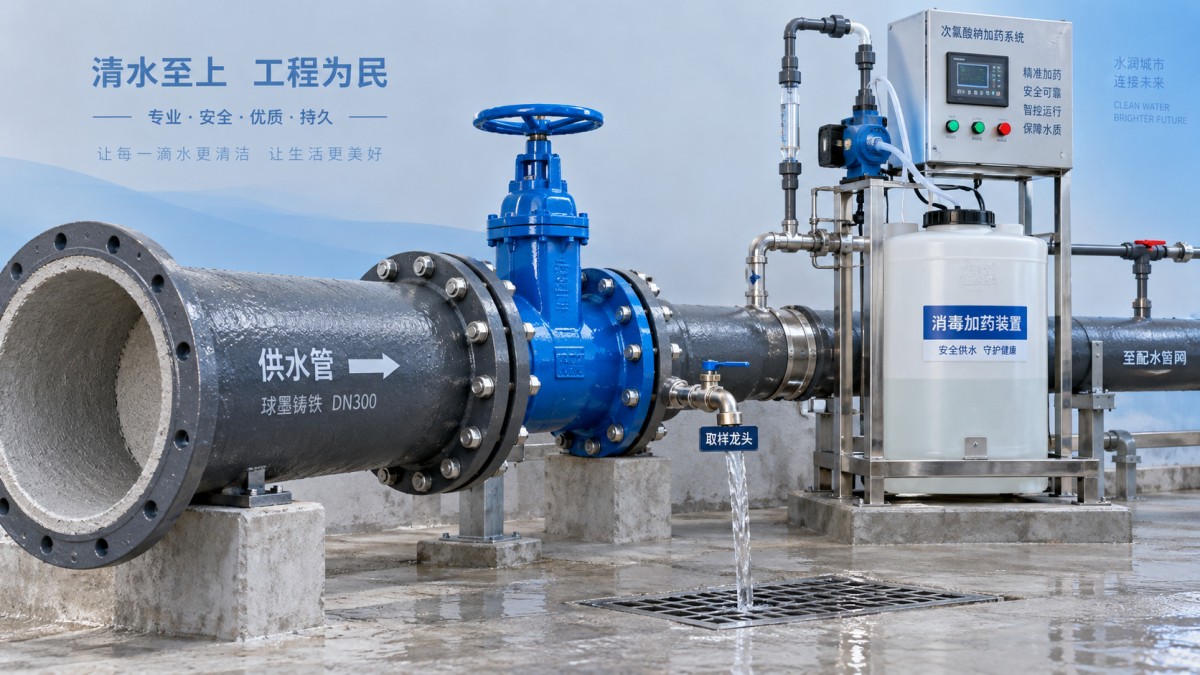
AWWA C651 describes different disinfection approaches, including continuous-feed, slug, and tablet or granule methods. Their preparation requirements and operating limits are not interchangeable. Select the method before installation activities make that choice impractical.
- Continuous-feed treatment: Chlorinated water fills the section, followed by a prescribed holding period. It requires controlled dosing and confirmation that treated water reaches the full treatment boundary.
- Slug treatment: A concentrated chlorinated volume moves through the pipeline. Flow, residual concentration, and exposure time must be controlled along the route, not just at the injection point.
- Tablet or granule treatment: This requires advance planning and is restricted to conditions permitted by the applicable standard. It is not a substitute for cleaning a contaminated main.
Record the required initial chlorine concentration, minimum exposure time, and acceptance residual from the approved procedure. Do not combine a concentration from one method with a contact time from another. Where project specifications and authority requirements differ, resolve the discrepancy before dosing.
Calculate the dose, then verify it in the pipe
Use actual internal diameter and section length to estimate water volume. For a cylindrical section, volume equals π multiplied by internal diameter squared, divided by four, multiplied by length. Keep units consistent and account for significant branches or chambers.
The theoretical available-chlorine mass in grams equals the target concentration in milligrams per litre multiplied by volume in cubic metres. Converting that mass into a disinfectant quantity requires its available-chlorine content and, for liquids, the relevant concentration and density information. Stored hypochlorite can lose strength, so an old label may not represent current potency.
Calculation establishes a starting dose; field measurements establish whether treatment conditions were achieved. Use a chlorine test method suitable for the expected concentration. Ordinary low-range instruments may give misleading results at disinfection concentrations. Follow validated dilution procedures where required.
Control contact time and investigate chlorine loss
Confirm treated water has reached representative outlets before applying the prescribed contact-time requirement. Maintain the specified hydraulic conditions and document chlorine readings at the locations and intervals required by the approved method. Treat valves, hydrant leads, and other included appurtenances according to the procedure.
An unexpectedly low residual can indicate chlorine demand, dilution, poor distribution, or untreated water entering the section. Check the dosing equipment, isolation arrangement, and cleanliness before adding more chemical. If treatment conditions fail, follow the approved corrective procedure; do not assume extra holding time automatically makes the section acceptable.
Chemical handling requires trained personnel, appropriate protective equipment, and the product safety data sheet. Never mix hypochlorite with acids or incompatible cleaners. Keep dosing operations separate from confined-space entry activities.
Flush, sample, and release only after acceptance
After the required treatment, flush with potable water until the residual meets the authority’s service and sampling requirements. Plan discharge before opening an outlet. Highly chlorinated water may require controlled dechlorination, and discharge must meet applicable environmental requirements.
Arrange bacteriological sampling through the authority or an accepted laboratory. Follow the specified sampling locations, timing, number of samples, and acceptance criteria. Use suitable sampling taps and sterile bottles containing the required chlorine neutralizer; avoid arrangements that can contaminate the sample.
A failed result requires investigation and corrective action under the approved procedure. Clear water and a satisfactory chlorine reading do not replace microbiological acceptance. Likewise, a passing sample does not excuse incomplete treatment records.
Before commissioning, retain the treatment boundary drawing, dosing records, residual measurements, flushing details, laboratory results, and release authorization. If the pipeline is opened or altered afterward, ask the authority whether further disinfection and testing are needed. Put the main into service only when the approved acceptance process is complete.
Navigation
Send Us A Message

First class quality service and professional after-sales team.
Get in Touch
*We respect your confidentiality and all information are protected.