Why DN100 ductile iron pipe does not have a 100 mm outside diameter
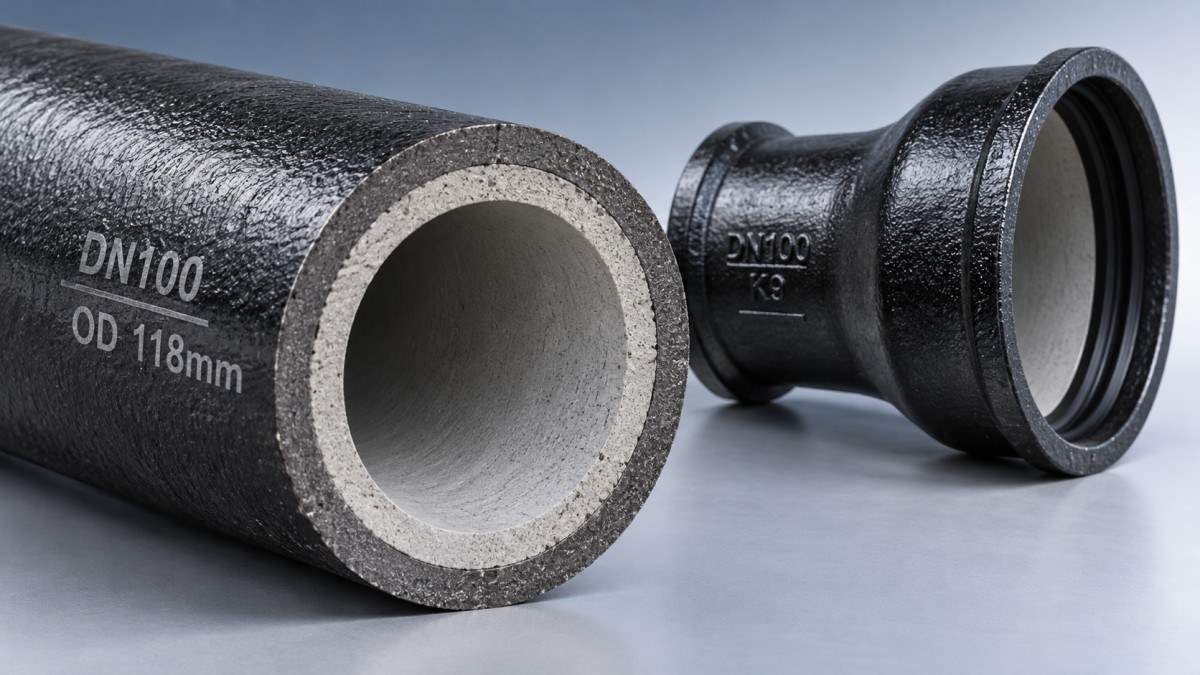
A DN100 Ductile Iron Pipe commonly has a specified outside diameter of 118 mm in widely used international and European dimensional systems. The number 100 identifies its nominal size; it does not prescribe a 100 mm outside diameter. The pipe’s external dimensions come from the applicable dimensional standard, while its internal opening also reflects wall thickness and lining.
That distinction matters at a connection. A fitting selected for a 100 mm outside diameter will not fit a pipe whose specified barrel diameter is 118 mm. However, a compatible DN100 ductile iron socket fitting is designed around the dimensions assigned to that nominal size. The shared designation works when the pipe and fitting belong to compatible dimensional and joint systems.
DN100 is a size designation, not a measurement
DN means nominal diameter. It provides a common way to identify the size of pipes, fittings, valves, and other pipeline components. The number following DN is related to the size of the flow passage, but it should not be treated as an exact measured bore.
Writing “DN100” therefore communicates a standardized size category. It does not establish the outside diameter, finished inside diameter, wall thickness, or socket dimensions by itself. Those details require the relevant specification or dimensional drawing.
The distinction becomes clearer when comparing materials. A steel pipe, plastic pipe, and ductile iron pipe described with similar nominal sizes can have different outside diameters. Some pipe systems use outside diameter as the primary size reference; others use nominal designations associated with a standardized dimensional series. Substituting one convention for another creates apparent contradictions where none exist.
Where the 118 mm dimension comes from
The 118 mm outside diameter is an assigned value in a standardized ductile iron pipe size series. It gives pipes and matching joints a defined external interface. It should not be interpreted as a universal calculation in which 100 mm of internal diameter plus two fixed wall thicknesses always produces 118 mm.
That arithmetic would imply a constant wall thickness and an exact 100 mm bore. Neither assumption follows from DN100. Different permitted wall thicknesses can exist within the same nominal size, and an internal lining further changes the finished opening.
A stable outside diameter allows compatible sockets and sealing systems to accommodate pipes with different specified wall thicknesses. The wall thickness changes inward while the external connection dimension remains controlled. This supports interchangeable connection geometry within the relevant system, subject to its tolerances and joint requirements.
The qualification “within the relevant system” matters. The DN label alone does not guarantee that every product sold internationally follows the same dimensional series. A regional specification or another pipe system can use different sizing conventions. Treat 118 mm as the expected specified barrel diameter only after confirming that the product documentation uses that dimensional series.
The bore changes with the wall and lining
A pipe cross-section contains separate dimensions: the outside of the iron barrel, the inside of the iron wall, and the finished surface of any internal lining. Confusing those boundaries is a common reason for expecting the wrong diameter.
For an ideal circular section with uniform thickness, the dimensional relationship is:
Finished inside diameter = iron barrel outside diameter − twice the iron wall thickness − twice the internal lining thickness.
This relationship explains the geometry; a product drawing supplies the actual values and tolerances. If the iron wall becomes thicker while the barrel outside diameter stays fixed, the bore becomes smaller. Adding an internal lining reduces the finished bore again without changing the nominal designation.
Cement mortar lining, where specified, belongs in the assessment of the waterway rather than the structural iron thickness. External coatings also need separate treatment. A measurement over a coating includes that coating, whereas a drawing may define its reference dimension at the iron surface. The applicable specification determines the dimensional reference and acceptance method.
Consequently, subtracting 100 from 118 and dividing by two does not establish the pipe’s wall thickness. That calculation assumes the finished bore is exactly 100 mm and ignores the lining. Obtain the specified wall and lining dimensions directly when evaluating a pipe section.
Pressure classification does not redefine DN100
A pressure class and a nominal size describe different properties. DN100 identifies the size series; the class identifies a specified performance category under the applicable pipe standard. A class change can affect the required wall thickness without changing the standardized barrel outside diameter.
This is why two DN100 pipes can share the same external connection dimension while having different internal dimensions. It also explains why outside diameter alone cannot establish pressure suitability. Material requirements, wall thickness, the joint design, and the applicable rating all contribute to that assessment.
When examining a listing such as Grade C Ductile Iron Pipe, the product title does not establish the complete dimensional specification. The accompanying technical data still needs to identify the nominal size, dimensional standard, outside diameter, wall requirements, and joint arrangement. A grade or class label cannot replace those details.
Matching a fitting requires more than the DN label
For a socket connection, the pipe spigot engages a gasket held within the socket. The sealing arrangement depends on the specified spigot diameter, dimensional tolerances, gasket profile, and socket geometry. A matching nominal size is the starting point, but compatibility also requires the correct joint system.
A mechanical coupling introduces a different requirement: its published outside-diameter range must include the actual pipe dimension. A coupling described simply as “100 mm” could refer to nominal size or to a measured diameter range. The accompanying drawing or range table resolves that ambiguity.
Flanged connections require another comparison. DN100 describes nominal size, while the flange standard and pressure designation determine details such as the bolt pattern and mating dimensions. The pipe’s 118 mm barrel diameter does not establish whether two flanges will bolt together.
Transitions between ductile iron and another material are particularly sensitive to sizing conventions. Each side of an adaptor must match its respective pipe outside diameter. Assigning both pipes a nominal size of 100 does not demonstrate that their external dimensions are equal.
Interpreting a measurement on an actual pipe
Measure the straight barrel or designated spigot area when assessing the pipe outside diameter. The enlarged socket has a different external dimension, so a reading taken across it cannot confirm the barrel size.
Surface condition also affects the result. Coating buildup, adhering material, and local damage can influence a reading. Measurements in more than one direction help distinguish a general diameter difference from local ovality, although acceptance must follow the specified inspection method and tolerances.
A measured diameter close to 118 mm on a DN100 pipe is consistent with the dimensional system described here. It does not, by itself, prove that the pipe meets every requirement. Likewise, a small difference from the specified diameter requires comparison with the permitted tolerance before it is treated as a defect.
A useful specification keeps the separate requirements visible: DN100, the applicable dimensional standard, the specified barrel outside diameter, the required class, lining details, and the connection type. With those entries defined, “100” and “118 mm” describe different aspects of the same pipe without ambiguity.
Navigation
Send Us A Message

First class quality service and professional after-sales team.
Get in Touch
*We respect your confidentiality and all information are protected.