
How K9 ductile iron pipe relates to pressure classes in ISO 2531
K9 ductile iron pipe does not correspond to one universal pressure class under ISO 2531. K9 identifies a wall-thickness class, whereas a pressure-class designation identifies pressure-related capability under the applicable standard requirements. When a pipe schedule specifies K9 but a supplier submits a C-class product, neither equivalence nor noncompliance can be established from those labels alone.
This distinction matters during technical approval: treating K9 as a fixed pressure rating can result in accepting a pipe or joint that does not satisfy operating pressure, surge pressure, or site testing requirements. The assessment must connect the specified standard edition, nominal diameter, wall thickness, and declared pressure limits for the actual pipe-and-joint configuration.
K9 describes thickness, not a fixed number of bar
In the K-class approach, the class coefficient determines nominal iron wall thickness in relation to nominal diameter. The familiar relationship is:
e = K × (0.5 + 0.001 × DN)
Here, e is nominal wall thickness in millimetres, DN is nominal diameter, and K is the thickness-class coefficient. For K9, the coefficient is 9. The applicable standard provisions must still be checked for minimum thickness, manufacturing tolerances, and the products to which the relationship applies.
This formula explains why “K9” cannot be read as “9 bar.” It also explains why the same K designation across several diameters does not establish a single pressure capability. Internal-pressure resistance depends on the relationship between diameter and effective wall thickness, together with material properties and the design provisions used to determine allowable pressure.
Nominal thickness is not necessarily the minimum thickness used in a pressure calculation. A technical review should account for permitted negative manufacturing tolerance and any other allowances required by the governing design method. Cement-mortar lining and external coatings should not be counted as structural iron thickness.
The standard edition changes the comparison
ISO 2531 has used different classification approaches across its editions. Earlier specifications commonly reference thickness classes such as K9; later pressure-class specifications use C designations. A document stating only “ISO 2531 K9” therefore leaves an important question unanswered: which edition and which classification provisions govern the supply?
Do not apply a pressure-class table from one edition to a thickness-class designation from another without a documented basis. The technical comparison should identify the applicable requirements for dimensions, material properties, pressure calculations, tolerances, joints, and testing.
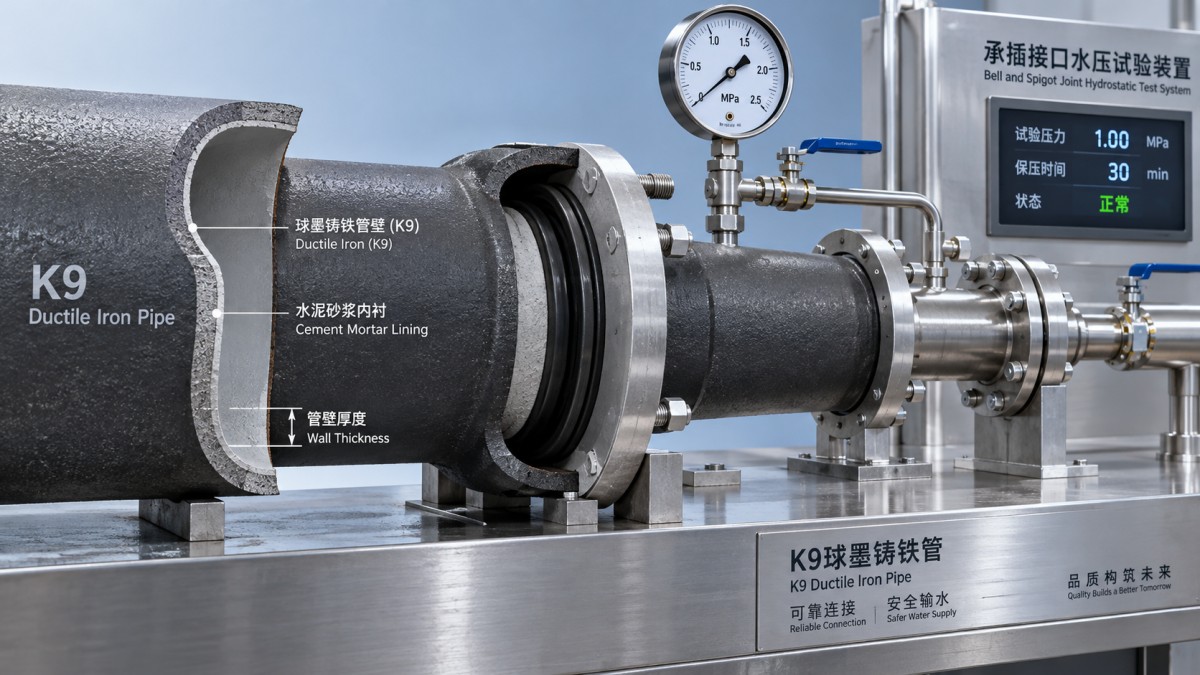
A supplier may offer a pressure-class pipe instead of a specified K9 pipe. That substitution requires a compliance review, not a change of terminology. Even where pressure capability is adequate, differences in wall thickness may affect external-load assessment, handling provisions, or requirements explicitly written into the project specification.
Read three pressure limits rather than one headline rating
A technical submittal should distinguish the pressure terms used for operation and testing. Under the applicable ISO definitions, the principal terms are:
- PFA — allowable operating pressure: the internal pressure a component can withstand continuously in service, excluding surge.
- PMA — allowable maximum operating pressure: the maximum internal pressure a component can withstand in service, including surge.
- PEA — allowable test pressure: the maximum internal hydrostatic pressure a newly installed component can withstand for the specified short-duration test.
These limits answer different questions. Normal service pressure must be assessed against PFA; the maximum pressure including hydraulic transients must be assessed against PMA. The proposed site hydrostatic test must remain within PEA for the assembled system and comply with the applicable testing procedure.
A factory hydrostatic test certificate does not replace this assessment. Production testing demonstrates compliance with specified manufacturing test requirements; its test pressure should not be treated as the continuous service rating. Nor should a supplier’s single “maximum pressure” figure be accepted without clarification of whether it means PFA, PMA, PEA, or a production test pressure.
The pipe barrel may not be the limiting component
Pressure suitability applies to the complete pipeline assembly. Socket joints, restrained joints, flanges, fittings, valves, adapters, and seals may have limitations different from those of the straight pipe barrel. A barrel calculation therefore cannot establish the allowable pressure of the installed line by itself.
Joint performance also depends on the stated configuration. Check whether declared ratings apply at the proposed angular deflection, whether axial restraint is provided, and whether the seal material is suitable for the conveyed fluid and service temperature. Restrained and non-restrained versions should not be assumed to have identical limits.
Pressure capacity and thrust restraint are separate checks. A non-restrained joint can be suitable for internal pressure while still requiring engineered thrust blocks or other restraint at bends, tees, reducers, and closed ends. Selecting a thicker pipe does not remove those requirements.
Buried installations introduce another assessment: cover depth, traffic loading, bedding, soil support, and installation quality. Satisfying internal-pressure requirements does not automatically establish adequacy under external loads, particularly when evaluating a thinner pressure-class alternative to a specified K9 wall.
A practical route from K9 specification to approval
When a submittal contains both K and C terminology, organize the review by nominal diameter and actual component configuration. A single blanket statement of equivalence is rarely sufficient for a schedule containing multiple sizes.
- Establish the contractual basis. Record the specified ISO 2531 edition and whether K9 is mandatory or an equivalent design may be proposed. Identify any separate installation, joint, coating, and testing requirements.
- Define the pressure envelope. Obtain design operating pressure, maximum pressure including surge, and proposed site test pressure. Use the design values at the relevant pipeline locations, not merely the pump discharge setting.
- Request diameter-specific evidence. Obtain nominal and minimum permitted iron thickness, declared PFA/PMA/PEA, joint type, and the calculation or standard-table basis supporting the ratings.
- Check the assembly. Compare the required pressures with the limits of every pressure-containing component. Review deflection, restraint, temperature, and other conditions attached to those limits.
- Resolve any substitution explicitly. Document whether the proposed product satisfies pressure, structural, dimensional, and contractual requirements. Where it departs from the specified thickness class, obtain the required design approval rather than describing it as automatically equivalent.
Supporting documents should connect to the offered products through drawings, markings, inspection records, and traceability information. A generic catalogue table is less useful if it does not identify the diameter, joint arrangement, or standard edition relevant to the supplied pipe.
Keep unrelated component approvals separate
A mixed infrastructure package may also include items such as Ductile Iron Manhole Cover2, identified as a ductile iron product. Shared material does not make its compliance evidence applicable to pressure pipe. Keep cover approval separate from the ISO 2531 pipe review; material identity alone establishes neither pipeline pressure capability nor cover load performance.
Writing an unambiguous acceptance requirement
Where the design requires K9 specifically, state the applicable standard edition and thickness requirements, then separately state the required pressure limits and joint conditions. Where pressure-class selection is permitted, specify the pressure envelope and the additional structural and installation criteria instead of relying on an informal K9-to-C conversion.
A useful acceptance record identifies, for each DN, the offered classification, minimum wall thickness, joint configuration, and declared PFA, PMA, and PEA. Any missing rating, unexplained conversion, or mismatch between the pipe and joint documentation should remain an unresolved technical item—not be covered by a general statement that the product “complies with ISO 2531.”
Navigation
Send Us A Message

First class quality service and professional after-sales team.
Get in Touch
*We respect your confidentiality and all information are protected.









