
Pipe Repair Solutions for Live Water Mains: Clamps or Replacement?
A repair clamp is a reasonable option for a localized leak in a ductile iron water main when the surrounding pipe remains sound and the selected assembly is suitable for the defect, pipe dimensions, and operating conditions. Section replacement becomes the stronger choice when damage extends beyond a sealable area, the pipe cannot support gasket compression, or movement and repeated failures suggest a wider problem.
The pressure to keep customers supplied should not determine the repair method on its own. A main remaining in service during assessment does not mean it can safely remain pressurized throughout the work. Separate two decisions: which repair will restore reliable service, and whether that repair can be installed under the conditions at the site.
Establish what has failed before choosing the repair
Water appearing at the ground surface rarely defines the full defect. It may travel along the pipe trench, and a visible leak can conceal a larger damaged area. Once access is safe, maintenance personnel need enough exposure to identify the leak source and assess the pipe around it without destabilizing the main or its supports.
A useful assessment records four things:
- Defect type and extent: distinguish a localized hole from a longitudinal crack, circumferential fracture, leaking joint, or damaged connection.
- Surrounding condition: look for corrosion, damaged coating, deformation, and evidence that deterioration continues beyond the visible opening.
- Operating conditions: establish normal pressure, credible pressure surges, and whether isolation valves can reliably control the affected section.
- Mechanical stability: assess settlement, unsupported pipe, joint movement, and external loads that could continue acting after the leak is sealed.
These observations determine whether a clamp has a sound surface on which to seal. Tightening a gasket against severely deteriorated pipe can fail to produce a reliable seal or further damage the remaining wall. Where wall condition is uncertain, appropriate inspection and engineering assessment should resolve that uncertainty before the repair is accepted as permanent.
Joint leaks require particular care. A barrel repair clamp may be unsuitable for the joint profile, and an external seal will not necessarily correct displacement or inadequate restraint. Identify the joint arrangement and cause of leakage before treating it as a simple hole in the pipe.
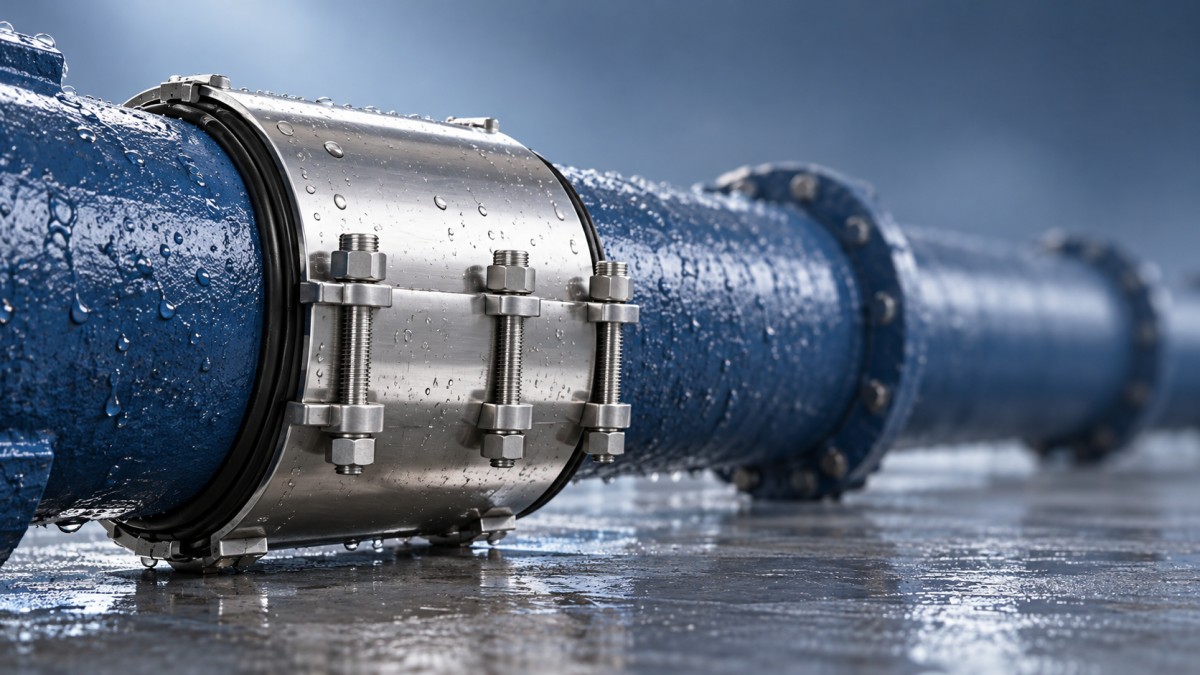
When a clamp is a defensible long-term repair
A compatible repair clamp can provide a durable repair where the defect is limited and the adjacent pipe retains adequate integrity. Its suitability depends on the specific clamp design and manufacturer’s permitted applications. The label “full-circle” alone does not establish that an assembly can handle every crack, pressure, or pipe condition.
Start with the actual outside diameter at the repair location. Nominal pipe size is insufficient for selection because pipe dimensions, surface condition, and local irregularities affect fit. The clamp must accommodate the measured diameter and provide the sealing coverage required for the defect. Its pressure capability must also suit the service conditions, including relevant transient loads.
Gasket selection deserves equal attention. The elastomer must be suitable for the conveyed water, temperature, and applicable drinking-water requirements. A rubber ring used in a pipe joint is not automatically interchangeable with a repair-clamp gasket. A component such as Rubber Ring1 would need its dimensions, material specification, and intended joint application checked before being considered for maintenance work; the product name alone establishes no compatibility.
Installation quality then determines whether the selected assembly can perform as intended. Surface preparation, gasket positioning, bolt tightening, and access around the pipe must follow the manufacturer’s procedure. Excess tightening is not a remedy for poor fit or an unsuitable sealing surface. Restricted access beneath the pipe can also prevent proper installation even when the clamp appears suitable on paper.
Cracks need a more cautious decision than isolated perforations. A clamp may seal escaping water while leaving the mechanism driving crack growth unresolved. Use it for a cracked main only where the specific assembly is approved for that defect and the pipe’s structural condition has been assessed. A conventional sealing clamp should not be assumed to restore axial strength or restrain a separated pipe.
When replacement addresses the problem more effectively
Section replacement becomes more persuasive when inspection shows that the defect cannot be bounded by sound pipe. Multiple nearby perforations, extensive wall deterioration, a substantial fracture, or another failure beside an earlier repair all weaken the case for adding a clamp. The apparent saving in repair time can disappear if the next leak requires another excavation and service interruption.
Replacement also offers an opportunity to correct causes that sealing alone leaves in place. If settlement has imposed bending on the main, the work may require improved bedding or support as well as new pipe. If joint movement is involved, the connection and restraint arrangement need review. Replacing a short length without addressing those conditions can leave the new assembly exposed to the same loads.
The replacement boundary should follow verified pipe condition and connection requirements. Cutting immediately beside visible damage can leave the new coupling attached to weakened material. Maintenance planning should therefore allow for additional exposure and a longer replacement length if inspection reveals deterioration beyond the initial excavation.
Replacement brings its own practical demands: a controlled outage, suitable cutting and lifting arrangements, compatible fittings, and a plan for water quality protection and return to service. Compare the total work involved. A clamp may reduce the immediate outage, while replacement may reduce the likelihood of repeated intervention. Neither outcome follows automatically from the repair category.
Keeping the main live has limits
Some repair assemblies are designed for installation on a pressurized main under defined conditions. That capability must be established for the particular product, defect, and site. A pressure rating describes only part of the decision; it does not establish that personnel can safely approach an unstable pipe or work in a flooding excavation.
Uncontrolled discharge, uncertain crack extent, inadequate excavation stability, or an inability to install the assembly as specified are reasons to stop and establish controlled conditions. Where isolation is necessary, the plan should account for valve performance, trapped pressure, drainage, and the consequences for the supply network. Ordinary section replacement requires isolation and depressurization of the affected section.
Keeping positive pressure can help limit contamination entry, but leakage and excavation conditions still require water quality controls. If the main is opened or loses pressure, apply the water utility’s procedures for cleaning, disinfection, flushing, sampling, and release back into service as applicable. Restoring pressure alone does not establish that the main is ready for unrestricted use.
A clamp can also serve as an interim measure while a planned replacement is organized, provided its use is technically justified. The maintenance record should state that purpose, the conditions attached to continued service, and the follow-up action. Otherwise, a temporary intervention can remain in place long after the assumptions supporting it have changed.
The strongest pipe repair solutions leave a clear basis for the next maintenance decision. Record the defect, observed pipe condition, selected components, installation checks, and return-to-service results. If another leak appears nearby, that record helps determine whether the issue is an isolated repair failure or evidence that the surrounding main now needs replacement.
Navigation
Send Us A Message

First class quality service and professional after-sales team.
Get in Touch
*We respect your confidentiality and all information are protected.









