Checking K9 ductile iron pipe for shallow burial under road traffic
K9 ductile iron pipe can be suitable for shallow burial beneath a road, but approval requires a structural check tied to the actual installation. The K9 designation alone does not establish a safe minimum cover. Pipe diameter, effective wall thickness, traffic loading, bedding support, and the condition of the surrounding soil all affect whether a particular section can carry the imposed loads.
For technical evaluators, the first decision is whether the proposed installation falls within the assumptions of an accepted design method or a documented manufacturer’s assessment. If it does, those calculations can support approval. If the cover, traffic, or trench conditions fall outside those assumptions, additional analysis or a revised installation detail is needed before the pipe class is accepted.
Establish what the K9 designation actually supports
K9 identifies a wall-thickness class within applicable ductile iron pipe specifications. It does not describe the complete buried-pipe system, and it should not be treated as a traffic-load rating. A pressure test certificate also cannot establish shallow-burial suitability: it addresses a different loading condition from wheel loads acting through pavement and backfill.
Start with the pipe specification, including its standard and edition. References to ISO 2531 or EN 545 should be checked against the actual product designation and project requirements, because classification provisions can differ between editions. Where a separate buried-pipe design method governs the project, use that method consistently. Avoid combining a load model from one method with acceptance limits or bedding assumptions from another unless the combination has an engineering justification.
The supplier’s documentation should establish the dimensions and material properties used in the calculation. Relevant inputs include outside diameter, specified wall thickness, applicable manufacturing tolerances, and the mechanical properties required by the governing specification. Any design allowance for corrosion or other wall loss must also follow the project’s design basis.
Use the effective structural wall thickness required by that method. A calculation based only on nominal thickness can overstate capacity if it ignores permitted thickness variation or required allowances. Linings and coatings should not be credited as structural reinforcement unless the design method explicitly permits it.
Diameter deserves particular attention. Two pipes carrying the same K9 designation do not necessarily have equivalent resistance to external loading. Their dimensions and ring behavior differ, so an approval for one size cannot automatically be extended to another. The assessment should identify every diameter covered by the proposed road crossing.
Define the shallowest cover and the governing traffic load
Record cover as the vertical distance between the pipe crown and the relevant finished surface, using the definition required by the design method. A depth measured to the pipe centerline or trench bottom can create a substantial error. The drawing should also distinguish pavement thickness from soil cover so that the calculation uses the correct layers and properties.
Evaluate the lowest credible cover along the route. Road levels, pipe gradients, utility crossings, and installation tolerances may create a short section with less protection than the general arrangement suggests. That section can govern the design even when most of the pipeline has adequate cover.
At shallow depth, concentrated wheel loads have less material through which to spread before reaching the pipe. Their effect depends on wheel position, contact area, axle arrangement, and the pavement and fill above the crown. An assumed load distribution must therefore match the chosen calculation method and the road construction.
Traffic inputs should come from the applicable road authority or project loading specification. Descriptions such as “light traffic” or “occasional trucks” are insufficient for approval. Consider whether the route must accommodate service vehicles, emergency access, heavy deliveries, or other loads beyond everyday passenger traffic. Include dynamic effects where required by the governing method.
Construction loading needs its own check. Before the final pavement and full cover are in place, haul vehicles or compaction equipment may pass over a more vulnerable installation. A pipe that satisfies the completed-road assessment may still require temporary cover, equipment restrictions, or a controlled crossing arrangement during construction.
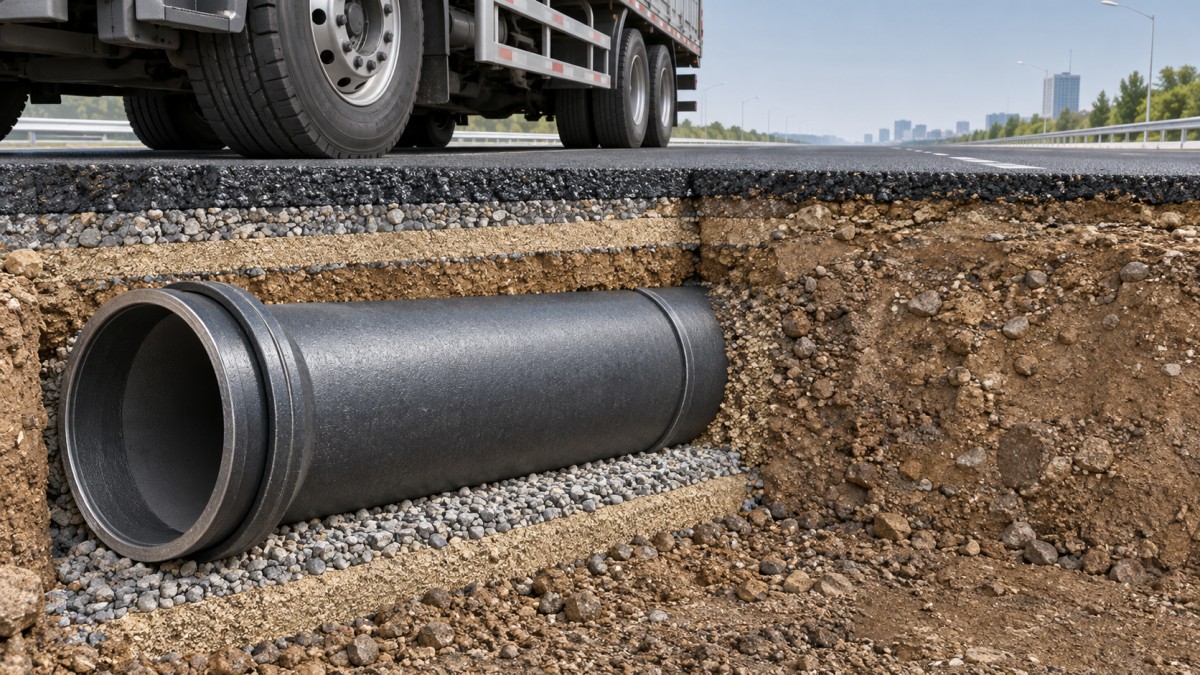
A useful assessment drawing shows the wheel position, pavement layers, minimum cover, pipe diameter, trench width, bedding, and surrounding ground. This makes inconsistencies visible—for example, a calculation that assumes a completed pavement while the construction sequence allows vehicle access over exposed backfill.
Check the pipe together with its soil support
The buried pipe carries loads through interaction with its bedding and surrounding soil. A stronger wall can provide additional capacity, but it cannot compensate reliably for every installation defect. Poor support beneath the barrel, loose material around the haunches, or abrupt changes in ground stiffness can create loading conditions that the calculation never considered.
The design assessment should address the relevant limit states under the governing method. These may include ring bending stress, deformation or ovalization, stability under external pressure, and longitudinal effects where support varies. Internal pressure, surge, and external loading should be combined as required by that method. Passing one check does not establish that the remaining checks are satisfactory.
Soil descriptions must be specific enough to support the adopted parameters. “Compacted backfill” does not explain the material type, placement method, achievable compaction, or stiffness assumed in the analysis. The evaluator should be able to trace each support assumption to an installation requirement that a contractor can execute and an inspector can verify.
- Bedding: Define how the pipe barrel will receive continuous support and how local hard points will be avoided.
- Haunch support: Specify material and placement requirements around the lower sides of the pipe, where access for compaction may be restricted.
- Trench conditions: Account for trench width, weak sidewalls, unstable formation, and any replacement material needed beneath the bedding.
- Groundwater: Assess its effect on installation stability, support conditions, and buoyancy where relevant.
Joint details also matter where the pipeline meets a chamber, valve assembly, or rigid structure. A Ductile Iron Double-Flanged Pipe may form part of such an assembly, but the flanged connection requires assessment of support, alignment, and imposed bending. Its material does not establish that the assembly can tolerate settlement or rotation in the same way as an adjacent flexible joint.
Pay particular attention to transitions between rigid structures and buried pipe. Differential settlement can introduce longitudinal bending and joint movement even where the ring calculation under traffic is satisfactory. The installation detail should explain how those movements are accommodated.
Decide whether to approve, protect, or revise the installation
A defensible approval package connects the calculations to the drawings and construction requirements. It identifies the governing minimum cover, pipe sizes and effective wall thicknesses, traffic assumptions, soil support parameters, relevant acceptance criteria, and construction-stage restrictions. Manufacturer guidance is useful when its assumptions match these conditions; a general minimum-cover statement needs enough supporting detail to establish that match.
Where the assessment fails, identify the governing mechanism before selecting a remedy. Increasing wall thickness may address some stress limits, while improved bedding may address inadequate support. Neither necessarily resolves excessive joint movement or an unfavorable construction load case.
Increasing cover or revising the pipe alignment can improve the loading arrangement. Where geometry prevents that, an engineered load-spreading slab or another protective structure may be appropriate. Such protection needs its own load path and support design: a slab that settles onto the pipe, or a casing supported inadequately at its ends, can introduce new problems. Concrete encasement likewise requires consideration of stiffness transitions, joints, and future maintenance.
Approval should state the conditions under which the design remains valid. If the calculation depends on a specified bedding arrangement, a minimum cover, or restricted construction traffic, those conditions belong in enforceable drawings and inspection requirements. When any of them changes on site, reassess the affected section before accepting it. That is the practical threshold for using K9 beneath a shallow road crossing: demonstrated capacity under conditions the project can actually deliver.
Navigation
Send Us A Message

First class quality service and professional after-sales team.
Get in Touch
*We respect your confidentiality and all information are protected.