
When K9 ductile iron pipe bends need restrained joints
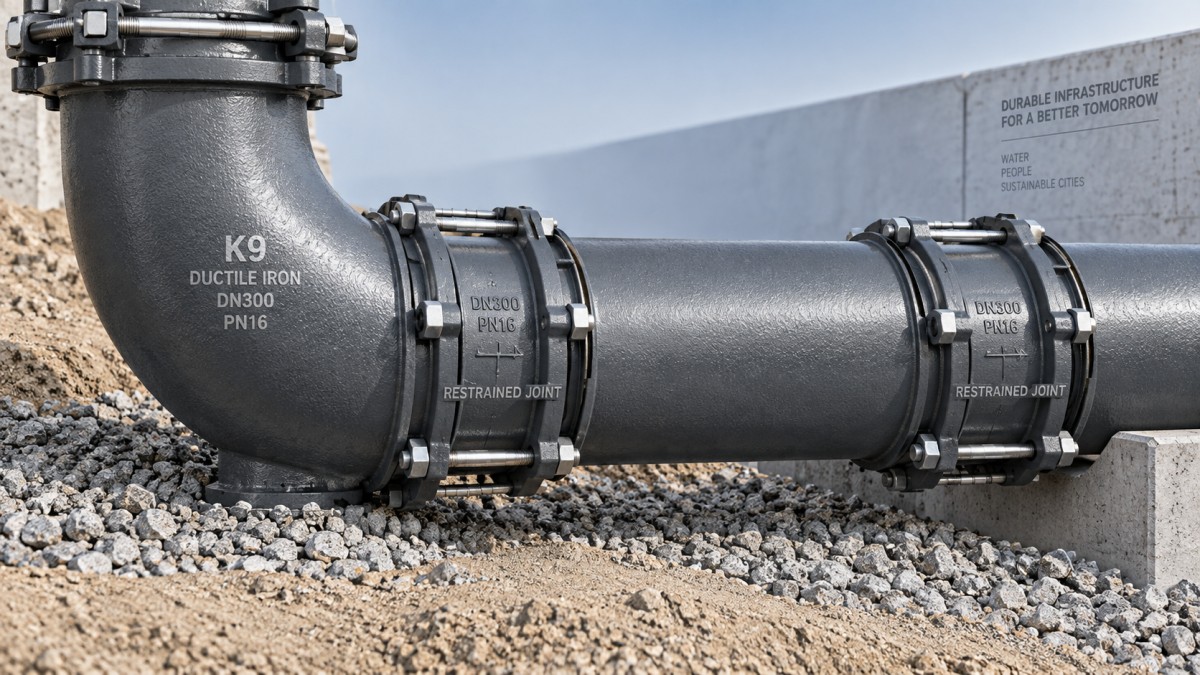
A bend in a K9 ductile iron pipe system needs restrained joints when its thrust cannot be safely resisted by an engineered thrust block or another approved anchoring arrangement. Common triggers include restricted excavation space, unsuitable ground, nearby utilities, and construction sequences that prevent a block from developing its required strength before pressure testing.
K9 describes pipe wall thickness; it does not mean the joints resist axial pullout. A standard push-on joint provides a pressure seal and permits limited movement, but it is not designed to hold a bend against hydraulic thrust. The decision therefore starts with how that force will reach stable ground—not with the pipe class alone.
Start with the force at the bend
Internal pressure produces an unbalanced force wherever a pipeline changes direction. At a bend, that force tends to push the fitting outward and can pull adjacent pipe ends from their sockets if nothing provides sufficient resistance.
For otherwise comparable conditions, thrust increases with pressure, internal pipe diameter, and bend angle. A larger pipe carries pressure over a larger cross-sectional area, while a sharper turn produces a greater change in the direction of the pressure forces. Even a relatively shallow bend needs an assessed means of thrust resistance.
The pressure used for that assessment must reflect the relevant design cases. Normal operating pressure alone can miss the higher loading created by hydrostatic testing or pressure surges. Temporary test closures also create thrust and need their own restraint arrangements.
Pipe strength, joint sealing capacity, and joint restraint are separate checks. A K9 pipe barrel may be suitable for the specified pressure while its ordinary socket connection still requires external thrust resistance.
When a thrust block remains a practical choice
A thrust block transfers the bend’s force through concrete into suitable ground. It can be an effective solution where sufficient space exists, the bearing soil is dependable, and construction can preserve the ground that the design relies on.
Its effectiveness depends on more than concrete volume. The bearing face must have the calculated area and orientation, and it must act against ground capable of carrying the load without excessive movement. Concrete placed against loose trench backfill cannot automatically be treated as equivalent to a block bearing against suitable undisturbed soil.
Access matters too. A block should allow the intended inspection and maintenance of joints. If its required footprint overlaps another utility, a property boundary, or a future excavation corridor, the arrangement may become impractical even though the hydraulic calculation is straightforward.
Where these conditions are satisfied, standard unrestrained joints with a properly designed thrust block may be appropriate. Restraint becomes necessary when the proposed arrangement cannot provide a dependable load path and no suitable alternative anchorage is available.
Site conditions that favor restrained joints
Congested trenches are a common reason to use restraint. In a street containing cables, drains, and other pipelines, there may be insufficient room for the block’s required bearing area. Restrained joints can transfer force through a designed length of connected pipeline, reducing dependence on a large concrete block immediately behind the bend.
Weak, disturbed, or variable soil also changes the decision. A block may need an impractical bearing area, or the ground may move too much to support it reliably. However, restrained joints do not remove soil from the calculation. A buried restrained pipeline generally mobilizes resistance through its interaction with surrounding ground. Poor soil may therefore require a longer restrained length, ground improvement, or separate engineered anchorage.
Vertical bends need particular attention because thrust can act upward or downward. An arrangement suitable for a horizontal bend cannot simply be rotated and assumed adequate. Cover, uplift resistance, groundwater, and the geometry of adjacent fittings can all affect the design.
Restraint can also suit locations where future excavation could remove a thrust block’s supporting ground. It provides a different means of distributing the force, although the buried restrained section must still retain the ground support assumed in its design.
Construction timing is another trigger. If testing must occur before a concrete block reaches its specified strength, the programme needs an engineered solution: sufficient curing time, designed temporary anchorage, or an appropriate restrained system. A schedule deadline does not reduce the thrust generated during testing.
Restraining the bend alone may leave the pipeline vulnerable
A restrained bend connection transfers force into the next pipe. If that pipe connects to an unrestrained socket before sufficient resistance has developed, separation can occur farther along the line. Locking the fitting’s immediate joints may simply move the vulnerable point.
The design must specify the complete restrained length on the relevant sides of the bend. That length depends on pressure, diameter, bend geometry, soil properties, cover, groundwater, and the restraint calculation method. There is no dependable rule that every bend needs the same number of restrained pipes.
Nearby bends, tees, reducers, valves, and dead ends can influence the same section of pipeline. Their forces and restrained lengths need to be considered together, especially where fittings sit close enough for their restraint arrangements to interact.
Exposed pipework and sections inside chambers require separate treatment. Resistance available from buried pipe cannot be assumed for a section surrounded by air. Supports, anchors, and structural connections must provide the load path appropriate to that location.
Choose a compatible joint system, not just a restraint label
Restrained joints use mechanical features to resist separation. The selected arrangement must be suitable for the actual pipe and fitting combination, including outside diameter, socket geometry, pressure duty, and permitted angular deflection. K9 classification by itself does not establish that compatibility.
The fitting and pipe connections must work as one system. A restrained pipe joint does not automatically make an adjacent fitting socket restrained, and components with similar nominal sizes may have different connection requirements.
The same distinction applies when reviewing connecting fittings such as a Double-Socket Sleeve. Its description as a pipe fitting does not establish axial restraint capability. If it sits within the calculated restrained section, its connection arrangement must maintain the required load path.
Procurement should capture those requirements before materials arrive. A supply package covering pipes, fittings, and rubber sealing rings still needs explicit joint specifications. Rubber seals provide sealing; axial restraint comes from the designed locking arrangement or external anchorage.
Turn the design into an installation that can be tested
Before releasing drawings and purchase orders, assemble the inputs that control the decision: pipe diameter, bend angle and orientation, operating and test pressures, surge allowance, trench layout, cover, groundwater conditions, and soil design parameters. These determine whether a block is feasible and how much restraint is needed.
The issued installation information should then make the following clear:
- Which joints are restrained and where each restrained section ends.
- Which pipe, fitting, seal, and locking components form the approved assembly.
- What insertion, engagement, and angular deflection requirements apply.
- What bedding, backfill, anchorage, and concrete strength conditions must exist before testing.
- How temporary closures and incomplete sections will resist test pressure.
Inspection should confirm assembly before backfilling hides the joints. Depending on the system, this includes checking insertion marks, locking component engagement, and allowable deflection. A connection can seal initially while an incorrectly assembled restraint remains unable to carry its intended load.
Pressure testing must follow the construction state assumed in the restraint design. Testing a partly backfilled restrained pipeline can leave less ground resistance available than the completed installation provides. Later trench widening, fitting relocation, or excavation beside a block can also invalidate the original assumptions.
The useful decision is whether the proposed arrangement carries the bend’s thrust continuously into dependable resistance under both testing and operation. Where a thrust block can do that within the available site conditions, it remains a valid option. Where it cannot, specify a compatible restrained system with a calculated extent, clear assembly requirements, and a testing sequence that supports the design.
Navigation
Send Us A Message

First class quality service and professional after-sales team.
Get in Touch
*We respect your confidentiality and all information are protected.









