
Firefighting Valves: Checking Listings, Pressure Ratings, and Supervision
A valve can fit the pipeline perfectly and still fail a fire protection compliance check. For quality control and safety personnel, selecting firefighting valves means looking beyond nominal diameter and connection type. The exact product listing or approval, allowable pressure, installation conditions, and valve-position supervision all need to match the intended service.
In ductile iron piping systems, those checks are especially important at transitions between buried mains, building entries, pump rooms, and sprinkler risers. Each interface can introduce a different pressure limit or inspection requirement. The practical question is not simply, “Does this valve fit?” It is, “Can we demonstrate that this complete assembly is suitable before it becomes difficult to access?”
Start with the valve’s duty, not the certificate folder
Before reviewing certificates, identify what the valve actually does. An isolation valve, check valve, pressure-reducing valve, and deluge valve have different functions and evaluation requirements. An approval for one function does not establish suitability for another.
Record the installation location, normal operating position, flow direction, system pressure, connection arrangement, and accessibility. Then establish the governing requirements: local regulations, adopted standards and editions, project specifications, insurer requirements, and decisions from the authority having jurisdiction (AHJ).
For projects using NFPA standards, the following distinctions help keep the review focused:
- NFPA 13: addresses sprinkler-system installation, including applicable control-valve provisions.
- NFPA 20: addresses stationary fire pumps and related installation requirements.
- NFPA 24: addresses private fire service mains and their appurtenances.
- NFPA 72: addresses fire alarm and signaling arrangements, including applicable supervisory signaling.
- NFPA 25: addresses inspection, testing, and maintenance of water-based fire protection systems after installation.
These installation and maintenance standards are not product certificates. Nor should they be applied indiscriminately to projects governed by a different regulatory framework.
Checking listings and approvals for firefighting valves
A supplier’s statement that a valve is “UL/FM compliant” is not enough for acceptance. UL listing and FM Approval are separate evaluations. Whether either or both are required depends on the project. Verify the exact product in the relevant certification organization’s directory rather than relying solely on a brochure or an undated certificate.
Examples of relevant product standards include UL 262 for gate valves for fire-protection service, UL 1091 for butterfly valves for fire-protection service, and UL 312 for check valves for fire-protection service. These examples are not a complete selection list; use the standard and certification category applicable to the actual valve.
Be equally careful with broader credentials. ISO 9001 concerns quality management systems, not fire-service approval of an individual valve. Drinking-water approvals address a different scope. Neither automatically substitutes for a required fire protection listing.
During receiving inspection, compare body markings, labels, nameplates, and packaging identification against the approved submittal. Photograph discrepancies before installation. A missing marking is easier to investigate while the valve is still on the receiving bench.
Pressure ratings: separate working duty from test conditions
One of the most consequential mistakes is treating a factory shell-test pressure as an allowable continuous operating pressure. A valve may withstand a short-duration manufacturing test at a pressure above its rated working limit. That does not authorize operation at the test pressure.
Check the manufacturer’s rated working pressure at the applicable temperature and compare it with the system’s maximum anticipated pressure. For pumped systems, do not use the normal running gauge reading alone. Review the maximum suction pressure combined with pump shutoff pressure, elevation effects, and any applicable surge allowance or transient analysis.
Then check the installation test separately. The specified field hydrostatic test must be compatible with the valve manufacturer’s instructions and the governing installation requirements. Resolve any conflict before pressurization; do not assume that a higher factory test value settles the issue.
The assembly is limited by its weakest applicable rating
A high-rated valve does not increase the pressure capability of the surrounding pipeline. Review flanges, adapters, couplings, gaskets, bolts, restrained joints, and connected equipment together. Pressure designations also do not prove dimensional compatibility: verify drilling, sealing faces, joint dimensions, and the relevant connection standards.
This distinction matters when specifying Ductile Iron Pipe K9 alongside firefighting valves. K9 is a wall-thickness classification used in relevant ductile iron pipe standards, not a universal pressure rating for every diameter and joint arrangement. The supplied product information gives a working-pressure range of 1.0–1.6 MPa, which must be confirmed for the selected size, joint, and project conditions.
Shanxi Datong Foundry Co.,Ltd. manufactures ductile iron pipes, fittings, and rubber sealing rings through integrated smelting and casting processes. For a coordinated piping package, request product-specific pipe, fitting, and seal documentation alongside the valve submittal. References to ISO 2531, EN 545, or EN 598 should be checked against the actual supplied product and application; they do not independently establish fire-service approval of the valve assembly.
Supervision must reveal a loss of readiness
A closed control valve can leave an otherwise sound system unable to deliver water. Valve-position supervision addresses that risk by indicating movement away from the required normal position. It is not the same as waterflow detection, and it does not prove that the pipe downstream is clear.
Determine the required supervision arrangement from the applicable standard, adopted edition, approved design, and AHJ requirements. Electrical supervision is common, but permitted alternatives and exceptions vary. Do not assume that every valve requires the same arrangement—or that a padlock is always an acceptable substitute.
For electrically supervised valves, review the complete arrangement:
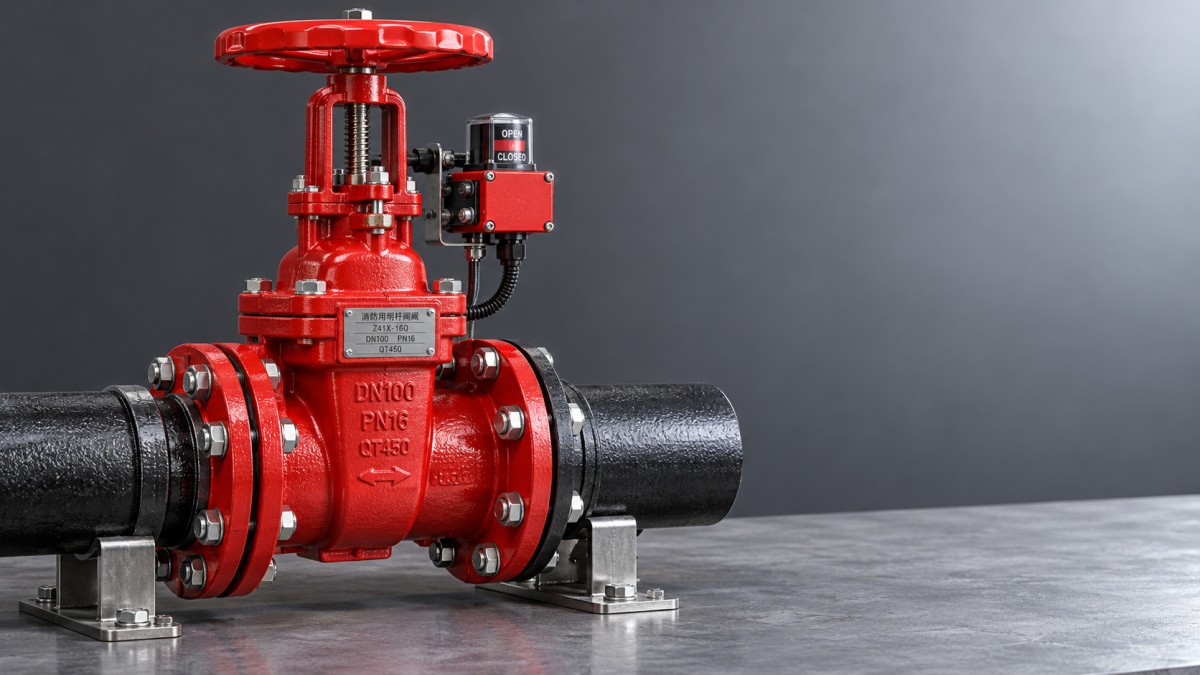
- Mechanical compatibility: the switch or supervisory assembly must suit the valve type and follow the applicable listing and installation instructions.
- Signal operation: verify activation at the required departure from the normal position under the governing requirements.
- Signal destination: confirm receipt and correct identification at the intended control unit and monitoring destination, where required.
- Restoration: return the valve to its required normal position and verify that the indication restores correctly.
- Service access: ensure operators can inspect, exercise, and maintain the valve without obstructing essential equipment.
A handwheel, position indicator, or outside screw and yoke provides useful visual information, but visual indication alone is not electrical supervision. Conversely, an installed switch is not evidence that the supervisory signal has been commissioned.
Make acceptance records usable after handover
The strongest acceptance package connects the installed valve to its documents and test results. Keep the approved model and size, verified listing or approval details, pressure-rating evidence, manufacturer instructions, installation location, and inspection findings together.
Record pressure-test results separately from supervisory functional tests. For each supervised control valve, identify its normal position, signal description, receiving panel, and completed restoration check. Where functional testing affects an active system, follow the applicable impairment procedures, coordinate notifications, and confirm protection is restored.
If documentation, markings, ratings, or supervision do not agree, place the item on hold and resolve the discrepancy with the responsible designer, manufacturer, and AHJ as appropriate. Physical fit is only the starting point. Reliable acceptance of firefighting valves requires a traceable match between the approved product, the actual pressure conditions, and a supervision arrangement that will expose an unsafe valve position.
Navigation
Send Us A Message

First class quality service and professional after-sales team.
Get in Touch
*We respect your confidentiality and all information are protected.









