
Municipal Pipe Systems: Prioritizing Renewal with Leak and Failure Data
Prioritize pipeline renewal by combining the likelihood of another failure with the consequences of losing that section of main. Leak counts provide a starting point, but the first budget allocation should reflect failure mechanisms, pressure conditions, service criticality, and available isolation routes. A frequently repaired main with an alternative supply path can rank below a main with fewer recorded failures that supplies a hospital or crosses a major transport corridor.
A defensible plan for municipal pipe systems needs a traceable chain from maintenance records to renewal decisions. Each proposed project should explain what is deteriorating, how the evidence supports intervention, and why replacement, rehabilitation, or operational correction fits the observed problem.
Make repair records comparable before ranking pipes
Start with pipe segments that have consistent attributes: material, diameter, installation period, pressure zone, and relevant ground conditions. Street boundaries alone are unreliable. One street can contain several pipe generations, while a single continuous main can pass through sharply different soil and loading conditions.
Assign each repair to a stable asset identifier and location. Separate main-barrel failures from service connection leaks, valve defects, and joint leakage. Repeated excavation around the same unresolved defect should remain linked to the original event; counting every visit as an independent failure exaggerates deterioration.
The minimum useful record includes the failure date, component involved, observed damage, repair method, and service interruption. Add photographs and field observations where available. Descriptions such as “longitudinal split,” “localized external corrosion,” or “displaced joint” support a stronger diagnosis than a general entry marked “pipe leak.”
Compare failure frequency against both pipe length and observation time. Raw totals favor long segments and assets with longer records. Also distinguish reported leaks from actively detected leaks: an area surveyed frequently will produce more discoveries than an equally deteriorated area that has received little investigation. A low recorded count is weak evidence of good condition when surveillance coverage is poor.
Read the failure pattern before choosing the intervention
The same repair frequency can point to different actions. Several leaks at fittings following road reconstruction suggest a different problem from scattered barrel perforations along a corroding main. The renewal boundary should follow the probable mechanism and its extent.
Pressure assessment needs more than a normal operating reading. Short transients can escape routine logging, while sustained high pressure increases loading and leakage through existing openings. Where failure timing suggests a hydraulic cause, collect pressure data at a sampling rate suited to the suspected event. Replacing pipe without correcting that cause leaves the renewed section exposed to the same loading.
Give service consequences a separate assessment
Failure likelihood and service consequence should remain visible as separate ratings, even when combined into a final priority score. A single total hides whether a project ranks highly because deterioration is advanced or because interruption would be difficult to manage. Those situations call for different supporting evidence.
Assess the actual isolation area rather than assuming that only the damaged segment will lose supply. Inoperable valves, uncertain valve locations, and absent network loops can turn a short repair into a much larger shutdown. Confirm alternative supply capacity under the expected isolation arrangement; a connection on the network map does not establish that adequate pressure and flow will remain available.
Consequences also include flooding pathways, road disruption, access for emergency repairs, and exposure of adjacent infrastructure. A buried main beside a basement entrance presents different damage pathways from one beneath open ground. Record the specific consequence and the assumption supporting it, rather than assigning every large-diameter main the same criticality.
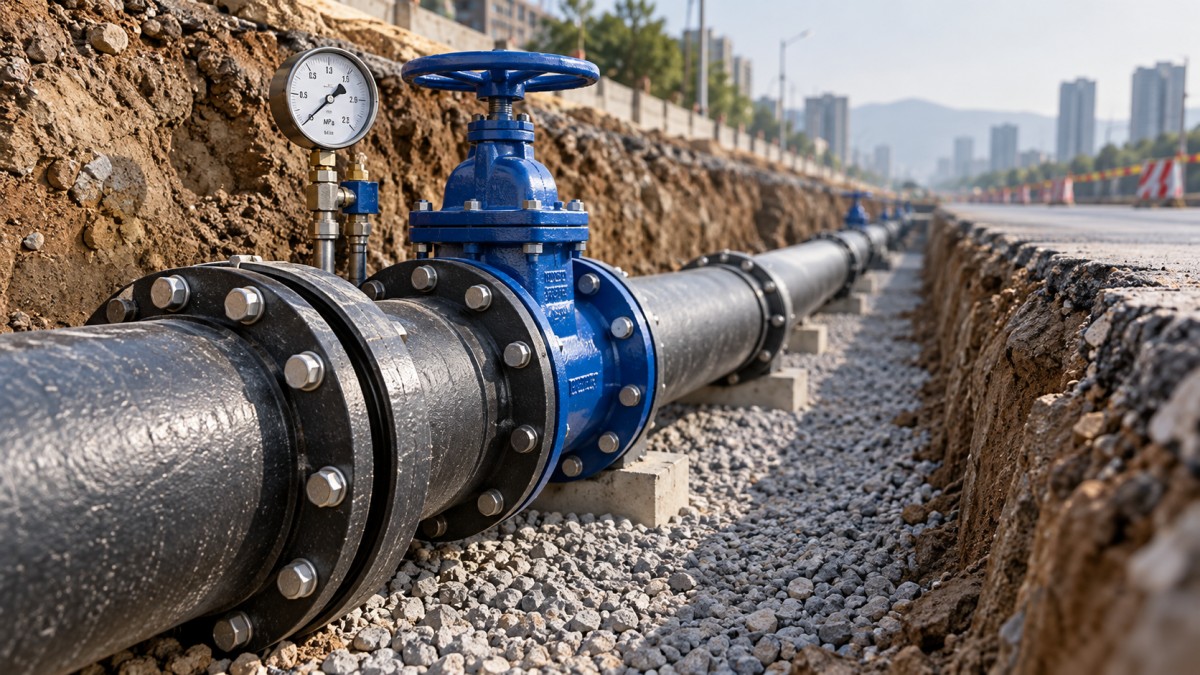
Isolation improvements sometimes offer an earlier reduction in disruption than immediate replacement. Valve selection must follow verified technical data: for an item listed as gate, confirm the actual valve type, pressure rating, bore, end connections, and operating requirements before including it in an isolation design. A product name alone does not establish suitability.
Build a ranking that exposes uncertainty
Use a documented scoring method with defined rating descriptions. Failure likelihood should draw on comparable failure history, observed condition, operating stress, and evidence of an active deterioration mechanism. Consequence ratings should reflect the verified shutdown area, critical service dependencies, and likely damage or access constraints.
Keep data confidence beside the ranking. An asset with uncertain material records and no recent inspection should carry an explicit evidence gap. That gap can justify targeted investigation, especially where failure consequences are severe. It should not automatically produce either the lowest or the highest replacement priority.
Before approving the program, test whether reasonable changes to scoring assumptions alter the leading projects. If small adjustments move a project far down the list, its priority needs closer examination. Projects that remain highly ranked across plausible assumptions have a stronger basis for near-term funding.
Document exceptions. Coordinating renewal with planned road works can reduce repeated excavation, but the decision should state why that opportunity advances a project ahead of another asset. Keeping the original risk ranking visible prevents construction convenience from quietly becoming the only selection criterion.
Match renewal scope to the diagnosed problem
Replacement is justified where deterioration is distributed, structural reliability is unacceptable, or the existing arrangement cannot meet required service conditions. Local repair remains appropriate for isolated defects with sound surrounding pipe. Rehabilitation requires a clear statement of what it will restore: leakage control, internal surface condition, or structural capacity. These outcomes are different, and treatment selection must account for the host pipe and connection details.
When ductile iron pipe is selected for replacement, specify the assembly against the site conditions. Pressure class and wall requirements need to account for operating pressure, anticipated surges, burial depth, traffic loading, and installation conditions. External protection should follow the assessed corrosion exposure; material choice alone does not resolve aggressive soil conditions.
Joint and fitting details deserve attention at transitions, bends, tees, and valves. Confirm dimensional compatibility with the existing main, particularly where records are incomplete. Establish restraint or thrust resistance for the actual configuration and ground conditions. Rubber sealing rings must match the joint design and conveyed water requirements, with handling and installation controls that prevent contamination, twisting, or displacement.
Carry these assumptions into construction records. Record exposed pipe condition, actual dimensions, bedding changes, and the locations of new fittings and isolation valves. Any difference between expected and observed deterioration should feed back into the ranking of nearby assets.
After commissioning, assess leakage, pressure behavior, and service interruptions across the affected area. Preserve the former asset history while starting a distinct record for the replacement. This keeps future renewal decisions tied to what was installed and observed, rather than allowing old failures to remain attached to new pipe.
Navigation
Send Us A Message

First class quality service and professional after-sales team.
Get in Touch
*We respect your confidentiality and all information are protected.









