EN 545 Ductile Iron Pipe Manufacturer: How to Verify Compliance Claims
EN 545 Ductile Iron Pipe Manufacturer: How to Verify Compliance Claims
Choosing an EN 545 Ductile Iron Pipe Manufacturer requires more than accepting a compliance statement on a quotation. The real challenge is confirming that the proposed pipes meet the applicable standard and project specifications—and that supporting records are traceable to the supplied batches. Reviewing technical documentation, test reports, markings, coatings, and joint performance before placing an order helps prevent a low purchase price from becoming an expensive acceptance problem.
Define what the supplier is actually claiming
EN 545 covers ductile iron pipes, fittings, accessories, and their joints for water pipelines. However, “EN 545 compliant” is not a complete purchasing specification. The applicable edition, pipe sizes, pressure classification, joint design, coatings, and intended service conditions still need to be agreed.
Ask the supplier to identify the standard edition used and submit a compliance matrix against your specification. Each requirement should point to a drawing, inspection record, test report, or declared exception. A statement that simply repeats your tender wording provides little evidence.
Keep drinking-water suitability separate from dimensional and mechanical compliance. Where potable-water approvals are required, verify the destination market’s requirements for materials in contact with water, including lining and elastomeric seals. EN 545 documentation should not be treated as automatic evidence of every local approval.
Separate certificates from product evidence
A management-system certificate can support confidence in factory controls, but it does not prove that a particular shipment meets your pipe specification. Product certification, design-performance evidence, and routine production records answer different questions.
For any certificate presented, check the issuing organization, validity, manufacturing address, product scope, and limitations. Verify it through the issuer where possible. A certificate covering another factory, a different product range, or only quality management should not be accepted as shipment-level compliance evidence.
- Design-performance evidence: Does it cover the offered joint system and relevant operating conditions?
- Production inspection records: Can results be connected to the material and production lots being supplied?
- Shipment documentation: Do quantities, sizes, classifications, and product descriptions match the purchase order?
Older qualification reports are not automatically invalid. The useful question is whether the tested design, materials, manufacturing conditions, and scope remain applicable. If the supplier has changed the joint geometry or gasket material, request an explanation of how the existing evidence still supports the offered product.
Follow the records back to the pipe
Traceability is where otherwise convincing submissions often become weak. Request a sample documentation package before order placement, then ask the supplier to demonstrate how a pipe identifier connects to production records, relevant tests, and the dispatch list.
Review mechanical-property results against the applicable EN 545 requirements for the product concerned. Check the sample identification, test method, acceptance criteria, actual results, and authorization. A report containing only “pass” is less useful than one showing what was measured and how acceptance was determined.
Distinguish routine works leak-tightness testing from joint-performance qualification. A satisfactory pipe test does not, by itself, establish how an assembled joint performs under angular deflection, pressure variation, or other specified conditions. The inspection plan should identify which checks apply to each pipe, which use sampling, and which rely on qualification evidence.
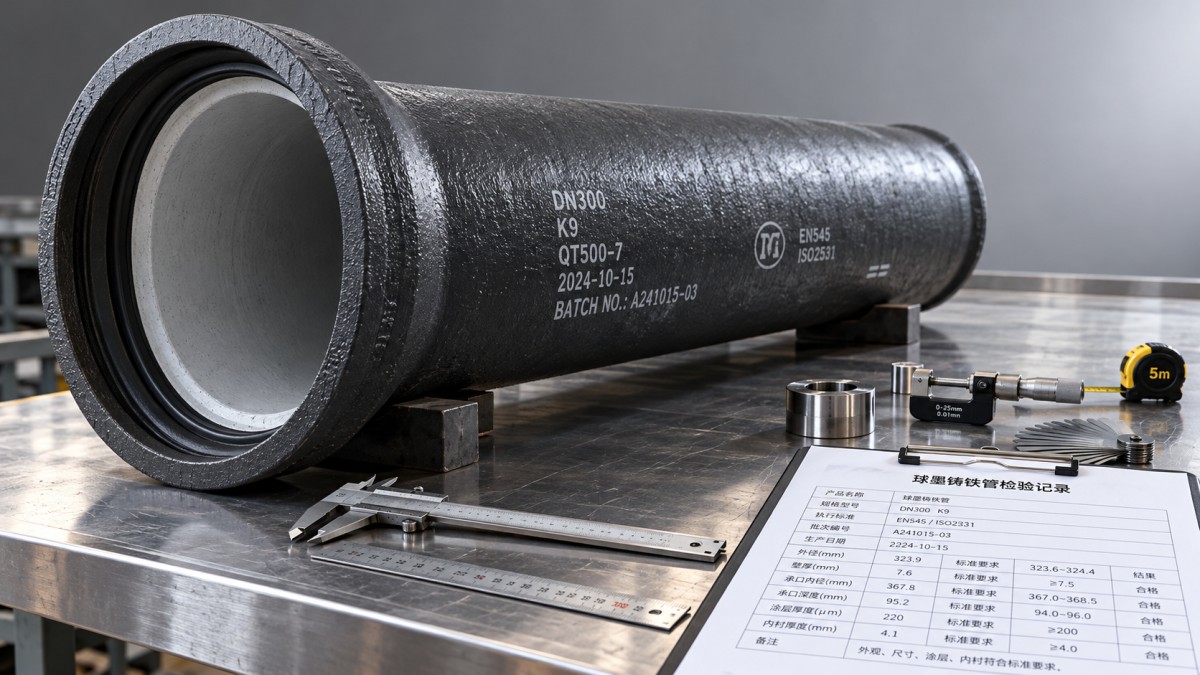
During inspection, compare physical markings with the approved marking requirements and delivery documents. Confirm that identification remains readable after coating, handling, and storage. Where individual marking does not carry every production detail, the supplier should explain the documented traceability link.
Check the details that create site costs
Dimensional compliance is not just a matter of nominal diameter. Review the applicable outside diameter, wall thickness and tolerances, socket and spigot geometry, effective length, and ovality requirements. Confirm the measurement locations and acceptance criteria rather than comparing catalogue descriptions alone.
Pressure terminology also needs discipline. Do not treat a pipe pressure class, flange designation, allowable system pressure, and factory test pressure as interchangeable. Ask the supplier to relate the offered pipe and joint arrangement to the project’s operating pressure, surge conditions, and installation constraints. Restrained and non-restrained joints require different attention to thrust management.
Coating and lining descriptions deserve equal scrutiny. Request the specified system, applicable inspection criteria, and repair procedure. Depending on the system, relevant checks may include coating mass or thickness, lining condition, adhesion, and surface defects. Soil exposure and water characteristics may justify requirements beyond a basic catalogue offering; the project specification should resolve this before pricing is finalized.
At connections to an Ball Valve, verify the actual valve specification, flange drilling, pressure designation, gasket arrangement, and support requirements. Pipe compliance does not establish the suitability of a separately supplied valve or its connection. Interface errors can halt installation even when the individual components are acceptable.
Assess the manufacturing route without assuming compliance
Shanxi Datong Foundry Co.,Ltd., located in Chuandi Industrial Park, Zezhou County, is an integrated manufacturer specializing in ductile iron pipes, fittings, and rubber sealing rings, combining smelting and casting processes. For a supplier with this production scope, a factory review can examine how material control connects with casting, finishing, inspection, and component identification.
Integrated production can make those interfaces easier to examine, but it is not proof of EN 545 compliance. Ask which operations are performed on site, which are subcontracted, and how externally supplied materials or components are accepted. For sealing rings, confirm the relevant material specification and compatibility with the proposed joint and service conditions.
Compare the accepted delivered cost
Normalize quotations before comparing totals. Pipe length, classification, joint type, lining, external protection, included gaskets, inspection scope, packaging, freight terms, and documentation can all change the apparent price advantage. Separate genuine specification differences from commercial discounts.
Put the inspection and test plan into the purchasing agreement. Identify document-review points, any witness or hold points, release authority, and the process for resolving nonconformities. If independent inspection is required, define its scope early: visual inspection alone cannot validate every performance claim.
Before awarding the order, request three connected items: a completed compliance matrix, a representative traceable inspection dossier, and a delivery-specific inspection plan. Unresolved gaps should become written conditions of acceptance—not assumptions left for the receiving team to untangle after shipment.
Navigation
Send Us A Message

First class quality service and professional after-sales team.
Get in Touch
*We respect your confidentiality and all information are protected.