A successful DN800 Ductile Iron Pipe installation requires three verified conditions: controlled lifting, continuous barrel support, and correctly assembled joints before work proceeds to backfilling.
For project managers, these controls protect more than workmanship. They reduce exposure to damaged components, failed pressure tests, installation delays, and difficult repairs after burial.
The practical priority is to establish inspection hold points, assign acceptance responsibilities, and confirm manufacturer requirements before crews begin lowering pipes into the prepared trench.
This guide explains how to organize those checks, identify conditions that justify stopping installation, and collect evidence that supports confident release of each completed section.
What Must Be Confirmed Before the First Lift?
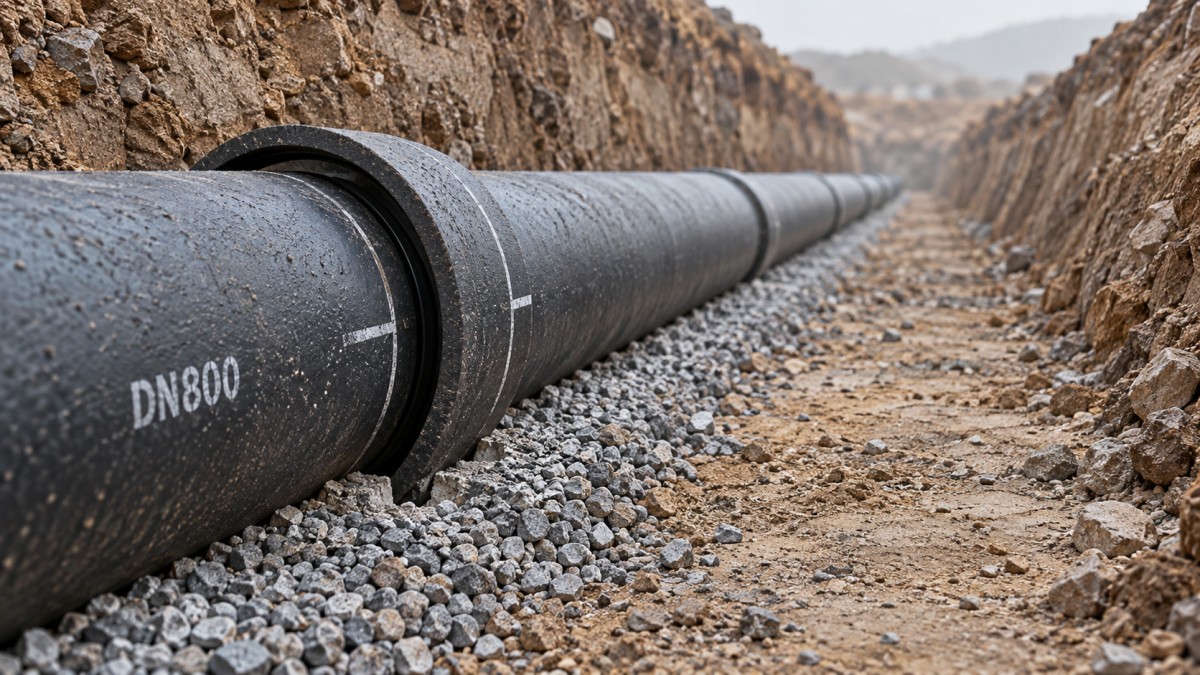
DN800 identifies nominal diameter; it does not establish a universal pipe weight, outside diameter, lifting arrangement, insertion depth, or permissible joint deflection for every product.
Obtain the approved pipe schedule and installation manual covering pipe length, pressure class, lining, external protection, joint design, gasket specification, and any required restraint system.
Confirm the governing specification and applicable standards, such as ISO 2531, EN 545, or AWWA requirements where specified. Acceptance must follow the actual project documents.
Use the following release checks to connect installation readiness with clear evidence. Unresolved items should have an assigned owner before equipment and crews are mobilized.
How Do You Control Lifting Risk Without Slowing Production?
Plan lifting around the actual pipe mass and crane configuration, including operating radius, lifting accessories, ground bearing conditions, and any restrictions near the trench edge.
A crane’s headline capacity does not establish capacity at the working radius. Have the responsible lifting personnel verify the planned configuration against the load chart.
Use manufacturer-approved lifting methods and suitable accessories that protect the pipe, lining, coating, and socket. Where slings are specified, confirm their arrangement and rated capacity.
Do not assume that lifting hooks, internal gripping devices, or chains are acceptable for the supplied pipe. Obtain approval for the particular handling method first.
Conduct a controlled trial lift just clear of the supports. Check balance, accessory seating, and load stability before moving the pipe toward the trench.
Keep personnel outside the suspended-load exclusion zone and use controlled guidance where appropriate. Nobody should stand beneath the pipe or between it and fixed objects.
After lowering, inspect for impact damage, coating abrasion, lining defects, and damaged joint surfaces. Record defects immediately and obtain an approved disposition before assembly continues.
What Bedding Conditions Prevent Settlement and Joint Stress?
Bedding should provide stable, uniform barrel support along the installed pipe. A straight-looking alignment alone does not demonstrate that the pipe has adequate support underneath.
Prepare the trench formation to the approved design and remove unsuitable material. Escalate soft areas, unexpected rock, or disturbed ground for an engineered treatment decision.
Control groundwater before bedding placement. Persistent water can wash out fines, soften the formation, and prevent the specified compaction from being achieved around the pipe.
Use the specified bedding material, thickness, and compaction criteria. These depend on ground conditions, cover, loading, and design requirements; no single thickness suits every installation.
Form socket recesses where required so the barrel carries the load. A socket bearing directly on the trench bottom can create concentrated loading and misalignment.
Check line and level before jointing, then verify them again afterward. Correcting alignment by forcing the pipe against an uneven foundation can transfer stress into joints.
Place and compact haunch material carefully beneath the lower sides of the pipe. Poorly filled haunches leave support gaps that surface inspection may not reveal.
For project control, photograph accepted bedding and record survey results before concealment. This evidence makes later settlement investigations more reliable and supports timely inspection release.
Which Joint Checks Matter Most Before Backfilling?
For push-in joints, begin by confirming that the gasket matches the supplied socket design and the service conditions. Nominal diameter alone does not establish compatibility.
Clean the socket, gasket groove, spigot, and sealing surfaces. Dirt, grit, ice, or packaging debris can prevent correct gasket seating and damage the seal during insertion.
Inspect the gasket for cuts, distortion, contamination, and deterioration. Store unused rings according to supplier instructions, protected from conditions that could compromise their sealing performance.
Seat the gasket exactly as instructed and apply only an approved lubricant in the specified locations. Unapproved products may affect elastomer compatibility or assembly behavior.
Align the pipe axes before insertion and apply controlled force using approved equipment. Stop if resistance becomes abnormal; investigate alignment, gasket seating, and surface condition.
Confirm insertion against the manufacturer’s reference marks and instructions. Do not assume that pushing the spigot fully against the socket back is the correct position.
Where the joint permits angular deflection, follow the specified assembly sequence and maximum allowance. Check the actual product limit rather than applying a generic DN800 value.
Check gasket position using the manufacturer’s prescribed method, where applicable. A visually aligned pipe does not, by itself, confirm that the sealing ring remained correctly seated.
For restrained or mechanical joints, complete the additional engagement, component, and tightening checks specified by the supplier. Push-in joint checks alone cannot establish restraint performance.
Where Do Procurement Decisions Affect Installation Quality?
Installation delays often begin with incomplete supply information. Require delivery documentation that connects pipe batches, fittings, sealing rings, certificates, and installation instructions to approved submittals.
Shanxi Datong Foundry Co., Ltd., located in Chuandi Industrial Park, Zezhou County, manufactures ductile iron pipes, fittings, and rubber sealing rings through integrated smelting and casting operations.
For procurement review, the listing Use all-in-one machine4 requires further technical clarification. Its supplied name alone does not establish suitability for DN800 installation or handling tasks.
Request the relevant datasheet and written confirmation of intended application before specifying equipment. Keep purchasing decisions tied to verified requirements, including capacity, compatibility, and operating conditions.
When Should the Manager Release Backfilling and Testing?
Release each installation section only after the agreed inspections are complete. Record pipe identification, location, joint checks, survey results, defects, repairs, and the accepting inspector.
Confirm thrust restraint at bends, tees, valves, and terminations against the design. Where thrust blocks are used, verify their construction and required strength before testing.
Coordinate backfilling with the approved pressure-test procedure. Requirements for pipe restraint, joint exposure, temporary works, and backfill coverage vary, so agree the sequence before installation.
Specify controlled placement around the pipe and appropriate compaction equipment. Prevent displacement during sidefill placement, and verify required cover before allowing construction traffic over the pipeline.
Plan testing with approved pressures, durations, acceptance criteria, calibrated instruments, and safe exclusion arrangements. Fill and vent according to procedure to manage trapped air appropriately.
A passed pressure test does not replace bedding or assembly inspections. Installation records remain essential evidence that concealed work met requirements before commissioning proceeds further.
What Defines a DN800 Installation Ready for Handover?
A DN800 Ductile Iron Pipe installation is ready to progress when lifting, support, joint assembly, restraint, and testing requirements have documented acceptance against approved criteria.
For project managers, the strongest cost control is early verification: resolve uncertain lifting arrangements, unstable bedding, and questionable joints while the work remains accessible for correction.
Build those decisions into the daily installation sequence, with named inspection owners and clear release points. That approach supports predictable progress and defensible handover records.