Small-Bore Elbow Selection for Instrument Lines: Radius and End Connections
A small-bore elbow should be selected as part of the complete instrument-line assembly, not as an isolated fitting. The controlling questions are whether its internal passage suits the measurement service, whether its ends match the specified tube or pipe, and whether the installed joint can withstand pressure, temperature, vibration, and maintenance loads. A compact elbow that fits the available space can still be the wrong choice if it restricts a sample stream, traps gas, or leaves insufficient room to assemble the connection.
Radius matters most where fluid is moving continuously, where deposits are possible, or where routing affects drainage. End connections govern assembly method, leak integrity, inspection, and replacement. In a largely static pressure-impulse line, connection quality and routing can be more consequential than the pressure-loss difference between elbow geometries.
Establish whether the line is tube or pipe
“Small-bore” does not define a single dimensional system. Instrument tubing is specified by outside diameter and wall thickness; pipe uses nominal pipe size together with a wall designation such as schedule. A 1/2-inch tube and NPS 1/2 pipe are not dimensionally interchangeable.
Before comparing elbows, establish the line’s dimensional basis, material specification, design pressure and temperature, and service function. Distinguish between a pressure-impulse line, a flowing analyzer sample line, and a pneumatic signal line. Their sensitivities to bore restriction, internal volume, contamination, and leakage differ.
Also distinguish a curved elbow from a compact fitting with an intersecting or machined internal passage. Both may turn the line through 90 degrees, but they do not necessarily have comparable flow paths. A catalog description alone is insufficient to establish bend radius, minimum bore, or hydraulic behavior.
Read radius together with bore and installed dimensions
For conventional butt-welding pipe elbows, long-radius and short-radius terminology commonly refers to nominal centerline radii of 1.5D and 1D respectively, with D based on nominal pipe size. Those conventions should not be transferred automatically to compression elbows or proprietary instrument fittings. Verify the actual dimensional drawing and applicable product standard.
Three dimensions answer different selection questions:
- Centerline radius: describes the curvature of a formed bend and helps assess routing and flow-path severity.
- Minimum internal diameter: identifies the narrowest passage, including restrictions at connection ends.
- Installed envelope: includes center-to-end dimensions, nuts, weld preparation, tube insertion, and tool clearance.
A larger external body does not guarantee a larger internal passage. Likewise, a compact elbow may save routing space but require more surrounding clearance for wrench movement than the layout allows. Compare assembled dimensions, not just the fitting body.
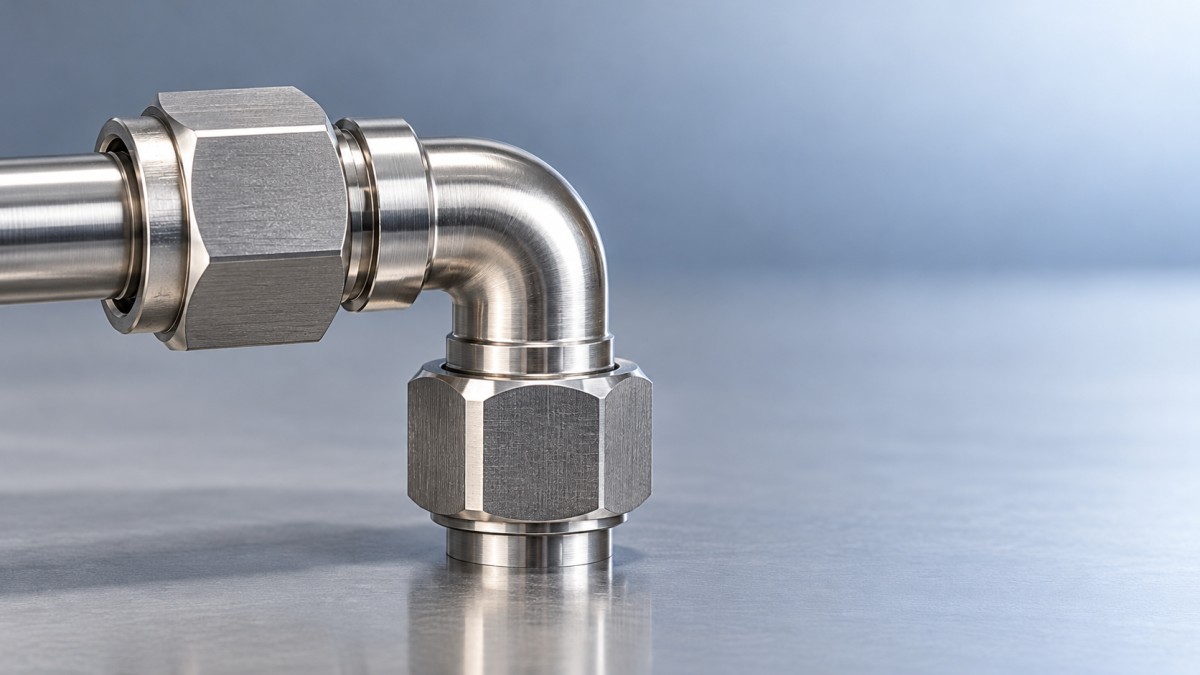
A continuous tube bend can eliminate a separate fitting and its joints where the tubing specification and installation conditions permit it. However, the bend must meet the tubing supplier’s minimum bend-radius requirements and the project’s limits for ovality, wall thinning, and workmanship. A tight field bend is not automatically preferable to a properly selected elbow.
Decide whether pressure loss actually controls the choice
In a flowing line, elbow pressure loss can be estimated using Δp = Kρv²/2, where K is the loss coefficient, ρ is fluid density, and v is velocity at the relevant section. The coefficient depends on geometry and flow conditions; a generic value for a smooth pipe elbow should not be assigned to a drilled instrument fitting without justification.
Check the complete flow path. A restricted connection bore, valve, filter, or length of small-ID tubing may dominate resistance. Choosing a larger-radius elbow achieves little if another component remains the principal restriction. For gas sample systems with appreciable pressure change, a suitable compressible-flow calculation is needed rather than relying solely on this simple expression.
A pressure-impulse line behaves differently. Once a static measurement has stabilized, there is essentially no sustained flow, so elbow friction does not create a continuing pressure drop. Trapped gas in liquid service, liquid pockets in gas service, plugging, and elevation-related liquid head are more important concerns. For transient measurements, line volume, restrictions, and fluid properties can still affect response.
Geometry should therefore preserve the required slope, drainage, or venting arrangement. A nominally superior radius is not an improvement if its installation creates an unwanted pocket or disrupts the intended liquid-column arrangement.
Match the connection to installation and service conditions
Compression ends require a qualified tubing combination
A compression elbow’s pressure capability depends on the fitting and the tubing used with it. Confirm the manufacturer’s permitted tube material, wall thickness, hardness, and pressure-temperature limits. A fitting body rating does not establish the rating of every possible assembly.
Do not assume that ferrules, nuts, and bodies from different manufacturers are interchangeable. Follow the specified assembly and remake instructions. Provide enough straight tube for full insertion and enough access to tighten and inspect the joint without pulling the tubing into alignment.
Thread form and orientation must both work
NPT, BSPT, and BSPP are not interchangeable descriptions of a threaded connection. Similar-looking threads can have different geometry and sealing requirements. A parallel-thread port may require a specified washer, O-ring, or other sealing feature rather than sealing at the threads.
Orientation is particularly important for male threaded elbows: achieving the required direction must not depend on backing off a joint that needs tightening for sealing. Where permitted, an adjustable connector or revised routing can resolve this conflict. Sealants must also be compatible with the fluid, temperature, and cleanliness requirements.
Welded ends move the risk into fabrication control
Welding removes some mechanical sealing interfaces but introduces fit-up, metallurgy, cleanliness, and inspection requirements. Socket-weld joints include an internal crevice that may be undesirable in contamination-sensitive or corrosive service. They also require the specified assembly gap and assessment for cyclic duty.
Butt-weld ends require compatible wall dimensions and controlled alignment. Where the material and service demand internal oxidation control, specify suitable purging. For either connection, confirm that the installed location permits the required examination and that future replacement will not require impractical cutting or dismantling.
Check ratings and vibration beyond the elbow body
The allowable pressure is governed by the lowest-rated applicable component at the design temperature. This includes tubing or pipe, fittings, adapters, seals, and instrument ports. A pressure class is not a universal pressure rating independent of material and temperature.
Apply the governing piping requirements to the actual system. ASME B31.3 may be relevant to process-plant instrument piping where the project places it within scope. ASME B16.9 addresses factory-made wrought butt-welding fittings, while ASME B16.11 addresses forged socket-welding and threaded fittings. These standards do not automatically qualify proprietary compression connections.
Vibration requires an assembly-level assessment. An elbow beside a heavy valve or unsupported instrument can experience bending loads that its static pressure rating does not address. Review support spacing, equipment movement, and restraint near rigid connections. Neither a larger radius nor a welded end compensates for poor support.
Turn the selection into a verifiable specification
The purchase description should identify both ends separately, including tube OD and wall requirements or pipe size and schedule, thread designation where relevant, material grade, minimum bore, dimensional envelope, and required pressure-temperature capability. Add service-specific cleanliness, joining, examination, and documentation requirements rather than relying on “instrument quality” as an undefined assurance.
For a static impulse line, prioritize leak integrity, slope, pocket avoidance, and support. For a flowing sample line, evaluate bore continuity and pressure loss alongside drainage and transport behavior. Where space is restricted, confirm assembly and replacement access before accepting the smallest elbow. The defensible choice is the geometry and connection combination that satisfies the line’s operating function—not simply the fitting that occupies the least space.
Navigation
Send Us A Message

First class quality service and professional after-sales team.
Get in Touch
*We respect your confidentiality and all information are protected.