
Will a 90° Elbow Repair Clamp Fit? Check Bend Geometry and Seal Coverage
A 90° elbow repair clamp will fit only when its approved geometry matches the elbow and its gasket can seal continuously on sound material beyond the damage. Nominal pipe size and a 90-degree bend angle are not enough. Actual outside diameter, bend radius, fitting profile, and nearby sockets or flanges can prevent an apparently suitable clamp from seating.
On a leaking ductile iron elbow, the wrong selection can leave the inner curve unsealed or place a gasket edge over a casting transition. Before committing to a repair, establish where the leak originates, measure the proposed sealing area, and compare those findings with the clamp manufacturer’s dimensional drawing and application limits.
First establish what the clamp must seal
Water tracking around an elbow can make a socket leak look like a defect in the fitting body. Identify whether the source is a localized wall defect, a crack, or a joint leak. These require different repair arrangements; a body repair clamp is not automatically suitable for sealing a socket or flange.
Follow site isolation, depressurization, draining, and access procedures before cleaning or taking contact measurements. Do not assume that an available repair clamp permits work on a live leak. Any installation under pressure requires a product and procedure specifically approved for that application.
- Localized wall leakage: Record the full damaged area, including surrounding corrosion or surface loss that could compromise gasket support.
- Visible cracking: Establish its extent and obtain an engineering assessment. Covering a crack does not establish that the fitting remains structurally acceptable.
- Joint leakage: Check joint position, gasket condition, and possible movement before selecting a repair intended for the elbow body.
A clamp’s sealing function also does not necessarily provide axial restraint. Elbow thrust, inadequate supports, or joint movement must be addressed separately unless the proposed repair system explicitly provides the required restraint.
Match the bend profile, not just the diameter
Two elbows with the same nominal size can have different centerline radii, body dimensions, and end configurations. A short-radius bend changes direction more sharply than a long-radius bend. A shell formed for one profile may contact the other unevenly, leaving gaps that bolt tightening cannot safely correct.
A diameter tape can help establish outside diameter on an accessible circular section, but it does not reveal ovality by itself. Where practical, supplement it with measurements across different orientations. Do not transfer a straight-pipe measurement to the elbow body without checking whether the fitting has a different external profile.
For a circular bend, distinguish the centerline radius from measurements taken along the inside or outside curve. They are not interchangeable. When identification markings or drawings are unavailable, send a dimensioned sketch and photographs with scale references to the manufacturer rather than estimating the radius from appearance.
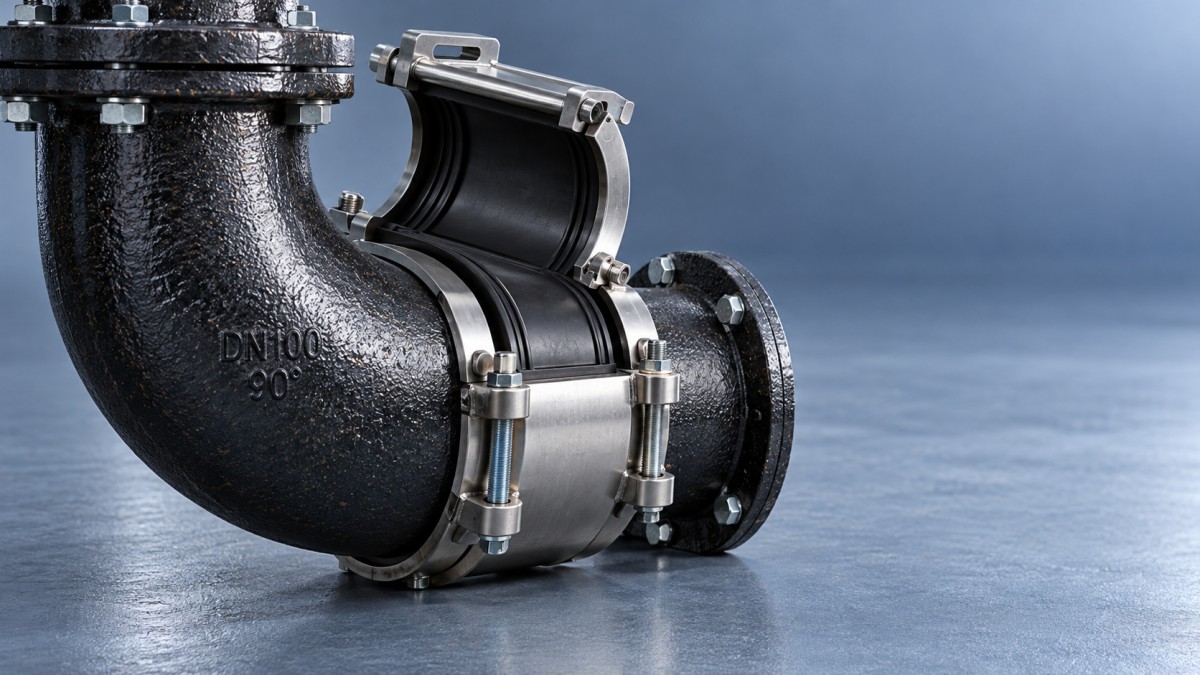
A conventional straight repair clamp should not be expected to follow a bend simply because its diameter range includes the pipe size. A straight section beside the elbow may be a possible sealing location, but only if the entire clamp footprint remains on an approved profile.
Check the complete gasket footprint
Covering the visible hole is not the same as achieving seal coverage. The gasket needs the manufacturer’s required contact area on sound material around the defect. On a bend, assess that footprint along the curved surface, not just as a straight-line distance in a photograph.
Mark the defect boundary and the proposed gasket perimeter. Then identify any feature within the sealing footprint that could prevent compression: deep corrosion pits, raised casting seams, loose coating, a diameter step, or an adjacent joint. A wider clamp is not automatically better if its edges extend onto a socket shoulder or flange hub.
The inside curve deserves particular attention because space is restricted and contact can be difficult to inspect. The outer curve may offer more access, but a clamp that appears seated there can still bridge the inner curve. Confirm full-profile compatibility rather than judging fit from the most visible side.
Surface preparation must follow the repair manufacturer’s instructions. Remove loose contamination as permitted, but do not grind away sound ductile iron or alter a fitting’s profile to force compatibility. Where corrosion has reduced wall integrity, gasket seating alone is not enough to justify the repair.
Confirm that the clamp can actually be installed
A dimensional match can still fail in a crowded valve chamber or trench. Check the path needed to bring each shell section around the elbow, insert bolts, and use the specified tightening tool. Nearby walls, supports, branches, and flange bolts may obstruct assembly even when the clamp’s final envelope appears to fit.
Ask for the assembly drawing, not only the overall dimensions. Check bolt direction, lug projection, shell split orientation, and any required opening clearance. Do not relocate supports or loosen adjacent joints merely to gain access without assessing their structural and restraint functions.
Clamps are designed to compress their seals through a prescribed tightening process, not to reshape an incompatible elbow. A shell that rocks, contacts a shoulder prematurely, or cannot reach its specified assembled position needs investigation. Extra torque is not a remedy for the wrong bend radius.
Treat gasket suitability as a separate decision
Once the metalwork fits, confirm that the gasket is suitable for the fluid, operating temperature, pressure conditions, and any applicable service approvals. Elastomer compatibility cannot be inferred from appearance or from the general description “rubber ring.” Geometry and material suitability are separate acceptance checks.
A separately listed component such as Rubber Ring4 should therefore be assessed only through its documented dimensions, material specification, and intended joint application. Its classification as a rubber ring does not establish compatibility with an elbow repair clamp. Use a replacement seal only when the clamp manufacturer confirms the required profile and specification.
Confirm the rating of the complete repair assembly for the intended service, including relevant pressure variations and temperature limits. A rating associated with a pipe, gasket material, or another clamp model cannot be transferred to the proposed combination.
Turn the survey into an accept-or-reject decision
Send the supplier one coordinated information package: fitting identification, actual diameters, bend profile, defect dimensions and location, available sealing surface, installation clearances, service conditions, and photographs. Request confirmation against a specific clamp model and drawing rather than a general statement that it suits ductile iron elbows.
Proceed only when the approved profile matches, the entire required seal footprint is supported, installation access is adequate, and the damage falls within the repair system’s limits. Missing dimensions call for further measurement; a known profile mismatch calls for another solution, not a trial tightening.
Where no approved clamp can clear a socket, follow the bend, or seal beyond weakened material, assess a purpose-designed repair enclosure or replacement of the affected fitting. After an accepted installation, follow the specified tightening sequence and return-to-service procedure, then check for leakage and movement. A dry exterior alone does not verify gasket seating, torque compliance, or structural suitability.
Navigation
Send Us A Message

First class quality service and professional after-sales team.
Get in Touch
*We respect your confidentiality and all information are protected.









